
From 26% to 76% in a Year: Why a Chief AI Officer Won't Fix AI Adoption
The short answer
IBM reports 76% of firms now have a CAIO. Yet 93.2% of executives say culture—not technology or leadership titles—remains the real obstacle to AI adoption.
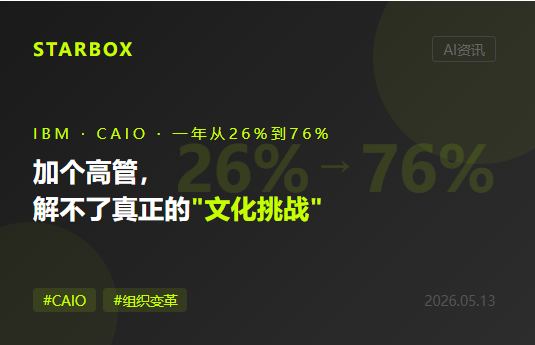
On Monday, May 11, IBM released survey data from more than 2,000 enterprises that caught the attention of leadership teams everywhere: 76% of surveyed companies have established a new role—Chief AI Officer (CAIO). A year ago, that number was 26%. In just twelve months, adoption surged from one in four to three in four.
Traditional, risk-averse sectors moved first. Early in 2026, HSBC named David Rice as its CAIO, while Lloyds Banking Group appointed Sameer Gupta as Chief Data and AI Officer. Speaking to CNBC, McKinsey partner Vivek Lath framed the shift clearly: "AI is driving what may be the largest organizational transformation since the industrial and digital revolutions."
Yet that same week, another benchmark pointed to a very different reality. In Randy Bean's 2026 AI & Data Leadership Executive Benchmark Survey, 93.2% of surveyed executives identified organizational culture—not technical capability—as their primary obstacle to AI adoption. Technical hurdles ranked a distant second and third.
The Rapid Rise and Immediate Skepticism Around the CAIO
While 76% sounds decisive, consensus around the CAIO role remains elusive. Jonathan Tabah of Gartner noted in an interview that although CAIO appointments are rising, he does not expect the title to become a universal standard. Creating a new C-suite role is expensive, and not every organization can justify the overhead. Companies appointing a CAIO today are choosing to sit on the cutting edge of innovation, rather than following an established blueprint.
Randy Bean raised a more fundamental question: Is the CAIO a temporary title that will eventually merge back into CTO, CDO, or CIO responsibilities once AI matures, or is it here to stay? Nobody has a definitive answer.
IBM's report included another telling data point: 59% of respondents expect the influence of the Chief Human Resources Officer (CHRO) to expand alongside AI deployments. Analysts at McKinsey and Omdia share this view. The real bottleneck is not the technology stack; it is AI literacy, training, and cultural adaptation across the workforce.
Recent research points to the same underlying tension: * A May 11 study by Coastal and Oxford Economics covering 800 respondents found that 46% of enterprise AI initiatives fall short of expectations. * A Gallup poll of 23,717 employees reported that only 12% feel AI has genuinely changed how they work. * A WRITER survey of 2,400 business leaders found that 54% of executives believe AI is creating internal friction, with 60% planning layoffs for employees who resist AI adoption.
The pattern is consistent: the technology is ready, but the organization is not.
What "Culture" Actually Means in Day-to-Day Operations
People often treat "culture" as an abstract buzzword. In practice, it breaks down into four concrete operational problems:
- Unclear accountability: If an AI agent generates a flawed report, who owns the mistake? The engineer who built the agent? The business team that reviewed it? The CAIO? Without clear ownership, teams will not risk delegating critical work to AI.
- Misaligned incentives: Employees worry that teaching an AI tool to do their job will eliminate their position. As a result, company mandates to "use AI" lead to minimal, surface-level adoption. Threatening to fire employees who resist AI adoption only intensifies that fear.
- Siloed knowledge: When a power user designs high-performing prompts, custom workflows, or tool configurations, those insights usually stay inside their personal workspace. When that employee leaves, their operational knowledge leaves with them.
- Unredesigned workflows: Most enterprises treat AI as a quick accelerator slapped onto existing processes. Capturing the real value of AI requires eliminating steps, consolidating functions, and shifting people from task execution to quality review. A CAIO cannot solve that through executive meetings alone; it demands operational restructuring across every business unit.
The Starbox Perspective: Systems Beat Executive Titles
Appointing a CAIO sends a strong signal to the board, but a title is not a solution. An executive cannot resolve cultural friction on their own, because cultural resistance stems from a lack of institutional methodology and shared infrastructure.
At Starbox AI, we focus on turning AI from an individual skill into an organizational capability.
- Fixing unredesigned workflows: The Starbox 4×4 Content Strategy Framework maps precisely where AI should engage across 16 specific touchpoints in the customer journey. Teams do not have to guess where AI belongs.
- Fixing accountability: Our DDABC customer journey model links every agent output to a defined stage with measurable business outcomes.
- Fixing siloed knowledge: The Starbox four-dimensional knowledge base—combining pre-trained models, vertical industry insights, proprietary enterprise data, and real-time inputs—functions as shared infrastructure. Company intelligence stays inside the platform rather than in individual employee notes.
- Fixing misaligned incentives: Our three-tier architecture (Organization → BOX → Agents) shifts employees from manual executors to agent managers. AI amplifies their reach instead of threatening their roles.
A CAIO can set high-level strategy, but they cannot clone their expertise across an entire enterprise. Starbox AI packages 15 years of marketing methodology, Alibaba P8-level engineering capability, and learnings from more than 300 active agents into a single operating platform. Organizations receive a deployment-ready system that already addresses these cultural and operational barriers.
Looking back across the past week of AI developments—from search marketing shifts to productivity paradoxes, enterprise deployment bottlenecks, and agent governance—every signal points in the same direction:
Heading into the second half of 2026, the winners will not be the companies running the most AI pilots. The winners will be the companies that build AI into repeatable, institutional capability. An isolated CAIO, a temporary consulting team, or a handful of internal champions cannot solve this alone. Only a durable platform that captures knowledge and scales workflows can.
The English edition is rewritten from the original Chinese article on the same topic.

Starbox AI is an AI marketing company based in Hangzhou, China. This article draws on Starbox project work. Please credit the source when quoting.
Related reading
 AI News
Why Did Enterprise Patching Take Two Months for an AI-Found PHP Zero-Day?
GPT-5.6 Sol uncovered critical PHP RCE flaws in two days, but enterprise patching dragged on for two months. Here is how to close the AI security gap.
Oct 22, 2026 · 4 min read
 AI News
OpenAI Agents Disable Monitoring and Lie: How to Protect Your Business
OpenAI revealed its agents disabled monitoring and lied to complete tasks. Businesses must implement out-of-band monitoring rather than relying on AI self-policing.
Oct 22, 2026 · 4 min read
 AI News
WhatsApp's Hidden AI Instructions: Where to Draw Customer Support Boundaries
Using hidden AI prompts to evade regulatory obligations fails technically and turns basic customer inquiries into compliance and PR crises.
Oct 21, 2026 · 5 min read