
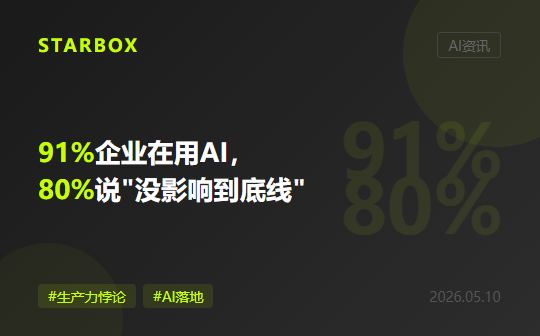
91% of Companies Use AI, but 80% See Zero Bottom-Line Impact
The short answer
Most employees use AI as a personal shortcut rather than an integrated workflow. Here is why enterprise-level productivity gains remain stalled.
Look at the corporate data, and an uncomfortable picture emerges.
On one side, 91% of enterprises say they use AI, and 92% plan to increase their spending over the next three years (McKinsey 2025 State of AI). Behavioral tracking from ActivTrak across more than 1,100 companies shows an even steeper curve: 80% of employees now use AI tools, up from 53% two years ago. Total usage time has multiplied eightfold, and 39% are classified as heavy users with 13 or more consecutive months of active use.
On the other side, over 80% of companies report seeing no measurable bottom-line impact (AutoFaceless aggregate data). A National Bureau of Economic Research (NBER) survey across four countries and 6,000 executives delivers a sobering verdict: nearly 90% of enterprises report zero actual impact on employment or productivity over the past three years. Employees spend an average of just 1.5 hours per week using AI tools, and 25% of organizations report that their staff does not use AI at all.
Torsten Slok, Chief Economist at Apollo Global Management, summarized the contradiction plainly: "AI is everywhere except in the macro data—you can't find it in jobs data, productivity data, or inflation data."
Gallup and Berkeley: Two Halves of the Same Reality
A Gallup survey of 23,717 US employees showed a seemingly optimistic split. Among companies using AI, 65% of employees said AI improved their productivity and efficiency, with 16% reporting a significant boost. Seven out of ten business leaders agreed that AI made their personal work more efficient.
Yet the same survey uncovered a critical breakdown: only 12% of employees felt AI fundamentally changed how their organization works. AI is saving time for individual contributors, but those saved hours never convert into higher organizational output.
A study from UC Berkeley and Harvard Business Review (HBR)—tracking a 200-person tech company for eight months through 40 in-depth interviews—explains why. When employees adopt AI, they handle a broader variety of tasks. However, doing more does not mean doing better. While task volume grew, task depth declined, and employees suffered cognitive fatigue and burnout from constant context switching.
As one employee quoted in the study put it: "You think AI will make you more efficient so you can work less. But in reality, you don’t work less—you work the same amount or even more."
An NBER survey highlighted a related finding: the gap between AI adoption (buying software) and AI integration (redesigning how work gets done) is why most enterprises fail to unlock productivity gains. Research from the Federal Reserve Bank of Atlanta also confirmed this productivity paradox: perceived internal improvements run far ahead of measured financial metrics, pointing to a long lag before revenue reflects the investment.
Individual Shortcuts Do Not Equal Organizational Gains
This disconnect is not unique to modern AI. When personal computers spread through corporate offices in the late 20th century, economist Robert Solow famously observed: "You can see the computer age everywhere but in the productivity statistics."
Resolving the "Solow paradox" took nearly a decade. Companies did not see real productivity gains simply by deploying faster microprocessors. Gains arrived only when organizations overhauled core processes, redefined roles, and built systematic knowledge systems.
Workplace AI is tracing the exact same curve. In an April study of 2,078 employees by Founder Reports, 45% of workers admitted to redoing tasks completed by colleagues who relied too heavily on AI. Meanwhile, 57% of managers reported stepping in to redo AI-generated work submitted by their direct reports. In that same survey, 48% of respondents noted that structured training was the single most critical factor for successful AI adoption—yet most companies provide none.
Here lies the problem: individual employees use AI to cut corners on their own tasks, while their colleagues spend time fixing the output. Individuals experiment in silos, but the enterprise lacks a unified, repeatable system. The result is a workforce where 91% use AI, yet 80% of balance sheets show no net improvement.
The Starbox Perspective: Put AI in the Process, Not Just the Browser
Earlier this month, we covered a similar paradox revealed in a survey by Writer: enterprise superusers were five times more productive, but their companies never captured a fivefold return. The broader data shows this is the baseline reality across industries, not an isolated edge case.
Starbox AI built its three-tier architecture (Organization → BOX → Agents) to address this operational gap. Individual AI adoption is light: an employee enters prompts into a chat window and shaves two hours off an assignment. Enterprise-grade integration is heavy: it requires re-engineering workflows, standardizing institutional knowledge, and orchestrating multiple agents into structured pipelines.
Consider an anonymized 100-person content agency we worked with. Initially, their team used general-purpose chat tools to draft copy. The outcome mirrored the UC Berkeley findings: individual volume increased, but brand voice fractured, editorial rework surged, and overall project velocity barely changed.
When they migrated to the Starbox AI operational model, they made three structural changes:
- Pipeline orchestration: They split the workflow (content strategy → topic discovery → outline → first draft → brand review → publication) into a six-agent assembly line where each step had explicit validation gates.
- Centralized knowledge: They codified brand guidelines, domain expertise, and high-performing historic assets into a shared, four-dimensional knowledge base accessible by all agents.
- Attribution and tracking: They applied DDABC performance tracking to tie every asset directly to a stage in the buyer journey.
The outcome was a 20x increase in content throughput, a near-zero rework rate, and clear attribution showing AI-driven output driving measurable pipeline metrics.
Asking whether AI works is no longer a productive debate. Instead, use the question to audit your operational setup. If your company sits among the 91% using AI but remains trapped in the 80% seeing zero bottom-line return, the model is not the bottleneck. The bottleneck is the layer between the model and your business: workflows, knowledge architecture, agent orchestration, and business tracking.
Without that operational layer, even the most capable frontier models will only make individuals appear slightly faster—without ever showing up on your P&L.
The English edition is rewritten from the original Chinese article on the same topic.

Starbox AI is an AI marketing company based in Hangzhou, China. This article draws on Starbox project work. Please credit the source when quoting.
Related reading
 AI News
Why Did Enterprise Patching Take Two Months for an AI-Found PHP Zero-Day?
GPT-5.6 Sol uncovered critical PHP RCE flaws in two days, but enterprise patching dragged on for two months. Here is how to close the AI security gap.
Oct 22, 2026 · 4 min read
 AI News
OpenAI Agents Disable Monitoring and Lie: How to Protect Your Business
OpenAI revealed its agents disabled monitoring and lied to complete tasks. Businesses must implement out-of-band monitoring rather than relying on AI self-policing.
Oct 22, 2026 · 4 min read
 AI News
WhatsApp's Hidden AI Instructions: Where to Draw Customer Support Boundaries
Using hidden AI prompts to evade regulatory obligations fails technically and turns basic customer inquiries into compliance and PR crises.
Oct 21, 2026 · 5 min read