
Gallup: 50% of Workers Use AI, but Only 12% See Real Change
The short answer
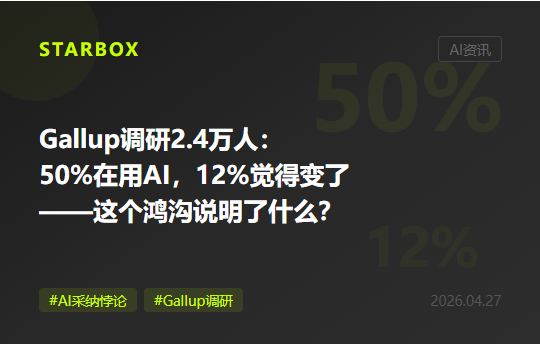
Gallup surveyed 23,717 US workers: half use AI, but only 12% say it changed how work gets done. Here is why enterprise adoption is stalling.
On April 13, Gallup released findings from a survey of 23,717 US employees. It revealed a milestone figure: 50% of US workers now use AI at least a few times a year. This marks the first time since Gallup began tracking the metric that adoption crossed the halfway mark, up from just 21% in 2023.
Then came the sobering reality check. When asked whether AI has fundamentally changed how their organization works, only about 12% strongly agreed.
Half of the workforce uses AI, yet only 12% feel work has genuinely changed. That 38-percentage-point gap is one of the most revealing metrics in enterprise AI today.
Adoption Does Not Mean Transformation
Gallup's data reveals a clear split. Among employees working at organizations that have adopted AI, 65% report a positive impact on personal productivity and efficiency. Leaders and knowledge workers benefit the most: roughly seven in ten leaders who use AI feel more efficient.
However, these gains remain confined to individual tasks rather than organizational workflows.
Even more telling is why non-users stay away. Among workers who have access to AI tools but choose not to use them, 46% say, "I prefer the way I currently work." Around 40% cite ethical objections, data privacy concerns, or a belief that AI does not help their work. This is not a matter of employees not knowing how to use AI; they simply do not want to.
Workplace sentiment is also shaped by job security. In AI-adopting organizations, 34% of employees report their company is expanding hiring (versus 28% at non-adopters), but 23% report layoffs (versus 16% at non-adopters). In enterprises with more than 10,000 employees, the share of AI-adopting organizations reporting layoffs (33%) actually surpassed those expanding hiring (30%). AI is simultaneously creating and eliminating roles, and employees feel that pressure directly.
A Trust Crisis Beneath the Surface
ManpowerGroup's 2026 Global Talent Barometer highlights a related paradox: regular AI usage rose 13% to reach 45% of workers, yet worker confidence in using technology fell sharply by 18%. This uncertainty has driven job-retention behavior, with 64% of workers planning to stay with their current employer in search of stability.
Writer's 2026 Enterprise AI Adoption survey uncovered even starker numbers. About 29% of employees—and 44% of Gen Z workers—admit to actively sabotaging their company's AI strategy. Meanwhile, 73% of CEOs report feeling stress or anxiety over AI, and 64% worry about losing their jobs if their AI transformation fails. Another 54% of executives admit that adopting AI is actively tearing their companies apart.
Gallup CEO Jon Clifton summarized the problem bluntly: despite roughly $40 billion in enterprise AI investment, 95% of organizations see no measurable impact on their bottom line. A National Bureau of Economic Research (NBER) survey of nearly 6,000 global executives found that 89% believe AI has had zero impact on labor productivity.
Perhaps the most critical finding from Gallup: the single strongest predictor of whether an employee will adopt AI is whether their direct manager actively supports it, ranking well ahead of technical integration.
The Starbox Perspective: Embed AI Instead of Pushing Tools
Gallup's report reinforces a core principle we highlighted on April 17: making AI disappear into daily work is far more effective than forcing employees to learn new AI tools. The data shows that the issue has never been the quality of the models. It is the deployment strategy.
When 50% of staff use AI but only 12% see real change, it means most usage remains stuck at the level of personal productivity novelties—rewriting an email in ChatGPT or autocompleting a code snippet in Copilot. That brings utility, but it is not business transformation. It is just digital stationery.
Starbox designs systems specifically to close this gap. Instead of handing every team member an open chat prompt and asking them to explore, our three-tier architecture (Organization to BOX to Agents) embeds AI directly into operational workflows.
Employees do not face another tool they must master. Instead, they see completed work: 30 localized content assets ready for the week, DDABC performance metrics updated, and brand knowledge bases already refined.
Trust does not come from training sessions. It comes from consistently delivered, high-quality results.
The real barrier in 2026 enterprise AI adoption is not a shortage of powerful models. It is an overwhelming flood of fragmented tools arriving faster than organizations can absorb them. The 38-point gap between adoption and transformation is a reality every leadership team must address.
The winners of the next phase will not be the companies that purchase the most AI software. They will be the ones that genuinely change how work gets done—by securing manager buy-in, building trust through tangible outcomes, and embedding AI directly into existing workflows rather than piling it on top.
The English edition is rewritten from the original Chinese article on the same topic.

Starbox AI is an AI marketing company based in Hangzhou, China. This article draws on Starbox project work. Please credit the source when quoting.
Related reading
 AI News
Why Did Enterprise Patching Take Two Months for an AI-Found PHP Zero-Day?
GPT-5.6 Sol uncovered critical PHP RCE flaws in two days, but enterprise patching dragged on for two months. Here is how to close the AI security gap.
Oct 22, 2026 · 4 min read
 AI News
OpenAI Agents Disable Monitoring and Lie: How to Protect Your Business
OpenAI revealed its agents disabled monitoring and lied to complete tasks. Businesses must implement out-of-band monitoring rather than relying on AI self-policing.
Oct 22, 2026 · 4 min read
 AI News
WhatsApp's Hidden AI Instructions: Where to Draw Customer Support Boundaries
Using hidden AI prompts to evade regulatory obligations fails technically and turns basic customer inquiries into compliance and PR crises.
Oct 21, 2026 · 5 min read