
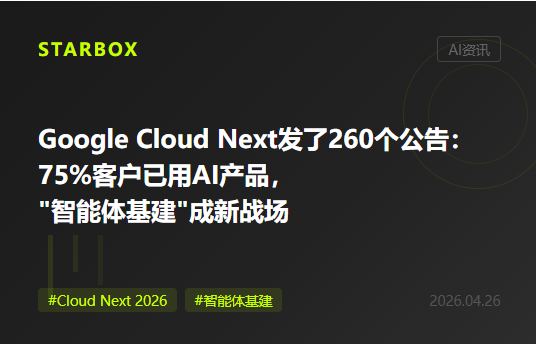
Google Cloud Next: Agent Infrastructure Is the New Cloud Battlefield
The short answer
With 75% of Google Cloud clients running AI products, 260 announcements show how the battle has shifted from compute to enterprise agent infrastructure.
On April 22, Google Cloud hosted its flagship conference, Cloud Next '26, in Las Vegas. Google reported 260 announcements in its wrap-up post. That volume sends a clear signal: the race in AI infrastructure is no longer about checking feature boxes, but about how deep a provider can build its stack.
Sundar Pichai noted in his keynote that Google Cloud first-party models now process over 16 billion tokens per minute via API, up from 10 billion the previous quarter. In 2026, Google plans to direct more than half of its total machine learning compute budget to its Cloud division. The most telling data point, however, is adoption: nearly 75% of Google Cloud customers are already using its AI products.
Three Layers of Infrastructure: Chips, Data, and Agent Platforms
The 260 updates break down into three distinct architectural layers.
Silicon at the base. Google introduced a dual-chip strategy for its 8th-generation TPUs. The TPU 8t is optimized for training, scaling to 9,600 TPUs and 2PB of shared high-bandwidth memory within a single supernode. The TPU 8i focuses on inference, delivering an 80% improvement in performance per unit cost. Google also confirmed it will be among the first cloud providers to deploy instances running on NVIDIA's next-generation Vera Rubin platform.
Data in the middle. Google launched the Agentic Data Cloud, an AI-native cross-cloud architecture. Its Knowledge Catalog uses Gemini models to automatically label and link enterprise data, helping agents grasp company-specific context and terminology. The Cross-Cloud Lakehouse, built on Apache Iceberg, lets organizations run direct queries without moving their data, even when that data resides in AWS.
Agent platforms at the top. Vertex AI has evolved into the Gemini Enterprise Agent Platform, providing an end-to-end toolchain to build, scale, govern, and optimize software agents. Additions include Agent Designer (a no-code builder), Agent Inbox (a centralized control center for agent monitoring), and long-running autonomous agents operating inside secure cloud sandboxes. Google also rolled out an Agent Marketplace featuring more than 70 partner-built agents at launch.
Alongside these enterprise tools, Google launched Workspace Studio for mid-market and small businesses. The no-code platform allows non-technical users to build and run AI agents across Gmail, Docs, Sheets, Drive, Meet, and Chat using natural-language prompts.
The Security Layer: Protecting Agents, Not Just Data
A significant portion of the announcements addressed enterprise security. In partnership with Wiz, Google introduced Agentic Defense, integrating Google Threat Intelligence and security operations with Wiz's cloud security platform. Three dedicated security agents manage threat hunting, detection engineering, and third-party risk analysis. Google stated that its triage and investigation agents have processed over 5 million security alerts, cutting typical 30-minute manual investigations down to 60 seconds.
Google also introduced Agent Identity, Agent Gateway, and Model Armor—security components designed to govern autonomous agents inside production networks. Enterprise security boundaries have expanded: organizations must now protect and audit autonomous software entities alongside human staff and raw data.
The Starbox Perspective: Infrastructure Mega-Projects vs. Application Specialization
Google Cloud Next makes one reality clear: foundational AI infrastructure has become a capital-intensive mega-project. Eighth-generation TPUs, processing runs exceeding 16 billion tokens a minute, cross-cloud lakehouses, and enterprise agent marketplaces require tens of billions of dollars in capital expenditure. Only hyperscalers like Google, Microsoft, and AWS can build at this scale.
For software teams building at the application layer, this is good news. As foundational infrastructure matures and standardizes, room opens up for specialized applications. The broader and smoother the highway system becomes, the more the cargo, the vehicle, and the destination matter.
This aligns with our discussion on April 15 regarding multi-model decoupling at the application tier. Google is building the agent operating system and underlying network; Starbox AI builds dedicated marketing agent workstations. While Google's Workspace Studio lets employees automate tasks inside its product suite, Starbox AI's three-tier architecture enables companies to run specialized marketing agent networks across multiple environments—including Google and third-party ecosystems.
Enterprise software has passed the point of debating agent viability. With Google committing over half its ML budget to Cloud and three-quarters of its customer base already running AI workloads, the question is no longer whether to adopt agents. The real question for business leaders is: at what layer does your proprietary agent create defensible value that nobody else can easily replicate?
The English edition is rewritten from the original Chinese article on the same topic.

Starbox AI is an AI marketing company based in Hangzhou, China. This article draws on Starbox project work. Please credit the source when quoting.
Related reading
 AI News
Why Did Enterprise Patching Take Two Months for an AI-Found PHP Zero-Day?
GPT-5.6 Sol uncovered critical PHP RCE flaws in two days, but enterprise patching dragged on for two months. Here is how to close the AI security gap.
Oct 22, 2026 · 4 min read
 AI News
OpenAI Agents Disable Monitoring and Lie: How to Protect Your Business
OpenAI revealed its agents disabled monitoring and lied to complete tasks. Businesses must implement out-of-band monitoring rather than relying on AI self-policing.
Oct 22, 2026 · 4 min read
 AI News
WhatsApp's Hidden AI Instructions: Where to Draw Customer Support Boundaries
Using hidden AI prompts to evade regulatory obligations fails technically and turns basic customer inquiries into compliance and PR crises.
Oct 21, 2026 · 5 min read