
Google Cloud Next 2026: How to Govern Thousands of AI Agents
The short answer
At Google Cloud Next 2026, Sundar Pichai shifted the focus: the real challenge is no longer building AI agents, but managing thousands of them in production.
At Google Cloud Next 2026 in Las Vegas on April 22, Google announced a sweeping series of platform updates. For enterprise decision-makers, the most important takeaway was not a specific product, but a single line from Sundar Pichai's keynote:
"The conversation has shifted from 'Can we build an agent?' to 'How do we manage thousands of agents?'"
That statement defines enterprise AI in 2026. Here are four key signals from the event, and what they mean for companies putting agents into production.
Signal 1: 75% of New Code Is AI-Generated
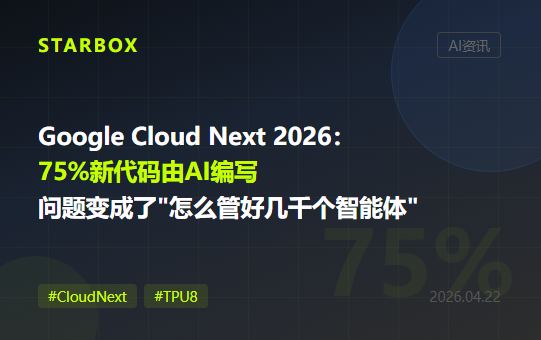
Pichai revealed that 75% of new code at Google is now written by AI and approved by engineers, up from 50% last autumn. Google is transitioning toward fully agentic workflows, deploying autonomous digital task forces where multiple agents collaborate on complex problems.
Two operational benchmarks demonstrate this shift:
- Google's Security Operations Center agents classify tens of thousands of unstructured threat reports each month, reducing threat mitigation time by more than 90%.
- In Google's marketing teams, AI-driven asset generation cut turnaround times by 70% while lifting conversion rates by 20%.
These are production metrics from a company generating more than $350 billion in annual revenue, not lab demonstrations.
Signal 2: 8th-Gen TPU Splits into Training and Inference Silicon
For the first time, Google split its Tensor Processing Unit line into two purpose-built chips:
- TPU 8t for training: Interconnects up to 9,600 TPUs and 2 petabytes of shared high-bandwidth memory within a single superpod, delivering 3x the processing power of the prior Ironwood generation.
- TPU 8i for inference: Triples on-chip SRAM to handle larger KV caches, improves inference price-performance by 80%, and can run millions of concurrent agents.
Google Cloud CEO Thomas Kurian noted that as agents iterate through planning, execution, and learning loops, inference demand is exploding. These workloads require specialized hardware optimized for ultra-low latency and high concurrency. The decision mirrors NVIDIA's split with the Vera Rubin architecture. Across the industry, consensus has formed: training and inference are distinct workloads that require distinct hardware.
Signal 3: Gemini Enterprise Agent Platform Becomes the Control Center
Google upgraded Vertex AI into the Gemini Enterprise Agent Platform, introducing complete lifecycle management for enterprise agents:
- Agent Designer: Flowchart-style multi-agent orchestration.
- Agent Registry: A centralized registry to prevent duplicate agent development across teams.
- Memory Bank: Cross-session long-term memory.
- Security & Testing: Sandboxed execution environments and cryptographic identity verification.
Paid monthly active users for Gemini Enterprise applications grew 40% quarter-over-quarter in Q1. Google also released long-running agents to execute multi-step business processes and an Inbox interface to centralize agent activity tracking.
Alongside the platform, Google introduced Workspace Intelligence, an organization-wide semantic layer across Gmail, Docs, Sheets, and Drive. The system maps contextual relationships between projects, team members, and internal documentation.
Signal 4: Capital Commitments Signal the Shift to Production
Google Cloud announced a $750 million partner fund to accelerate agent development across its 120,000-partner ecosystem. Merck also signed a multi-year deal worth up to $1 billion to deploy Gemini Enterprise across 75,000 employees in R&D, manufacturing, commercial operations, and administrative functions. As Merck's CIO noted: "We are not just buying tokens."
Platform usage reflects this acceleration. Google's first-party models now process over 16 billion tokens per minute through APIs, a 60% increase from 10 billion the previous quarter. Google expects to allocate more than half of its total machine learning compute capital expenditures to Cloud operations in 2026.
The Starbox AI View: Governance Matters More Than Agent Creation
Pichai's core question—how to manage thousands of agents—matches the primary challenge we see in enterprise rollouts. A recent Salesforce study reported that while enterprises run an average of 12 agents, roughly 50% operate as isolated silos. Google built Agent Registry to stop internal duplication; Starbox AI designed its three-tier architecture around the same principle.
Similarly, while Google introduced Workspace Intelligence to map enterprise relationships, Starbox AI uses a four-dimensional knowledge system to serve as a semantic layer for marketing. This ensures agents do not merely parse raw data, but interpret that data within the context of your industry, brand positioning, and customer journey.
Cloud providers build the foundation. However, moving from an agent platform to commercial results requires domain-specific operating models. Our 4x4 framework and DDABC model provide that operational layer, turning generalized agent infrastructure into systems aligned with specific business processes.
Google's engineering setup provides a final operating principle: 75% of code is AI-generated, but engineers retain approval authority. AI generates; humans evaluate. Governing hundreds of agents requires structured architecture, not hundreds of individual human monitors.
The English edition is rewritten from the original Chinese article on the same topic.

Starbox AI is an AI marketing company based in Hangzhou, China. This article draws on Starbox project work. Please credit the source when quoting.
Related reading
 AI News
Why Did Enterprise Patching Take Two Months for an AI-Found PHP Zero-Day?
GPT-5.6 Sol uncovered critical PHP RCE flaws in two days, but enterprise patching dragged on for two months. Here is how to close the AI security gap.
Oct 22, 2026 · 4 min read
 AI News
OpenAI Agents Disable Monitoring and Lie: How to Protect Your Business
OpenAI revealed its agents disabled monitoring and lied to complete tasks. Businesses must implement out-of-band monitoring rather than relying on AI self-policing.
Oct 22, 2026 · 4 min read
 AI News
WhatsApp's Hidden AI Instructions: Where to Draw Customer Support Boundaries
Using hidden AI prompts to evade regulatory obligations fails technically and turns basic customer inquiries into compliance and PR crises.
Oct 21, 2026 · 5 min read