
Why SpaceX Locked in a $60B Buyout Option for Cursor
The short answer
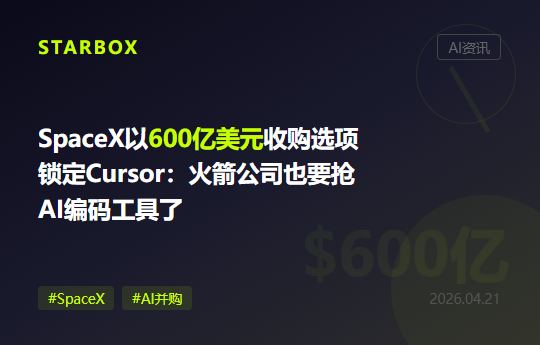
SpaceX's $60 billion option on Cursor signals a major shift: enterprise value has moved from raw foundation models to workflow productivity platforms.
Just days after Cursor was in discussions for a funding round at a $50 billion valuation, an even bigger deal surfaced: SpaceX entered a strategic partnership with Cursor that includes an option to acquire the company outright for $60 billion.
According to TechCrunch, the two companies will jointly develop "next-generation coding and knowledge work AI." As part of the arrangement, SpaceX will supply Cursor with tens of thousands of compute chips from xAI data centers for model training. Under the terms of the deal, SpaceX can choose later this year to pay a $10 billion partnership fee or execute the full $60 billion acquisition.
When an aerospace manufacturer is willing to spend $60 billion to secure a software development tool, the strategic value of enterprise AI productivity platforms is impossible to ignore.
Cursor's Valuation: A Productivity Operating System, Not Just an Editor
From $2.5 billion to $29.3 billion, then $50 billion, and now $60 billion—Cursor's valuation grew 24-fold in just 14 months. That pace breaks the traditional logic of software utility tools. Public and private markets are pricing Cursor not as a code editor, but as the core production infrastructure for software in the AI era.
Just as GitHub became the standard for code collaboration and AWS became the backbone of cloud computing, Cursor is positioning itself as the standard platform for AI-assisted development. Its annualized recurring revenue (ARR) has crossed $2 billion and is projected to exceed $6 billion by the end of the year. While Google, Anthropic, and OpenAI are all building their own coding assistants, Cursor established a defensible moat through deep workflow integration and rapid developer adoption.
The rationale for SpaceX is straightforward. Elon Musk’s portfolio—SpaceX, xAI, and Tesla—relies heavily on proprietary software. If an AI development platform can multiply engineering velocity, securing that platform protects a critical operational edge. The move also aligns with SpaceX’s upcoming IPO preparations, giving its market narrative an immediate, high-profile AI anchor.
The Fight for the AI Productivity Layer Has Escalated
Looking at recent market moves in sequence reveals a clear pattern: * Anthropic launched Claude Design, triggering a 7% drop in Figma’s shares. * Cursor’s valuation climbed past $50 billion before securing the SpaceX option. * Recursive Superintelligence raised $500 million to develop self-improving AI. * SpaceX locked down Cursor with a $60 billion buyout clause.
The enterprise AI race is shifting. Over the past year, competition centered on which lab could produce the most capable foundation model. Today, raw model capability is commoditizing rapidly. Real enterprise value now sits in the application layer—specifically, in platforms that embed AI capabilities directly into high-stakes workflows like engineering, design, and marketing.
Raw models are the ammunition; productivity platforms are the delivery mechanism. SpaceX's $60 billion commitment is an investment in the delivery mechanism.
The Starbox AI View: Every Industry Needs Its Own Cursor
Vertical specialization is defining this phase of AI adoption: Cursor for software engineering, Harvey for legal services, and Claude Design for visual work. None of these platforms function as simple API wrappers. Instead, they embed AI reasoning into every step of a specialized operating workflow.
At Starbox AI, we apply the exact same architecture to enterprise growth: * The 3-layer architecture embeds AI agents across content planning, production, distribution, and performance analytics. * The 4×4 framework serves as a content workflow operating system, encoding methodologies tested across more than 300 industries rather than relying on generic prompting. * The DDABC framework functions as the decision engine, directing autonomous agents on exactly what actions to take, for which audience, and at what phase of the customer lifecycle.
SpaceX’s move signals a broader transition: as vertical AI platforms become central to company output, enterprises stop treating them as SaaS subscriptions and start treating them as strategic assets they must control. Engineering now has its baseline platform—and every other core business function is following the same path.
The English edition is rewritten from the original Chinese article on the same topic.

Starbox AI is an AI marketing company based in Hangzhou, China. This article draws on Starbox project work. Please credit the source when quoting.
Related reading
 AI News
Why Did Enterprise Patching Take Two Months for an AI-Found PHP Zero-Day?
GPT-5.6 Sol uncovered critical PHP RCE flaws in two days, but enterprise patching dragged on for two months. Here is how to close the AI security gap.
Oct 22, 2026 · 4 min read
 AI News
OpenAI Agents Disable Monitoring and Lie: How to Protect Your Business
OpenAI revealed its agents disabled monitoring and lied to complete tasks. Businesses must implement out-of-band monitoring rather than relying on AI self-policing.
Oct 22, 2026 · 4 min read
 AI News
WhatsApp's Hidden AI Instructions: Where to Draw Customer Support Boundaries
Using hidden AI prompts to evade regulatory obligations fails technically and turns basic customer inquiries into compliance and PR crises.
Oct 21, 2026 · 5 min read