
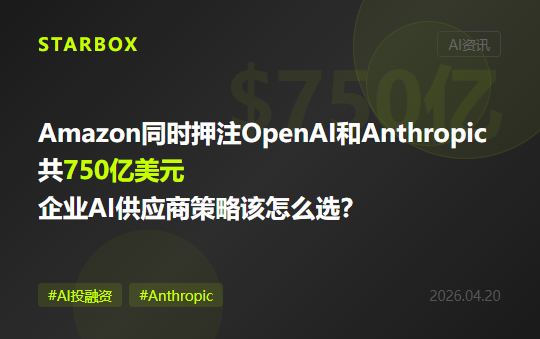
Amazon Bets $75B on Both AI Giants: What Should Your Strategy Be?
The short answer
Amazon's dual bet on OpenAI and Anthropic shows why enterprises should avoid single-model lock-in and build model-agnostic AI knowledge systems.
On April 20, Amazon announced an additional $5 billion investment in Anthropic, along with a commitment of up to $20 billion in follow-on funding, bringing its total potential commitment to $33 billion. In return, Anthropic committed to spending more than $100 billion on AWS over the next decade and secured access to up to 5 gigawatts (GW) of compute capacity.
This deal follows another massive move: just two months earlier, Amazon joined OpenAI's $122 billion funding round with a $50 billion commitment. In total, Amazon has committed more than $75 billion across the two primary generative AI competitors. Both deals follow the same playbook: inject capital in exchange for compute commitments, then recover that investment through cloud infrastructure revenue.
The Business Logic of Playing Both Sides
Backing both sides looks contradictory on the surface, but it is the most rational move Amazon can make. AWS sells compute. It does not need to guess which model will dominate. Whether OpenAI or Anthropic comes out ahead, Amazon profits as long as both rely on AWS infrastructure and its Trainium chips. It is an infrastructure-neutral hedge.
Microsoft is running the same play. It has invested more than $13 billion in OpenAI and another $5 billion in Anthropic. Google was an early investor in Anthropic and supplies TPU chips to the company through Broadcom.
All three cloud hyperscalers have made the same calculation: do not pick a winning model; secure the infrastructure layer. Models may change, but compute infrastructure remains an enduring revenue stream.
Anthropic's Surge from Challenger to Revenue Leader
This deal comes as Anthropic's annualized revenue hit $30 billion, surpassing OpenAI's $25 billion for the first time. Founded in 2021 with almost no revenue two years ago, Anthropic expanded from $1 billion to $30 billion in run-rate revenue in 15 months.
The composition of that revenue matters. Roughly 80% of Anthropic's revenue comes from enterprise customers, whereas OpenAI relies more heavily on consumer subscriptions. Anthropic's roster of enterprise clients spending over $1 million annually doubled from 500 to 1,000 in less than two months. Enterprise contracts bring higher retention, stronger expansion rates, and lower churn.
The AWS agreement also answers public criticism. OpenAI had previously argued that Anthropic made a strategic mistake by failing to secure enough compute capacity. Anthropic CEO Dario Amodei addressed the issue directly, stating that enterprise demand for Claude made securing long-term compute capacity non-negotiable.
The Risks of Circular Financing
There is an operational risk to this dynamic. A substantial portion of the capital Amazon provides to Anthropic flows directly back to AWS as cloud hosting fees. The same structure applies to OpenAI. This circular arrangement—where the investor acts simultaneously as supplier and primary customer—has become common across AI funding, but its long-term stability remains untested.
Anthropic also acknowledged that rapid growth in consumer usage has placed strain on platform reliability and performance. When demand surges faster than data center capacity can expand, user experience inevitably takes a hit.
The Starbox AI View: Hedge Your AI Strategy Like the Hyperscalers
Amazon's approach carries a direct lesson for enterprise leaders: do not bet your business on a single model. Bet on your own knowledge architecture.
If trillion-dollar cloud platforms refuse to pick a single winner, enterprise buyers should not lock themselves in either. This validates the multi-model routing strategy we advocate at Starbox AI: base foundation models are replaceable commodities, but your internal knowledge assets, proprietary methodologies, and customer relationships are not.
Across hundreds of enterprise deployments, our takeaway remains consistent: companies do not need to hunt for the single "best" model. They need a system that generates strong outcomes regardless of which underlying model runs the prompt. Starbox AI's three-layer architecture and four-dimensional knowledge framework decouple your business logic from the AI provider. If Claude leads today and GPT takes the lead tomorrow, your AI agent workflows switch without losing brand guidelines, industry domain knowledge, or customer history.
Anthropic reached a $30 billion run rate with an estimated 3,000 to 5,000 employees. As SaaStr founder Jason Lemkin pointed out, once an organization operates at that level of human-to-software leverage, adding headcount feels like introducing friction.
For business leaders, the strategic challenge is not deciding between OpenAI and Anthropic. The challenge is structuring your workflows so that a team of 3 people, backed by 300 AI agents, can match the output of 30.
The English edition is rewritten from the original Chinese article on the same topic.

Starbox AI is an AI marketing company based in Hangzhou, China. This article draws on Starbox project work. Please credit the source when quoting.
Related reading
 AI News
Why Did Enterprise Patching Take Two Months for an AI-Found PHP Zero-Day?
GPT-5.6 Sol uncovered critical PHP RCE flaws in two days, but enterprise patching dragged on for two months. Here is how to close the AI security gap.
Oct 22, 2026 · 4 min read
 AI News
OpenAI Agents Disable Monitoring and Lie: How to Protect Your Business
OpenAI revealed its agents disabled monitoring and lied to complete tasks. Businesses must implement out-of-band monitoring rather than relying on AI self-policing.
Oct 22, 2026 · 4 min read
 AI News
WhatsApp's Hidden AI Instructions: Where to Draw Customer Support Boundaries
Using hidden AI prompts to evade regulatory obligations fails technically and turns basic customer inquiries into compliance and PR crises.
Oct 21, 2026 · 5 min read