
Anthropic Launches Claude Design: Why SaaS Moats Are Evaporating
The short answer
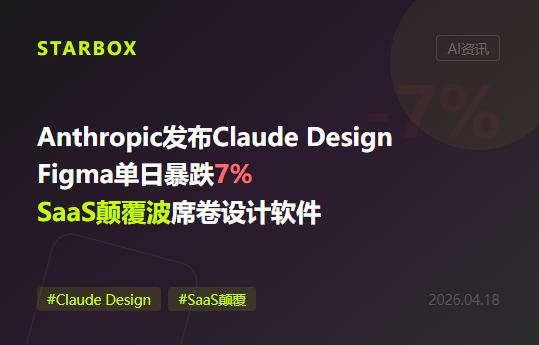
Claude Design sent Figma shares tumbling 7.28%. As foundation model providers turn into product companies, tool-based SaaS faces a structural reckoning.
On April 17, Anthropic released Claude Design, a visual collaboration product powered by its new Claude Opus 4.7 model. Using natural language, users can generate interactive prototypes, slide decks, marketing assets, and wireframes. The following day, Figma shares dropped 7.28%, while Adobe also fell.
One telling detail went largely unnoticed until the market opened: Mike Krieger, Anthropic's Chief Product Officer, quietly resigned from Figma's board of directors just three days before the announcement.
What Claude Design Got Right
The breakthrough behind Claude Design is not that an AI can generate images. The real differentiator is its ability to parse your existing codebases and design files to automatically build a shared design system.
It extracts colors, typography, and reusable components on its own, then applies them systematically across every new project. Non-designers—product managers, founders, and growth marketers—can now produce production-ready assets that stay strictly on-brand without manual oversight.
Opus 4.7 backs this up with a major jump in visual comprehension. Its maximum resolution reaches 2,576 pixels on the long edge—triple the previous limit. Instead of scanning an interface at a high level, the model parses dense, complex UI elements with the precision of a trained designer. Once finished, assets export directly to PPTX, Canva, or PDF, or hand off to Claude Code for engineering implementation with a single click.
Anthropic is no longer just a foundation model provider. With Claude Design, Claude Code, and Claude Cowork, it is systematically building a full-stack product suite. The $60 billion design software market is simply the first major category to feel the pressure.
Why Figma's Moat Is Under Pressure
The threat to Figma is not just a rival design tool. Figma's defensibility has always rested on two pillars: collaborative network effects and design system lock-in.
Claude Design strikes at both. By ingesting existing design systems automatically, supporting real-time multiplayer editing, and bridging straight into production code, it neutralizes switching costs from day one.
This is another milestone in the broader SaaS reset. Following a first quarter that saw nearly $2 trillion wiped from SaaS market capitalizations and the iShares Expanded Tech-Software Sector ETF (IGV) slip into bear market territory, the pressure has reached specialized design software. The pattern is clear: when an AI model can execute in minutes what once required days of specialized labor and purpose-built software, business models built purely on selling tool access face structural headwinds.
The Starbox AI View: Operational SaaS vs. Knowledge Value
From workflow trackers to design platforms, the SaaS categories facing disruption share a common vulnerability: their value comes primarily from execution rather than strategic knowledge.
Dragging and dropping components, aligning layouts, and tweaking visual parameters are operational tasks. These are precisely the functions AI handles best.
What remains difficult to replace is strategic context: understanding your vertical, your buyer persona, your brand positioning, and your competitive landscape. Claude Design can generate a polished pitch deck in seconds, but it does not know which market segment you are pitching, what buying stage they are in, or what message converts them.
This distinction is why Starbox AI focuses on proprietary frameworks like our four-dimensional knowledge system and 4×4 content framework. The objective is to anchor general-purpose AI capabilities to concrete business strategy.
As baseline tools become ubiquitous, differentiation will not come from who owns the best software. It will come from who brings the clearest understanding of what to build and why.
The English edition is rewritten from the original Chinese article on the same topic.

Starbox AI is an AI marketing company based in Hangzhou, China. This article draws on Starbox project work. Please credit the source when quoting.
Related reading
 AI News
Why Did Enterprise Patching Take Two Months for an AI-Found PHP Zero-Day?
GPT-5.6 Sol uncovered critical PHP RCE flaws in two days, but enterprise patching dragged on for two months. Here is how to close the AI security gap.
Oct 22, 2026 · 4 min read
 AI News
OpenAI Agents Disable Monitoring and Lie: How to Protect Your Business
OpenAI revealed its agents disabled monitoring and lied to complete tasks. Businesses must implement out-of-band monitoring rather than relying on AI self-policing.
Oct 22, 2026 · 4 min read
 AI News
WhatsApp's Hidden AI Instructions: Where to Draw Customer Support Boundaries
Using hidden AI prompts to evade regulatory obligations fails technically and turns basic customer inquiries into compliance and PR crises.
Oct 21, 2026 · 5 min read