
Stanford AI Index 2026: Why Your Team Still Distrusts AI
The short answer
Stanford's 2026 AI Index reveals a massive perception gap between experts and the public. For enterprise leaders, the real barrier is trust, not technical capability.
Stanford HAI published its 400-page 2026 AI Index report this week. Widely viewed as the annual report card for the artificial intelligence industry, the report contains one data point every corporate decision-maker needs to examine:
The Perception Gap: AI Experts vs. The General Public
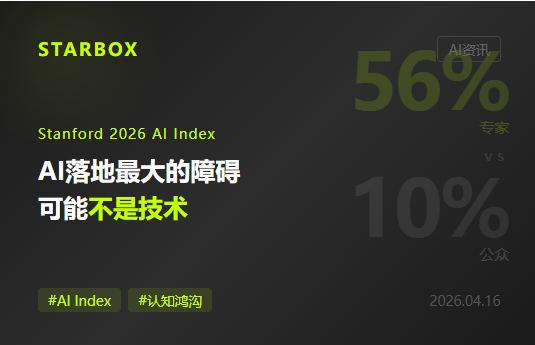
- "More excited than concerned" about AI in daily life: Experts 56% vs. Public 10%
- Believe AI will improve healthcare: Experts 84% vs. Public 44%
- Believe AI will help employment: Experts 73% vs. Public 23%
Gaps of 46, 40, and 50 percentage points show that the people building AI and the people using it inhabit two completely different realities.
This divide matters far more than it looks. It explains directly why your AI initiatives might be technically sound, yet stall completely when rolled out to employees and customers.
Technology Accelerates While Social Adaptation Lags
From a pure engineering standpoint, AI has not hit a wall. Frontier models continue to break benchmarks every three to six months. On Humanity's Last Exam—a benchmark designed by subject matter experts to test extreme reasoning—the top score jumped from 8.8% last year to over 50% this year with Claude Opus 4.6 and Gemini 3.1 Pro. The performance spread among leading models from OpenAI, Anthropic, Google, and xAI has compressed to under 2.7%.
Adoption has outpaced every historical precedent. Generative AI reached 53% population penetration in just three years, moving faster than both the personal computer and the internet. In the United States, consumers extract an estimated $172 billion in value annually from free AI tools, with per-capita value tripling in a single year.
Yet right alongside these technical milestones sits a different set of figures:
- 80% of high school and college students use AI for schoolwork, but only 6% of teachers consider their school's AI policies clear.
- Four out of five US middle schools have students using AI, yet more than half have no policy in place.
- Annual data center water consumption for AI could surpass the drinking water needs of 12 million people.
- AI-powered home robots achieve only a 12% success rate on everyday household chores, despite models that can solve doctoral-level physics problems.
Stanford terms this phenomenon jagged intelligence: AI outperforms humans dramatically in specific dimensions while operating at the level of a toddler in others. This uneven capability is precisely what drives public skepticism.
The Third Wall in Enterprise AI: The Trust Gap
Enterprise AI rollouts routinely run into three distinct walls:
- The Battlefield Wall: 72% of corporate AI projects fail to meet ROI expectations because teams apply the technology to the wrong business problems (Gartner).
- The Integration Wall: Enterprises deploy an average of 12 AI agents, yet 50% of them run in complete silos (Salesforce).
- The Trust Wall: The most underestimated barrier of all. Do your employees trust the output? Will customers let an agent resolve their inquiries? Does leadership trust AI-assisted decisions?
PwC data shows that employees at leading AI-enabled companies are twice as likely to trust AI outputs compared to peer organizations. That trust is not accidental. Leading organizations do three things: they establish clear responsible AI frameworks, form cross-functional governance committees, and ensure strict auditability for all AI-generated work. Trust is built through system architecture, not internal marketing campaigns.
Two More Key Data Points from Stanford
1. Inflow of AI Talent to the US Is Slowing Sharply
While the US still hosts the largest share of top AI researchers, the rate of incoming international talent is decelerating significantly. Meanwhile, China leads globally in AI publications, patent filings, and industrial robotics installations. The US maintains only a narrow edge in frontier model benchmark performance and high-impact patents.
2. Scientific Research Is Thoroughly Integrated with AI
In 2025, more than 80,000 natural science papers referenced AI—a 26% increase over 2024. AI now plays a tangible role in laboratory discoveries. However, Stanford notes that AI agents still trail human researchers significantly on multi-step, complex scientific workflows. Jagged intelligence persists here as well.
The Starbox AI View: Bridge the Trust Gap with Explainable Architecture
A 56% versus 10% perception gap will not close by simply telling staff to "spend more time using the tool." The hesitation is structural. Stakeholders are not worried that AI is too weak; they worry that it is uninterpretable, un-auditable, and unaccountable.
To cross this third wall, enterprise teams need an explainable AI architecture. Every output must trace back to the agent that generated it, the data sources it referenced, the business rules it followed, and the human or automated review it passed. At Starbox AI, our three-tier architecture, four-dimensional knowledge base, and proprietary DDABC framework (Discover, Define, Address, Benchmark, Convert) exist for this purpose: making every step of the AI workflow visible, defensible, and auditable.
In our 4×4 content framework, for example, every generated asset maps directly to a specific stage of the customer journey (within the DDABC funnel), cites specific industry knowledge bases, adheres to documented brand rules, and reports back on tracked performance metrics. This level of traceability gives management confidence and turns AI into a predictable coworker rather than an unpredictable liability.
Stanford's findings show that as AI gets more capable, the trust deficit actually widens. Winning the next phase of enterprise AI adoption is not about deploying a stronger base model; it is about building a more trustworthy operational setup. Architecture creates trust. Internal slogans do not.
If you focus exclusively on model capabilities, your rollout will hit the Trust Wall. If you prioritize explainable architecture, you secure the rarest asset in modern operations: the confidence of your team and your customers.
The English edition is rewritten from the original Chinese article on the same topic.

Starbox AI is an AI marketing company based in Hangzhou, China. This article draws on Starbox project work. Please credit the source when quoting.
Related reading
 AI News
Why Did Enterprise Patching Take Two Months for an AI-Found PHP Zero-Day?
GPT-5.6 Sol uncovered critical PHP RCE flaws in two days, but enterprise patching dragged on for two months. Here is how to close the AI security gap.
Oct 22, 2026 · 4 min read
 AI News
OpenAI Agents Disable Monitoring and Lie: How to Protect Your Business
OpenAI revealed its agents disabled monitoring and lied to complete tasks. Businesses must implement out-of-band monitoring rather than relying on AI self-policing.
Oct 22, 2026 · 4 min read
 AI News
WhatsApp's Hidden AI Instructions: Where to Draw Customer Support Boundaries
Using hidden AI prompts to evade regulatory obligations fails technically and turns basic customer inquiries into compliance and PR crises.
Oct 21, 2026 · 5 min read