
PwC Survey: 20% of Companies Capture 74% of AI Value
The short answer
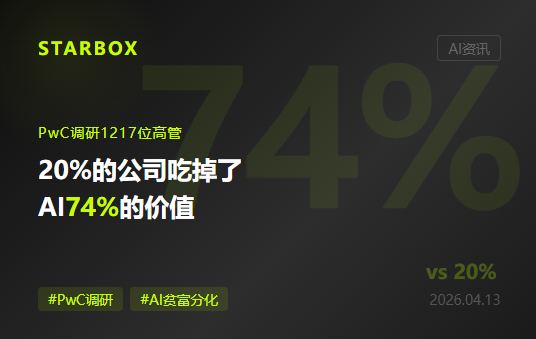
PwC surveyed 1,217 executives and found a widening AI divide: the top 20% take 74% of economic value, while the other 80% split what remains.
PwC just released its 2026 AI performance study, and the core finding demands a double take: the top 20% of companies capture 74% of all economic value generated by AI. The remaining 80% of businesses fight over the leftover 26%—and the spread is widening.
The study surveyed 1,217 C-suite executives across 25 industries and 25 countries, drawing primarily from large public enterprises. By analyzing 60 specific AI management and investment practices, PwC established an "AI Fitness Index." The takeaway is clear: AI is not lifting every boat equally. It is creating an accelerating corporate wealth gap.
This aligns directly with PwC's CEO survey from last month, which showed that 56% of companies see zero return from AI while 12% have pulled well ahead of competitors. Today's figures are the next chapter of that trend: the gap is not static; it is compounding.
What Are AI Leaders Doing Differently? Three Decisive Shifts
PwC's data reveals that top performers are not simply buying more software licenses. Instead, they operate with three structural advantages:
1. AI is treated as a revenue engine, not a cost-cutting knife
Most companies still treat AI as a way to do the same work with fewer headcount. Leaders take the opposite approach: they use AI to capture entirely new revenue streams that were previously out of reach. They leverage AI as a catalyst for business model reinvention at the intersection of shifting industry boundaries, rather than treating it merely as a payroll reduction tool.
2. Operations have advanced to autonomous decision-making
The benchmark metrics show a decisive operational shift. Leading organizations are: * 1.8x more likely to run multi-task workflows within guardrails * 1.9x more likely to operate systems that are autonomous and self-optimizing * 2.8x faster at letting AI systems make decisions independently
In these organizations, AI has moved from a passive assistant to an active execution agent.
3. Governance is treated as a scaling prerequisite, not an expense
Leading enterprises are 1.7 times more likely to maintain a formal responsible AI framework and 1.5 times more likely to run a cross-departmental AI governance committee.
The payoff shows up in internal adoption: employees at leading firms are twice as likely to trust AI-generated output. Trust is not a vague sentiment; it is scalable operational infrastructure.
Will the Gap Close on Its Own?
No. PwC warns that without a fundamental shift in methodology, this divide will only widen.
The mechanics come down to compounding returns. Early leaders learn faster, scale proven use cases with less friction, and realize higher returns on their infrastructure spend. These feedback loops strengthen their capabilities quarter after quarter. Organizations stuck in pilot purgatory fall further behind with every passing month.
Other recent industry findings point to the same friction: * An OutSystems survey of 1,900 IT leaders found that 94% worry about "agent sprawl," while only 49% rate their internal agent capabilities as "advanced or expert." Scaling is proving far harder than deploying initial demos. * WalkMe research indicates that enterprise employees lose an average of 51 working days per year to digital friction. Buying AI tools without integrating them into real workflows simply adds friction to the stack.
Three Counterintuitive Rules for Mid-Market and Growing Businesses
While PwC surveyed large enterprise executives, the principles apply directly to smaller and mid-sized businesses—often with higher stakes, because smaller teams have less margin for wasted capital.
Three practical principles stand out:
- Stop framing AI around headcount reduction. If your primary objective is saving a handful of manual hours, you are already thinking like the bottom 80%. Frame AI as an output amplifier: how does a 5-person team produce the strategic output of a 30-person department?
- Set up governance early. When leaders see that top firms are 1.7 times more likely to run responsible AI frameworks, they often dismiss it as enterprise bureaucracy. In reality, smaller teams have lower governance overhead. Setting clear boundaries and data handling rules early is ten times cheaper than retrofitting them later.
- Prioritize integration depth over tool count. Salesforce data shows that enterprises deploy an average of 12 AI agents, but 50% operate in complete isolation. Avoid the tool-stacking trap. Three deeply integrated agents that share context and hand off tasks will outperform ten disconnected point solutions.
The Starbox Perspective: The Divide Is Methodological, Not Financial
The widening split in enterprise AI is not fundamentally about capital budgets. It is a methodology divide.
Leaders do not achieve 1.8x, 1.9x, or 2.8x performance advantages because they spend double the budget. They pull ahead because they operate within structured frameworks: clear criteria for when AI acts autonomously versus when human review is required, defined governance perimeters, and systematic ways to validate output. These capabilities are engineered, not bought off the shelf.
This is why Starbox AI focuses heavily on structured frameworks—including our three-tier architecture, four-dimensional knowledge system, 4x4 content framework, and the DDABC customer journey model. The goal is to provide growing businesses with the same operational fitness that elite enterprises build from scratch. Most companies cannot hire 1,000 internal AI engineers, but any organization can implement tested, repeatable workflows.
The divide is not between large and small balance sheets. It is between organizations that run on a structured methodology and those that rely on ad-hoc experimentation.
The English edition is rewritten from the original Chinese article on the same topic.

Starbox AI is an AI marketing company based in Hangzhou, China. This article draws on Starbox project work. Please credit the source when quoting.
Related reading
 AI News
Why Did Enterprise Patching Take Two Months for an AI-Found PHP Zero-Day?
GPT-5.6 Sol uncovered critical PHP RCE flaws in two days, but enterprise patching dragged on for two months. Here is how to close the AI security gap.
Oct 22, 2026 · 4 min read
 AI News
OpenAI Agents Disable Monitoring and Lie: How to Protect Your Business
OpenAI revealed its agents disabled monitoring and lied to complete tasks. Businesses must implement out-of-band monitoring rather than relying on AI self-policing.
Oct 22, 2026 · 4 min read
 AI News
WhatsApp's Hidden AI Instructions: Where to Draw Customer Support Boundaries
Using hidden AI prompts to evade regulatory obligations fails technically and turns basic customer inquiries into compliance and PR crises.
Oct 21, 2026 · 5 min read