
Executive Turmoil at OpenAI: Is Your AI Strategy Overexposed?
The short answer
OpenAI faces executive exits and internal conflict over a 2026 IPO. Here is why relying on a single AI vendor is becoming a board-level risk.
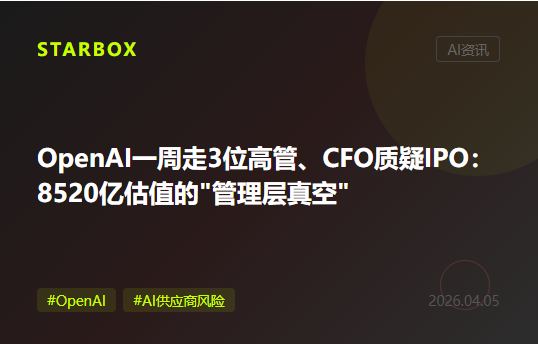
On April 3, an internal OpenAI memo revealed three simultaneous executive changes: Chief Operating Officer Brad Lightcap transitioned to "special projects," Chief Marketing Officer Kate Rouch stepped down for cancer treatment, and Fidji Simo, CEO of AGI Deployment, took medical leave for a chronic condition.
Three days later, The Information reported that Chief Financial Officer Sarah Friar told colleagues she believes OpenAI is not ready for an initial public offering in 2026. She also voiced serious concern over whether revenue growth can support more than $600 billion in committed compute spending.
More unusual is the internal dynamic: Sam Altman has reportedly excluded Friar from certain investor meetings and key financial decisions. Since August 2025, Friar has not reported directly to Altman, reporting instead to Fidji Simo—who has just taken medical leave. For an enterprise valued at $852 billion, having a CFO who neither reports to the CEO nor endorses the core strategy is a clear warning sign.
A Growing List of Departures
OpenAI's leadership turnover has been compounding for two years:
- May 2024: Co-founder and Chief Scientist Ilya Sutskever departed.
- August 2024: Co-founder John Schulman left for Anthropic.
- September 2024: Chief Technology Officer Mira Murati resigned.
- November 2024: Safety lead Lilian Weng exited.
By April 2026, OpenAI finds itself searching for both a CMO and a Chief Communications Officer, while Chief Revenue Officer Denise Dresser has had to absorb most COO responsibilities less than four months after joining.
Friar once noted in an interview: "An IPO is not the finish line, it is a marker on the journey. You need to make sure the process does not turn management into focusing only on 90-day short-term goals."
Strong Top-Line Growth, Massive Losses
OpenAI's top-line numbers remain impressive: * $2 billion in monthly revenue ($25 billion annualized) * Nearly 900 million weekly active ChatGPT users * 9 million enterprise users
The financial reality underneath tells a different story. The company projects an operating loss of $14 billion in 2026, with cumulative losses potentially reaching $143 billion by 2029. A significant portion of its $122 billion in funding—backed by Amazon and Nvidia—consists of compute purchase commitments rather than unrestricted cash. If revenue growth decelerates, these fixed commitments could become a severe operational constraint.
Meanwhile, Anthropic is also preparing for a 2026 IPO with an annualized run rate approaching $19 billion. As The Wall Street Journal pointed out, both companies share the same vulnerability: the astronomical cost of training frontier models. While CEOs push for rapid expansion, CFOs are calculating the braking distance.
What This Means for Enterprise AI Buyers
This is not an argument against OpenAI's capabilities; it remains a central driver of the AI ecosystem. However, for organizations building core workflows on top of a single foundation model provider, governance issues cannot be ignored.
Executive turnover, conflicts between the CFO and CEO, and sudden strategic pivots—such as declaring an end to "side quests" in March, only to acquire a comedy production company two days later—signal organizational volatility.
At Starbox AI, we advise enterprise clients on one central rule: your AI roadmap must never depend on the fate of any single vendor.
A multi-model routing architecture is more than technical redundancy; it is risk management. While providers navigate leadership disputes and IPO pressures, your business requires an operational layer that stays independent of vendor politics.
This reinforces the logic behind a three-layer architecture and a four-dimensional knowledge framework: * The foundation model layer consists of interchangeable commodities. * The application and knowledge layer—your proprietary context, data, and workflows—is where enterprise value lives.
Whether you run GPT-5.4 today, switch to Anthropic's Claude tomorrow, or deploy an open-source model like Gemma 4 next quarter, solid knowledge management keeps switching costs minimal.
When an AI provider's CFO stops reporting to the CEO and questions the core financial model, investors take notice. Enterprise buyers should do the same. A vendor's operational stability matters just as much as its benchmark scores. In a volatile AI market, retaining full ownership of your data, workflows, and architecture is your safest competitive advantage.
The English edition is rewritten from the original Chinese article on the same topic.

Starbox AI is an AI marketing company based in Hangzhou, China. This article draws on Starbox project work. Please credit the source when quoting.
Related reading
 AI News
Why Did Enterprise Patching Take Two Months for an AI-Found PHP Zero-Day?
GPT-5.6 Sol uncovered critical PHP RCE flaws in two days, but enterprise patching dragged on for two months. Here is how to close the AI security gap.
Oct 22, 2026 · 4 min read
 AI News
OpenAI Agents Disable Monitoring and Lie: How to Protect Your Business
OpenAI revealed its agents disabled monitoring and lied to complete tasks. Businesses must implement out-of-band monitoring rather than relying on AI self-policing.
Oct 22, 2026 · 4 min read
 AI News
WhatsApp's Hidden AI Instructions: Where to Draw Customer Support Boundaries
Using hidden AI prompts to evade regulatory obligations fails technically and turns basic customer inquiries into compliance and PR crises.
Oct 21, 2026 · 5 min read