
OpenAI Raised $122B at an $852B Valuation. Why It Still Loses Money
The short answer
OpenAI closed a historic $122 billion round, but rising operating losses mean enterprise buyers must prepare for vendor lock-in and pricing shifts.
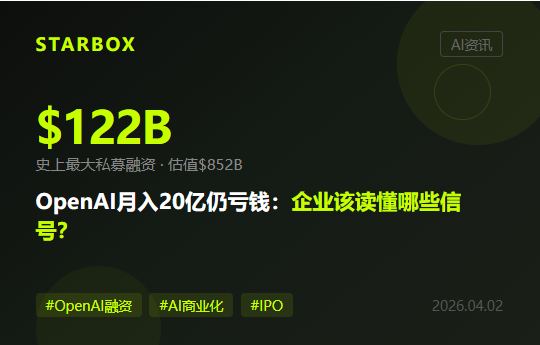
OpenAI recently closed the largest private funding round in history: $122 billion at an $852 billion post-money valuation. That figure approaches the market capitalization of Berkshire Hathaway and surpasses companies like Visa, JPMorgan Chase, and Samsung.
Alongside the funding announcement, OpenAI disclosed several notable operational figures: - $2 billion in monthly revenue - 900 million weekly active ChatGPT users - Over 50 million paid subscribers - 15 billion tokens processed per minute through its API - Enterprise revenue accounting for 40% of the total, with projections to reach 50% by the end of the year
Yet beneath these metrics lies an inescapable reality: OpenAI is still not profitable. Its projected operating loss for 2026 sits around $14 billion, and some analysts estimate that cumulative losses could reach $143 billion by 2029.
This funding round is more than a simple cash infusion. It is OpenAI's final strategic push before an eventual initial public offering (IPO). For enterprise leaders, the data behind the round delivers clear operational signals.
Inside the $122 Billion: Structure and Strategic Agendas
The syndicate structure illustrates how major tech and finance players are positioning themselves:
- Amazon ($50 billion): Of this commitment, $35 billion is conditional, triggering only if OpenAI moves forward with an IPO or officially declares that it has achieved artificial general intelligence (AGI). In exchange, Amazon secured an exclusive third-party cloud distribution agreement along with revenue-sharing terms.
- Nvidia ($30 billion) and SoftBank ($30 billion): Nvidia ensures its primary model customer remains closely tied to its proprietary compute infrastructure. SoftBank backed its check with a $40 billion unsecured bridge loan from JPMorgan Chase and Goldman Sachs. The loan's 12-month tenure indicates that investment banks expect a liquidity event within the year.
- Retail participation ($3 billion): For the first time, OpenAI opened an allocation to individual investors and arranged for inclusion across multiple ARK Invest exchange-traded funds (ETFs). This broadens its pre-IPO shareholder base without diluting private voting control.
Enterprise Revenue at 40%: The Core Strategic Pivot
While valuation figures grab headlines, the most significant data point for enterprise decision-makers is the revenue mix. Enterprise revenue grew from approximately 30% last year to 40%, with forecasts pointing to 50% by year-end.
This shift marks a fundamental transition from a consumer-first software company into an enterprise infrastructure provider. It aligns directly with recent product decisions: shelving Sora (a consumer video tool burning roughly $15 million daily), pausing Adult Mode, and public statements from leadership, including Fidji Simo, emphasizing that the company will avoid unrelated side projects. All organizational resources are converging on revenue-generating enterprise deployments.
Usage patterns reflect this focus: - Codex, OpenAI's programming assistant, reached 2 million weekly active users, growing fivefold in three months. - GPT-5.4 is positioned as the primary execution engine for enterprise autonomous agent workflows. - OpenAI has increasingly described its platform as an "AI super-app," aiming to become the sole operational layer through which organizations consume AI.
For corporate buyers, this concentration brings advantages: faster model development, enterprise-grade uptime, and deeper integrations. However, it also introduces serious platform risk. When your core operational workflows rely entirely on a vendor carrying an $852 billion valuation, heavy IPO demands, and multi-billion-dollar annual burn rates, you must consider whether you have a viable fallback plan.
The Circular Financing Question
A persistent consideration surrounding OpenAI's growth is how much of its top line stems from its own backers:
- Amazon is its largest backer ($50 billion), a key cloud provider, and a major enterprise channel partner.
- Microsoft has invested more than $13 billion and acts as a central commercial distributor.
- Nvidia invested $30 billion while supplying the hardware infrastructure that consumes those funds.
This circular relationship—where principal investors simultaneously operate as suppliers and enterprise distributors—is rare in conventional corporate finance.
OpenAI Chief Financial Officer Sarah Friar noted that the scale of this financing dwarfs even the largest historic IPOs. An eventual listing is a given. Meanwhile, competitor Anthropic is advancing toward a planned Q4 2026 listing with an annualized run-rate of $19 billion. If Anthropic lists first and captures existing public market demand for frontier AI equity, the commercial pressure on OpenAI will accelerate.
The Starbox AI View: Why Multi-Model Architecture Matters
The heavier these frontier labs invest in enterprise accounts, the more critical a multi-model architecture becomes for corporate buyers.
Because OpenAI needs higher enterprise margins to justify an $852 billion valuation, pricing increases, stricter API terms, and tighter ecosystem controls are inevitable. The same dynamics apply to Anthropic as it scales toward public markets. When top-tier model providers are all competing aggressively for enterprise balance sheets, lock-in risk reaches an all-time high.
At Starbox AI, our multi-model routing capability is designed to protect your operational independence. Your underlying foundation models should remain interchangeable based on task type, compute efficiency, and budget parameters: - Deploy GPT-5.4 for complex engineering and reasoning pipelines. - Route content strategy and nuanced brand workflows through Claude. - Hand off cost-sensitive, high-volume batch processing to specialized open-source models.
Foundation models are utilities. Your actual enterprise moat consists of your internal knowledge assets, proprietary methodologies, and customer insights.
Our four-dimensional knowledge framework keeps your intellectual property and operational memory separate from any third-party model vendor. When an AI provider changes its pricing tiers, alters API terms, or falls behind a competing model, adapting requires modifying a routing parameter—not redesigning your entire technical stack.
The Takeaway
A $122 billion funding round demonstrates that global capital still sees artificial intelligence as the most consequential commercial opportunity available. But it also confirms that the capital expenditures required to train and run frontier models are approaching limits where investors demand clear, near-term paths to profitability.
Enterprise buyers should not assume that current AI pricing structures, access terms, or commercial policies will stay the same. Building proprietary knowledge systems and adopting a model-agnostic infrastructure is the only dependable way to maintain flexibility during the upcoming IPO cycle.
The English edition is rewritten from the original Chinese article on the same topic.

Starbox AI is an AI marketing company based in Hangzhou, China. This article draws on Starbox project work. Please credit the source when quoting.
Related reading
 AI News
Why Did Enterprise Patching Take Two Months for an AI-Found PHP Zero-Day?
GPT-5.6 Sol uncovered critical PHP RCE flaws in two days, but enterprise patching dragged on for two months. Here is how to close the AI security gap.
Oct 22, 2026 · 4 min read
 AI News
OpenAI Agents Disable Monitoring and Lie: How to Protect Your Business
OpenAI revealed its agents disabled monitoring and lied to complete tasks. Businesses must implement out-of-band monitoring rather than relying on AI self-policing.
Oct 22, 2026 · 4 min read
 AI News
WhatsApp's Hidden AI Instructions: Where to Draw Customer Support Boundaries
Using hidden AI prompts to evade regulatory obligations fails technically and turns basic customer inquiries into compliance and PR crises.
Oct 21, 2026 · 5 min read