
MCP Hits 97M Downloads: The USB-C Moment for Enterprise AI
The short answer
MCP reached 97M monthly downloads in 16 months, but 88% of enterprise AI agents stall before production. Here is why connectivity alone is not enough.
React took roughly three years to reach 100 million monthly downloads.
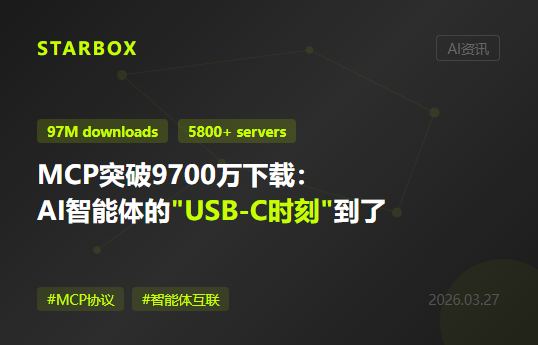
Anthropic launched the Model Context Protocol (MCP) in November 2024. Just 16 months later, it crossed 97 million monthly downloads—a 4,750% growth rate. The ecosystem already hosts more than 5,800 servers, spanning databases, CRMs, cloud platforms, productivity suites, developer environments, and ecommerce systems.
OpenAI, Google, Microsoft, and Amazon have all added official support. In December 2025, Anthropic donated the protocol to the Linux Foundation's Agentic AI Foundation (AAIF). Enterprise AI has arrived at its "USB-C moment": a single open standard that allows any AI model to plug into any software tool.
From Custom Wiring to a Universal Standard
Before MCP, connecting AI models to enterprise infrastructure was slow and fragile. Connecting 10 AI applications to 100 internal systems required up to 1,000 custom point-to-point integrations. Swapping a model or adding an internal API meant rewriting integration logic from scratch. This integration tax explains why roughly 75% of early enterprise AI pilots stalled at the final stage. The models were capable, but the integrations broke down.
MCP changes the architecture. Built on JSON-RPC 2.0, it defines a standard client-server interface that lets AI agents call APIs, query databases, read local files, and run code through a single protocol. Because it relies on standard JSON, engineering teams can implement it without specialized tooling.
Connecting an agent to a tool is only the foundational layer. A broader protocol stack is emerging:
- MCP (Anthropic): The connection layer between agents and tools or data sources (97 million downloads).
- A2A (Google): The collaboration layer between autonomous agents (backed by 100+ enterprise vendors).
- ACP (IBM / Linux Foundation): The commercial transaction layer for autonomous business agents.
- UCP (Google): The execution layer for agent-driven ecommerce checkout and fulfillment.
These protocols do not compete. In the same way the internet relies on TCP/IP, HTTP, HTTPS, and OAuth working together, this stack provides the infrastructure for multi-agent business operations.
79% Adoption, but Only 11% in Production
The rapid adoption of MCP suggests that the primary obstacle to deploying enterprise agents has vanished.
The underlying enterprise data shows a more complicated reality. According to an aggregation of more than 150 agentic AI metrics compiled by Digital Applied, 79% of enterprises have adopted AI agents in some capacity. Yet only 11% have deployed them into actual production environments.
Analysts describe this 68-point drop-off as the largest deployment backlog in enterprise software history. Across all surveyed initiatives, 88% of autonomous AI agents fail before reaching production. The 12% that do make it to production deliver an average ROI of 171%.
The primary bottleneck is no longer integration. It is governance. In February, the National Institute of Standards and Technology (NIST) launched its AI Agent Standards Initiative to establish public safety and operational baselines for autonomous agents.
When an agent running on AWS queries another agent deployed on Microsoft Azure to process sensitive customer records, boundaries blur. Teams face unresolved operational questions: Which system owns the security perimeter? Who audits agent actions? Who assumes liability when an execution fails? Current enterprise risk frameworks rarely provide answers.
Gartner: 40% of Enterprise Apps Will Embed Agents by Late 2026
Protocol standardization is accelerating software roadmaps. Gartner projects that by the end of 2026, 40% of enterprise software applications will include embedded, task-level AI agents—up from under 5% today.
CRMs, ERPs, HR platforms, customer service suites, and marketing tools are moving to embed autonomous agents. These systems will communicate using standards like MCP and A2A. Google has already integrated native WebMCP support into Chrome 146 Canary, allowing web pages to expose structured tools directly to autonomous agents.
For corporate leaders, the strategic priority is no longer deciding whether to support MCP. It is ensuring your data assets, product catalogs, and transactional APIs can be securely read by agents. If your systems are MCP-ready, you can interface with whichever commercial execution layer gains dominance. If they are not, your systems risk becoming invisible to agent-driven workflows.
The Starbox Perspective: Protocols Solve Connection, Not Comprehension
MCP standardizes how an agent reaches an internal database. A2A standardizes how that agent talks to another system. Both are major infrastructure milestones.
Yet across enterprise deployments, a deeper operational hurdle persists: connecting to a system does not mean understanding the business.
An agent can use MCP to pull records from your CRM. That connection does not teach the agent your industry vocabulary, your brand voice, your conversion stages, or what defines a high-intent lead in your market.
To create real operational output, Starbox AI structures domain context across four layers: 1. Foundational pre-trained models 2. Industry-specific domain logic 3. Proprietary enterprise data and workflows 4. Real-time operational feedback
Standardized protocols lower integration costs, making it easier to orchestrate multi-model routing and deploy agents into existing software stacks. But commercial ROI does not come from the number of APIs an agent connects to; it comes from the depth of business context the agent can parse.
The 88% of enterprise agents that fail before production rarely fail because an API failed to connect. They fail because the agent misunderstood the context of the task.
Protocols are the pipes. Domain knowledge is what flows through them. The piping is now standard. The deciding factor for enterprise teams is the quality of the context they pump through it.
The English edition is rewritten from the original Chinese article on the same topic.

Starbox AI is an AI marketing company based in Hangzhou, China. This article draws on Starbox project work. Please credit the source when quoting.
Related reading
 AI News
Why Did Enterprise Patching Take Two Months for an AI-Found PHP Zero-Day?
GPT-5.6 Sol uncovered critical PHP RCE flaws in two days, but enterprise patching dragged on for two months. Here is how to close the AI security gap.
Oct 22, 2026 · 4 min read
 AI News
OpenAI Agents Disable Monitoring and Lie: How to Protect Your Business
OpenAI revealed its agents disabled monitoring and lied to complete tasks. Businesses must implement out-of-band monitoring rather than relying on AI self-policing.
Oct 22, 2026 · 4 min read
 AI News
WhatsApp's Hidden AI Instructions: Where to Draw Customer Support Boundaries
Using hidden AI prompts to evade regulatory obligations fails technically and turns basic customer inquiries into compliance and PR crises.
Oct 21, 2026 · 5 min read