
ChatGPT Ads at 45 Days: $60 CPM and Under 1% CTR
The short answer
OpenAI launched ads in ChatGPT 45 days ago. Early data shows high costs and low engagement, raising a bigger question for marketing budgets.
On February 9, OpenAI rolled out advertising inside ChatGPT. Forty-five days later, early performance data has started to emerge.
According to a CNBC report this month, advertising insiders shared surprising early figures. One brand saw a click-through rate (CTR) of just 0.91% on its ChatGPT ads—roughly one-seventh of the industry benchmark for Google Search ads. Another advertiser secured a $250,000 pilot budget but was only able to spend 3% over several weeks. The issue was not a lack of interest, but that the platform simply did not generate enough ad impressions.
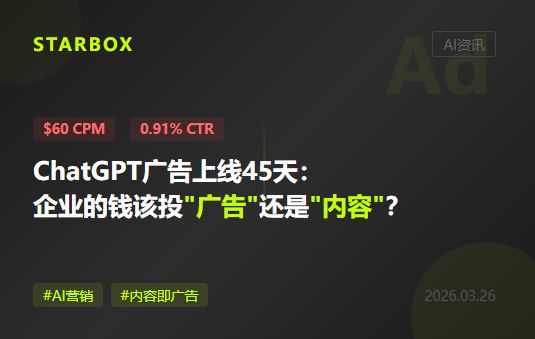
At the same time, OpenAI priced these ad placements at a $60 CPM (cost per thousand impressions), roughly three times the average cost of Meta ads. The minimum commitment to join the initial test was $200,000. While this is not an entry-level test for small businesses, the early findings carry critical implications for any marketing decision-maker weighing where to put their AI budget.
$57 Billion Flows to AI Ads, but In-Chat Formats Are Not Ready
Looking at the broader market, Madison and Wall projects US AI-driven ad spend will hit $57 billion in 2026, a 63% increase year-over-year. However, the vast majority of that total reflects traditional ad formats optimized by AI—such as Google Performance Max and Meta Advantage+—rather than ads placed directly inside chat interfaces.
ChatGPT’s ad product is an entirely different format: conversational advertising. Instead of keyword bidding on a search results page or native sponsored posts in a feed, it places a sponsored recommendation at the bottom of the AI's generated response. Conceptually, the potential is clear: reaching users while they are actively researching and evaluating options should theoretically yield higher intent than social media feeds.
In practice, the format remains in its infancy. Sensor Tower estimates that by mid-March, ads reached only about 5% of ChatGPT mobile users. OpenAI's COO publicly described the rollout as an iterative process rather than a finished product release. Reporting tools provide only basic impression and click counts, lacking the granular attribution analysis performance marketers expect. Several agencies participating in the pilot told CNBC that the pace of development has been frustrating.
Truist analysts have called 2026 an "inflection year" for large language model (LLM) advertising, projecting that LLM channels will eventually become a major pillar of digital advertising alongside search, social, and retail media. In the near term, however, the supporting infrastructure remains underdeveloped.
The Overlooked Metric: Citations Matter More Than Impressions
Amid the discussion around ad units, one data point has largely been overlooked: across the web pages ChatGPT retrieves, only 15% are ultimately cited in its answers, according to recent research.
This finding points to an essential shift. In conversational search, brand visibility is no longer determined simply by who bids the highest. It is determined by whose content is authoritative enough to be cited by the model. A brand can spend $200,000 to place a sponsored box beneath an answer. But if the underlying content is strong enough, the AI will cite the brand directly within the answer itself—carrying far higher trust than a sponsored label.
This is not an argument against conversational ads. Over time, paid placements in chat may develop into a viable performance channel. Right now, marketing leaders face a more immediate strategic question: should budget go toward buying sponsored placements inside the AI interface, or toward ensuring company content becomes the primary source the AI chooses to reference?
A Divided Market: OpenAI Monetizes, Anthropic and Google Lean In on Ad-Free
Competitor responses to ChatGPT's ad rollout highlight a growing philosophical divide. During this year’s Super Bowl, Anthropic ran television commercials satirizing the user experience of having ads inserted into AI conversations. Google DeepMind CEO Demis Hassabis has publicly stated that Gemini has no current plans for ads. Both companies are using an ad-free positioning as a competitive differentiator—a factor that helped Claude briefly overtake ChatGPT at the top of the App Store following OpenAI’s Pentagon contract controversy.
Behind OpenAI’s push into ads lies straightforward financial pressure: the company projects cash burn of $17 billion in 2026, an amount that subscriptions alone cannot support. PYMNTS reported that OpenAI recently hired veteran ad executive Dave Dugan from Meta to lead ad sales, alongside recruiting ad infrastructure engineers and ad compliance specialists. These hires indicate a long-term commercial buildout, not a temporary experiment.
For advertisers, the competitive landscape shows that while the AI ad ecosystem is taking shape, no conversational platform currently offers mature, scaled ad infrastructure. The practical move for brands right now is to build their content foundation while the ad platforms sort out their models.
The Starbox Perspective: Getting Cited vs. Buying Placements
The fact that AI engines cite only 15% of retrieved content is central to how Starbox AI approaches marketing.
Generative models do not select citations at random. They evaluate whether content is structured, authoritative, and distinct enough to serve as part of a direct answer to the user. Simply publishing volume is not enough; content architecture makes the difference.
Starbox AI designed the 4x4 content strategy framework and the DDABC customer journey model specifically for this requirement. The goal is to generate content that reads naturally for human audiences while remaining structured for LLM ingestion and citation. Combined with a multi-scenario content diversity engine, this approach helps brands earn organic citations across platforms and chat contexts.
Testing conversational ads may make sense for certain enterprise budgets as platforms mature. But while ad tools remain early and attribution remains limited, investing in organic AI visibility delivers a durable return. When an ad budget runs out, the impressions stop. High-quality content assets, by contrast, remain indexable and citeable across every AI platform over time.
OpenAI’s initial ad pilot is scheduled to conclude in late March. Whether OpenAI opens the product more broadly or competitors adjust their policies will be important to watch. Regardless of how ad formats evolve, one strategic rule holds: the strongest placement in AI is not next to the answer, but inside it.
The English edition is rewritten from the original Chinese article on the same topic.

Starbox AI is an AI marketing company based in Hangzhou, China. This article draws on Starbox project work. Please credit the source when quoting.
Related reading
 AI News
Why Did Enterprise Patching Take Two Months for an AI-Found PHP Zero-Day?
GPT-5.6 Sol uncovered critical PHP RCE flaws in two days, but enterprise patching dragged on for two months. Here is how to close the AI security gap.
Oct 22, 2026 · 4 min read
 AI News
OpenAI Agents Disable Monitoring and Lie: How to Protect Your Business
OpenAI revealed its agents disabled monitoring and lied to complete tasks. Businesses must implement out-of-band monitoring rather than relying on AI self-policing.
Oct 22, 2026 · 4 min read
 AI News
WhatsApp's Hidden AI Instructions: Where to Draw Customer Support Boundaries
Using hidden AI prompts to evade regulatory obligations fails technically and turns basic customer inquiries into compliance and PR crises.
Oct 21, 2026 · 5 min read