
PwC Survey: 56% of CEOs Get Zero AI ROI, but Top 12% Pull Ahead
The short answer
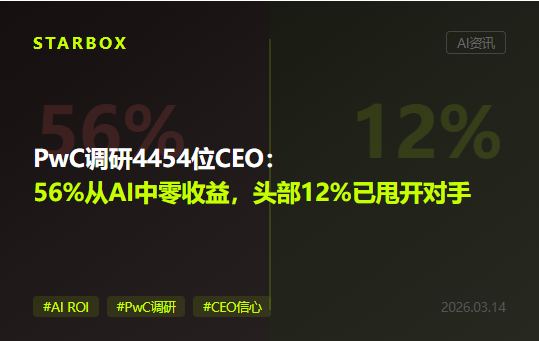
PwC's survey of 4,454 CEOs shows 56% saw zero revenue or cost gains from AI in the past year, while an elite 12% captured compounding financial advantages.
The data behind enterprise AI adoption reveals a sharp split. At the World Economic Forum in Davos, PwC released its 29th Annual Global CEO Survey, gathering insights from 4,454 chief executives across 95 countries and territories.
The headline finding is stark: 56% of CEOs reported that AI delivered neither revenue growth nor cost reductions over the past 12 months.
Worse, executive confidence in short-term business growth has tumbled. Only 30% of CEOs expressed strong confidence in their company's revenue prospects over the coming 12 months—a five-year low, down from 56% in 2022.
Yet within this landscape, a distinct group has pulled away: 12% of CEOs reported that AI investments simultaneously generated top-line revenue growth and bottom-line cost savings.
PwC Global Chair Mohamed Kande noted that 2026 is becoming a decisive year for AI: a small tier of companies is capturing measurable financial returns, while the majority remains trapped in pilot purgatory.
What separates that top 12% from the 56% seeing zero financial impact?
What the Top 12% Do: Deep Integration, Not Surface Adoption
PwC's cross-analysis of this top 12% highlights several clear patterns.
First, these leaders do not run isolated experiments across disconnected departments. Instead, they embed AI deeply across three core enterprise areas: products and services, demand generation, and strategic decision-making. CEOs who execute on all three are two to three times more likely to report concurrent revenue gains and cost cuts.
Second, infrastructure matters as much as the models themselves. Companies that establish responsible AI frameworks and enterprise-grade integration environments are three times more likely to see meaningful financial returns. Independent analysis in the report shows that organizations applying AI systematically across products, services, and customer experience earn profit margins nearly four percentage points higher than their peers.
As Fortune noted in its coverage of the report, the issue is rarely model performance. Most companies fail because they apply AI as a tactical patch—using it to speed up existing workflows slightly—rather than redesigning operations around AI capabilities.
The difference is simple: 56% of organizations are using software tools, while 12% are building interconnected systems.
The Executive Paradox: Heavy Budgets, Short Horizons
The survey exposes a fundamental disconnect in executive attention. Over 80% of CEOs plan to maintain or expand their investments in cloud, AI, and data analytics in 2026, and 42% cite the inability to transform fast enough to keep pace with technology as their top operational fear.
At the same time, CEOs report spending an average of 47% of their working hours managing issues with horizons under one year. They allocate only 16% of their time to decisions spanning five years or more.
This creates a serious structural bottleneck. Companies continue funding AI initiatives, but leadership teams spend their cognitive bandwidth on short-term firefighting. That leaves little room to tackle the structural work AI requires: redesigning core business processes, updating organizational models, and unifying enterprise data.
A 2026 survey by DigitalOcean across more than 1,100 developers and CTOs reinforces this operational wall. While 67% of technical respondents reported personal productivity gains from AI, only 10% managed to deploy autonomous AI agents at scale in production environments.
The biggest barrier was not technical capability, but operational cost: 49% stated that inference costs remain prohibitively high, and nearly half of the surveyed companies allocate between 76% and 100% of their total AI budget strictly to inference computing.
Is the Window Closing for the 56%?
Catching up is still possible, but the competitive window is closing.
PwC's data points to a compounding advantage for early movers. The companies that successfully deploy AI at scale build operational flywheels: larger proprietary datasets, battle-tested governance frameworks, and teams experienced in production AI operations. The cost and effort required for laggards to close that gap increases every quarter.
As Kande emphasized, enterprise value is concentrating rapidly. The organizations that succeed will be those that make bold structural bets and commit to building foundational capabilities rather than funding disconnected pilots.
The Starbox Perspective: Moving from Tools to Systems
The findings in the PwC report match what we see regularly working with enterprise clients at Starbox AI. Most businesses do not suffer from a lack of AI tools; they suffer from an inability to connect those tools into a unified operational system.
Consider a familiar scenario: marketing uses one third-party tool to draft blog posts, operations uses another to compile reports, and the creative team uses a standalone image generator. Each department appears to be adopting AI. Yet the tools do not communicate, data remains trapped in silos, institutional knowledge is not shared, and business impact cannot be measured.
This is the tactical fragmentation PwC describes.
Starbox AI addresses this structural challenge through a three-tier architecture: Organization, BOX, and Agent. By organizing deployment this way, disparate AI tasks unify into an enterprise-grade intelligent system. Underneath, a four-dimensional knowledge framework anchors every agent in the company's verified operational data and proprietary methodologies, rather than relying on generic model outputs.
The difference between the 56% seeing zero return and the 12% pulling ahead is not the size of their software budget. It is organizational architecture. Winning with AI is no longer about buying more software seats—it is about integrating intelligent agents directly into your core business operations.
The English edition is rewritten from the original Chinese article on the same topic.

Starbox AI is an AI marketing company based in Hangzhou, China. This article draws on Starbox project work. Please credit the source when quoting.
Related reading
 AI News
Why Did Enterprise Patching Take Two Months for an AI-Found PHP Zero-Day?
GPT-5.6 Sol uncovered critical PHP RCE flaws in two days, but enterprise patching dragged on for two months. Here is how to close the AI security gap.
Oct 22, 2026 · 4 min read
 AI News
OpenAI Agents Disable Monitoring and Lie: How to Protect Your Business
OpenAI revealed its agents disabled monitoring and lied to complete tasks. Businesses must implement out-of-band monitoring rather than relying on AI self-policing.
Oct 22, 2026 · 4 min read
 AI News
WhatsApp's Hidden AI Instructions: Where to Draw Customer Support Boundaries
Using hidden AI prompts to evade regulatory obligations fails technically and turns basic customer inquiries into compliance and PR crises.
Oct 21, 2026 · 5 min read