
AI Agents Leave Pilot Purgatory: What 1,500 IT Leaders Say
The short answer
Jitterbit's survey of 1,500 IT leaders reveals 78% of enterprise AI projects deliver measurable value as organizations scale from single tools to agent fleets.
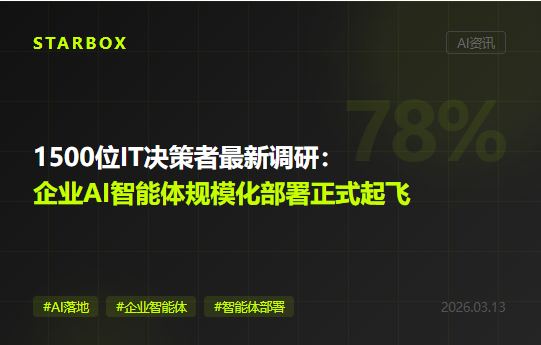
Enterprise integration platform Jitterbit recently released its 2026 AI Automation Benchmark Report. Surveying 1,500 global IT decision-makers, the report delivers a clear finding: 78% of enterprise AI projects are now delivering measurable value, while only 2.5% of organizations report failure or negative ROI.
These figures challenge the prevailing narrative of the past two years that most enterprise AI initiatives stall out. As Jitterbit CEO Bill Conner put it: "The era of the AI pilot is over, and the era of the agentic enterprise has begun."
Here are the three primary signals behind the data and what they mean for companies scaling their AI initiatives.
Signal 1: Budget Is No Longer the Primary Hurdle
For years, conversations around enterprise AI adoption inevitably circled back to constrained budgets and uncertain ROI. According to this cross-enterprise survey, financial limitations are no longer the top barrier to progress.
Instead, the primary concern is AI accountability. Forty-seven percent of organizations rank accountability as their primary consideration when evaluating AI tools, rising to 53% among large enterprises. Implementation speed ranks second at 43%, measuring the time required from initial deployment to realized value.
Enterprises are no longer asking whether they can use AI. They are asking who is responsible when an AI system makes an error, and how quickly a system can reach production. The focus has shifted from technical feasibility to governance, risk management, and operational velocity.
Signal 2: Deployments Are Shifting from Single Tools to Agent Fleets
The volume of active agents inside enterprises is accelerating. Surveyed companies currently run an average of 28 AI agents and plan to increase that number to 40 over the next 12 months—a 43% increase. For mid-to-large enterprises with annual revenues between £100 million and £500 million, the planned expansion is even more aggressive, moving from an average of 31 agents to 49.
This aligns with Gartner's earlier projection that 40% of enterprise applications will embed task-specific AI agents by the end of 2026, up from less than 5% in early 2025. Research from Anthropic and Material points in the same direction: 57% of organizations have already deployed multi-step agent workflows, and 81% plan to expand into more complex operational use cases this year.
More than 80% of surveyed enterprise environments currently operate between 1 and 50 AI agents. This introduces a distinct operational challenge: agent sprawl. Deploying agents is straightforward; managing, coordinating, and auditing dozens of them across disparate systems is not. Moving from individual digital assistants to coordinated agent fleets requires changes to core enterprise architecture.
Signal 3: Speed-to-Market Replaces Cost Cutting as the Primary Driver
The report highlights a shift in strategic motivation: 38% of organizations identify accelerating time-to-market for products and services as the primary driver of their AI automation strategy. This ranks ahead of improving customer experience (35%) and reducing technical debt (26%). AI is increasingly treated as a competitive growth driver rather than a back-office efficiency play.
Reporting from the March issue of Adweek reflects this divide. In marketing, the operational gap between AI-native businesses and traditional organizations using point-solution tools is widening quickly. AI-native organizations structure their workflows around automated data pipelines and rapid decision-making cycles. Organizations using AI merely as an execution tool for tasks like copywriting face declining returns: while the marginal cost of content creation approaches zero, the strategic value of generic content collapses with it.
Discussions at the Enterprise Connect 2026 conference in Las Vegas (March 10–12) echoed the same theme: 2026 marks the transition from testing AI capabilities to running full-scale production workflows where business units must show clear, attributable returns.
The Starbox AI View: Agents Are an Organizational System, Not Point Tools
The survey findings align with what we observe working with enterprise clients at Starbox AI: the operational bottleneck in AI deployment is rarely the underlying model. It is organizational architecture.
The accountability issues highlighted in the report appear frequently in uncoordinated deployments. Marketing teams adopt one generative tool for campaign copy, customer support adopts an independent agent for ticketing, and sales teams use a third platform for pipeline analysis. Without shared infrastructure, these systems produce conflicting outputs, fracture brand governance, isolate data, and prevent accurate performance attribution.
This is why Starbox AI builds around a unified three-tier framework: Organization, BOX (the intelligent workspace), and Agents. Autonomous agents should not operate as isolated departmental tools. They require a centralized environment for orchestration, governance, and continuous iteration.
Our four-dimensional knowledge architecture—combining pre-trained models, industry context, proprietary enterprise data, and real-time operational feeds—is designed to resolve the data integration bottlenecks cited in Jitterbit's report. An enterprise agent cannot function reliably if it floats on top of a generic public model without direct access to validated internal operational data.
The data from early 2026 makes one point clear: the window for exploratory AI pilots is closing. First movers are already restructuring their operating workflows around coordinated agent systems.
How many agents are currently running inside your business, and are they equipped to communicate with one another? If that question is difficult to answer, your AI infrastructure needs a unified operational plan.
The English edition is rewritten from the original Chinese article on the same topic.

Starbox AI is an AI marketing company based in Hangzhou, China. This article draws on Starbox project work. Please credit the source when quoting.
Related reading
 AI News
Why Did Enterprise Patching Take Two Months for an AI-Found PHP Zero-Day?
GPT-5.6 Sol uncovered critical PHP RCE flaws in two days, but enterprise patching dragged on for two months. Here is how to close the AI security gap.
Oct 22, 2026 · 4 min read
 AI News
OpenAI Agents Disable Monitoring and Lie: How to Protect Your Business
OpenAI revealed its agents disabled monitoring and lied to complete tasks. Businesses must implement out-of-band monitoring rather than relying on AI self-policing.
Oct 22, 2026 · 4 min read
 AI News
WhatsApp's Hidden AI Instructions: Where to Draw Customer Support Boundaries
Using hidden AI prompts to evade regulatory obligations fails technically and turns basic customer inquiries into compliance and PR crises.
Oct 21, 2026 · 5 min read