
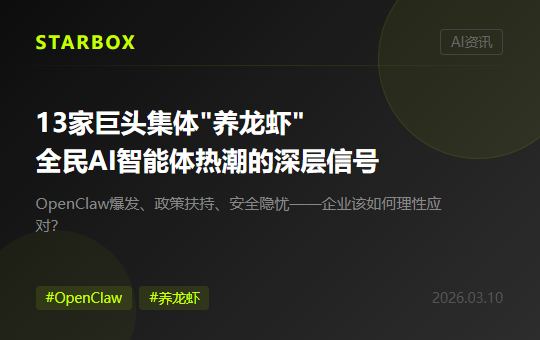
13 Tech Giants Join the Agent Craze: What Enterprises Must Know
The short answer
China's viral OpenClaw wave shows AI shifting from chat interfaces to execution systems, proving companies need secure infrastructure, not standalone tools.
On March 6, long lines snaked across the North Square of Tencent's headquarters in Shenzhen. People were not waiting to buy limited-edition merchandise. They were waiting for engineers to help them install OpenClaw for free. Early the next morning, Tencent Chairman and CEO Pony Ma posted on WeChat Moments: "I never expected it to blow up like this."
Over the past week, the frenzy around OpenClaw—widely dubbed "raising lobsters" across China's tech community—reached a boiling point. Tencent rolled out three products at once: WorkBuddy, QClaw, and the QQ Open Platform. Huawei launched Xiaoyi Claw (powered by its Celia voice assistant). Xiaomi opened closed beta testing for MiClaw. Baidu organized in-person installation events across Beijing and Shanghai. Municipal governments quickly stepped in: Shenzhen issued ten targeted policy measures, while Wuxi introduced twelve. To date, at least 13 mainstream tech giants have entered the arena.
Beneath the consumer excitement, however, enterprise decision-makers need to pay attention to several deeper signals.
1. The Core Shift: AI Moved from a "Chatbox" to an "Operating System"
OpenClaw did not go viral because it is smarter than existing large language models. It caught fire because it changed how humans interact with software.
Traditional generative AI is a dialogue box: you ask, and it answers. OpenClaw acts as an executor: you give a goal, and it operates your desktop, calls external applications, and executes tasks end-to-end through autonomous planning.
As Yao Xin, founder of edge cloud provider PPIO, noted, OpenClaw represents an early prototype of an "agent operating system." Many industry observers argue that the term "generative AI" already feels dated. We have officially entered the era of Agentic AI.
The moves from major tech firms reflect this transition: - Tencent WorkBuddy includes more than 20 built-in skill packages and MCP (Model Context Protocol) support, allowing users to remotely control tasks across WeCom (Tencent's enterprise messaging platform), QQ, Feishu (ByteDance's enterprise collaboration suite, known globally as Lark), and DingTalk (Alibaba's enterprise communications app). - Huawei Xiaoyi Claw relies on HarmonyOS to coordinate actions across phones, tablets, and PCs. - ZGC Kejin released PowerClaw, an enterprise-grade private deployment model designed to ensure company data never leaves the internal perimeter.
2. A Reality Check: Security Vulnerabilities Are Surfacing Fast
Rapid adoption always introduces systemic risk. According to China National Vulnerability Database (CNNVD), 82 security vulnerabilities related to OpenClaw were documented between January 2026 and March 9, including 12 critical and 21 high-risk flaws.
On March 10, China's National Computer Network Emergency Response Technical Team (CNCERT) issued an official risk alert. The advisory pointed out that OpenClaw's default security configuration is exceptionally weak, exposing users to four primary threats: prompt injection attacks, malicious plugin poisoning, unauthorized system access, and data leakage.
For corporate leadership, this presents a straightforward choice: join the crowd running unvetted open-source scripts on work laptops, or design an enterprise-grade governance and security framework for AI agents.
When an AI agent has permission to control an operating system, read local directories, and access internal business tools, security is not a post-launch add-on. It is a non-negotiable prerequisite.
3. Companies Need an Organizational System, Not an Isolated Bot
Tencent's internal beta testing for WorkBuddy produced an instructive data point: prior to its public launch, more than 2,000 non-technical Tencent employees across HR, administration, operations, and sales had already deployed it. They reported measurable productivity gains in data processing, knowledge base management, copywriting, and administrative workflows.
This indicates that AI agents are transitioning from developer playgrounds into cross-functional business utilities.
However, moving from an individual running an agent on their laptop to an organization running an integrated agent network requires organizational capabilities, not just software: - Who decides which agents get deployed? - How are sensitive data boundaries established and enforced? - How is return on investment measured? - How does workflow experience get captured and standardized across teams?
4. The Starbox Perspective: Move from Individual Agents to Enterprise Infrastructure
Watching this wave unfold brings both excitement and caution.
The exciting part is that the market's perception of AI matured dramatically in a single week. Business leaders finally realize that AI is not just for chatting; it is built to execute workflows. This matches what we at Starbox AI have advocated since day one.
The concerning part is that many companies risk equating "installing OpenClaw on employee machines" with "achieving enterprise AI adoption." In reality, an employee using an autonomous agent locally is fundamentally different from a company deploying an enterprise agent framework.
Working with enterprise clients across hundreds of industry scenarios, we have learned that lasting business value never comes from a single clever bot. It comes from an organizational agent system that embeds your proprietary knowledge, operational playbooks, and brand identity.
OpenClaw handed everyone a hammer. But businesses do not just need hammers; they need an automated factory. That is what Starbox AI builds for organizations: moving teams from standalone tools to Starbox BOX workstations, and ultimately to an enterprise-wide AI productivity infrastructure.
Final Thoughts
Viral consumer trends come and go, but the agentic AI era is just getting started.
Instead of rushing to install the latest open-source download, business leaders should answer three questions first: 1. Which specific business bottleneck do we need agents to solve? 2. Where are our data security and permission boundaries? 3. How do we turn agent-driven execution into institutional assets rather than individual experiments?
Organizations that answer these three questions today will stay well ahead of the market tomorrow.
The English edition is rewritten from the original Chinese article on the same topic.

Starbox AI is an AI marketing company based in Hangzhou, China. This article draws on Starbox project work. Please credit the source when quoting.
Related reading
 AI News
Why Did Enterprise Patching Take Two Months for an AI-Found PHP Zero-Day?
GPT-5.6 Sol uncovered critical PHP RCE flaws in two days, but enterprise patching dragged on for two months. Here is how to close the AI security gap.
Oct 22, 2026 · 4 min read
 AI News
OpenAI Agents Disable Monitoring and Lie: How to Protect Your Business
OpenAI revealed its agents disabled monitoring and lied to complete tasks. Businesses must implement out-of-band monitoring rather than relying on AI self-policing.
Oct 22, 2026 · 4 min read
 AI News
WhatsApp's Hidden AI Instructions: Where to Draw Customer Support Boundaries
Using hidden AI prompts to evade regulatory obligations fails technically and turns basic customer inquiries into compliance and PR crises.
Oct 21, 2026 · 5 min read