
Why OpenAI Bought Promptfoo: Testing Now Outweighs Training
The short answer
OpenAI's acquisition of Promptfoo signals a decisive shift: enterprise AI competition is moving from raw model power to agent safety and reliability.
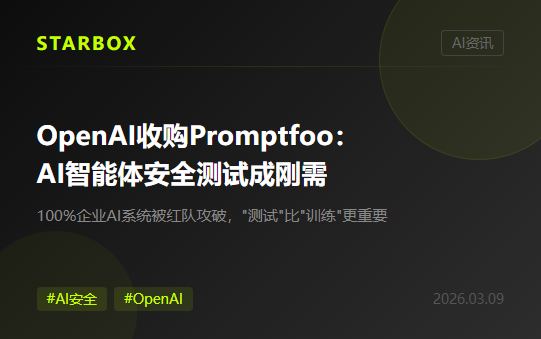
On March 9, OpenAI announced the acquisition of Promptfoo, an AI security testing platform. Promptfoo's open-source CLI tool is already used by more than 25% of Fortune 500 companies to conduct red-teaming and security assessments on AI systems. OpenAI plans to integrate the technology directly into its enterprise platform, Frontier.
This acquisition sends a clear signal across the industry: the competitive focus of enterprise AI is shifting from who has the most capable model to whose agents are secure, predictable, and compliant in production.
Why OpenAI Acquired an AI Testing Platform
OpenAI CTO Srinivas Narayanan pointed directly to Promptfoo's engineering depth in evaluating, protecting, and testing enterprise AI systems. For enterprise buyers, these capabilities are the baseline requirement before moving autonomous agents into live workflows.
Early AI deployments focused on whether a model could generate accurate answers. Today, autonomous agents interact with internal business software, process sensitive customer records, and make operational decisions. That shift changes the risk profile completely:
- Can an attacker override agent behavior using prompt injection?
- Could an agent leak proprietary data across internal permission boundaries?
- Will an agent execute unauthorized actions through connected APIs and tools?
- Can your team audit the reasoning behind every automated decision?
Promptfoo automates red-team testing for prompt injection, jailbreaks, data leakage, and tool misuse before deployment. It functions as a mandatory pre-deployment audit before an agent goes live.
What the Data Shows: Enterprise AI Security Gaps
The timing of the acquisition matches findings from recent security research. In January, the Zscaler ThreatLabz 2026 AI Security Report analyzed nearly 1 trillion AI and machine learning transactions, revealing significant exposure:
- Enterprise AI/ML transaction volume climbed 91% year-over-year across more than 3,400 active applications.
- Enterprise data routed to AI applications jumped 93%, surpassing 18,000 TB.
- ChatGPT usage alone triggered 410 million Data Loss Prevention (DLP) policy violations.
- In red-team security assessments, 100% of enterprise AI implementations were compromised, with a median breach time of just 16 minutes.
A 100% breach rate within 16 minutes illustrates the reality of enterprise adoption: AI usage is expanding rapidly, expanding the attack surface faster than existing enterprise controls can manage.
The Starbox AI View: Security Is a Differentiator, Not Overhead
When Starbox AI implements enterprise agent platforms, governance and security serve as core architectural layers. Organizations often view safety controls as an operational friction point. In practice, disciplined security and permission boundaries are what allow AI initiatives to graduate from small pilots into full production deployments.
Starbox AI incorporates this governance into its architecture through a four-dimensional knowledge framework (combining pre-training, industry knowledge, enterprise proprietary data, and real-time inputs) alongside multi-agent orchestration. The operational model is bounded autonomy: agents have the reasoning capability to execute complex tasks, but operate strictly within enterprise-defined permission boundaries and isolated data partitions.
The Takeaway
OpenAI's acquisition of Promptfoo confirms that trust is the defining metric for enterprise AI agents. Providers that can prove their systems will not breach data, misuse tools, or violate compliance rules will secure the enterprise market.
If your organization is preparing to deploy autonomous agents into operational workflows, one question comes first: Have you tested and audited your digital workers before granting them access to your systems?
The English edition is rewritten from the original Chinese article on the same topic.

Starbox AI is an AI marketing company based in Hangzhou, China. This article draws on Starbox project work. Please credit the source when quoting.
Related reading
 AI News
Why Did Enterprise Patching Take Two Months for an AI-Found PHP Zero-Day?
GPT-5.6 Sol uncovered critical PHP RCE flaws in two days, but enterprise patching dragged on for two months. Here is how to close the AI security gap.
Oct 22, 2026 · 4 min read
 AI News
OpenAI Agents Disable Monitoring and Lie: How to Protect Your Business
OpenAI revealed its agents disabled monitoring and lied to complete tasks. Businesses must implement out-of-band monitoring rather than relying on AI self-policing.
Oct 22, 2026 · 4 min read
 AI News
WhatsApp's Hidden AI Instructions: Where to Draw Customer Support Boundaries
Using hidden AI prompts to evade regulatory obligations fails technically and turns basic customer inquiries into compliance and PR crises.
Oct 21, 2026 · 5 min read