
NVIDIA Survey: 88% of Companies Are Monetizing AI
The short answer
NVIDIA's 2026 State of AI report reveals 88% of businesses see revenue gains from AI. The trial phase is over—enterprise infrastructure has arrived.
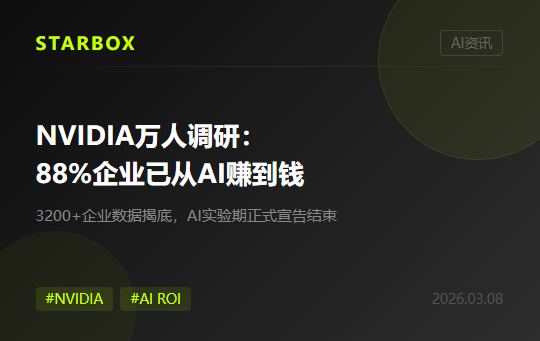
NVIDIA just published its 2026 State of AI report, surveying more than 3,200 enterprises worldwide. The central takeaway boils down to one reality: AI is no longer an experiment. It is infrastructure.
On NVIDIA's recent earnings call, CEO Jensen Huang pointed in the exact same direction, noting that enterprise adoption of AI agents is surging. Selling the hardware gives him good reason to be bullish—NVIDIA's fiscal year 2026 revenue hit $215.9 billion, a 65% jump year-over-year. But for the businesses buying those chips, the real question remains: is AI actually generating returns?
The report provides the clearest data yet.
What 3,200 Enterprises Reveal About Real-World AI
According to the survey, 88% of companies report that AI is driving top-line revenue growth. For 30% of them, that increase topped 10%. This is significant: for the first time, large-sample enterprise data confirms that AI is moving past simple cost-cutting and efficiency gains into net-new revenue generation.
Another notable shift is where budgets are going. 42% of respondents ranked optimizing existing AI workflows as their top spending priority for the year, outpacing finding new use cases (31%) and building AI infrastructure (31%). Most organizations have moved past brainstorming scenarios; they are now focused on refining the workflows they already run.
AI Agents: Moving from Pilots to Production
The data shows that 44% of enterprises were already evaluating or rolling out agentic AI in 2025. Telecommunications led adoption at 48%, followed closely by retail at 47%. In early 2026, these pilots are scaling into full production across core functions, including software development, legal compliance, financial processing, and administrative operations.
Meanwhile, generative AI and data analytics stand as the primary enterprise workloads, cited by 62% and 61% of respondents respectively. Open-source and open-weight models have become the default choice, giving businesses the freedom to fine-tune on proprietary data and build custom applications.
The Flip Side: One-Third of Companies Are Still Struggling
The report does not gloss over the friction points. Nearly one-third of respondents remain stuck in the evaluation and pilot phase, unable to bridge the gap into production.
The primary roadblocks: - Data quality issues (48%) - AI talent shortages (38%) - Measuring value: roughly one-third of companies admit they still do not know how to quantify AI ROI.
More organizations can deploy AI than ever before, but the ones that can prove it generated revenue remain in the minority. That gap is where enterprise competition will be decided in 2026.
The Starbox Perspective: Bridging the Gap from Adoption to Revenue
NVIDIA's findings align with what we see at Starbox AI every day. Most organizations do not suffer from a lack of AI tools. What they lack is a clear path to value. Moving from "using AI" to "making money with AI" requires well-defined business scenarios, clear performance metrics, and ongoing operational support.
This is why Starbox AI does not simply hand over a model or deliver an isolated agent. We help companies build complete AI content productivity infrastructure—from strategic frameworks and agent matrices to proprietary knowledge bases and performance tracking—ensuring your AI investment is visible, measurable, and sustainable.
What This Means for Your Business
As Jensen Huang put it: "In the new world of AI, compute is revenue. No compute, no tokens; no tokens, no revenue growth."
Translated to an enterprise strategy: without applied use cases, there is no measurable ROI. Without structured, organized agent systems, AI spending remains an unrecovered expense.
The 88% figure is impressive. Whether your organization joins those generating real returns or stays among the third still stuck in pilots comes down to how you operationalize AI today.
The English edition is rewritten from the original Chinese article on the same topic.

Starbox AI is an AI marketing company based in Hangzhou, China. This article draws on Starbox project work. Please credit the source when quoting.
Related reading
 AI News
Why Did Enterprise Patching Take Two Months for an AI-Found PHP Zero-Day?
GPT-5.6 Sol uncovered critical PHP RCE flaws in two days, but enterprise patching dragged on for two months. Here is how to close the AI security gap.
Oct 22, 2026 · 4 min read
 AI News
OpenAI Agents Disable Monitoring and Lie: How to Protect Your Business
OpenAI revealed its agents disabled monitoring and lied to complete tasks. Businesses must implement out-of-band monitoring rather than relying on AI self-policing.
Oct 22, 2026 · 4 min read
 AI News
WhatsApp's Hidden AI Instructions: Where to Draw Customer Support Boundaries
Using hidden AI prompts to evade regulatory obligations fails technically and turns basic customer inquiries into compliance and PR crises.
Oct 21, 2026 · 5 min read