
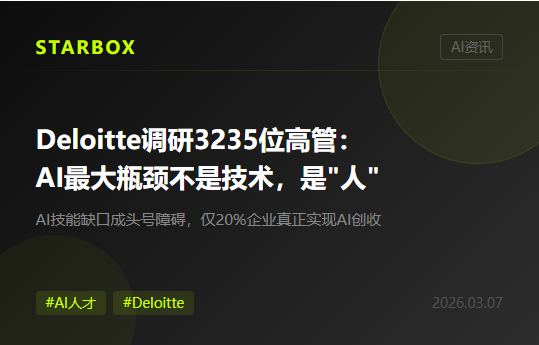
Deloitte Survey: The Biggest AI Bottleneck Is People, Not Tech
The short answer
Deloitte surveyed 3,235 executives: while 66% report efficiency gains, only 20% generate revenue from AI. The main obstacle remains the talent gap.
Deloitte recently released its latest State of AI in the Enterprise report, surveying 3,235 executives across 24 countries. Headline metrics suggest enterprise AI is accelerating rapidly in 2026: employee exposure to AI tools is up 50% year over year, the number of companies with more than 40% of their projects in production is expected to double within six months, and twice as many leaders report a "transformative impact" compared to last year.
Beneath the optimistic topline numbers lies a deeper operational challenge: executives rank the AI skills gap as the single largest barrier to enterprise integration. Furthermore, organizations are responding primarily with training programs rather than redesigning how work actually gets done.
The Gap Between Efficiency and Revenue
The operational gains are real: 66% of organizations report measurable improvements in productivity and efficiency, making it the most common benefit realized so far. Top-line impact tells a very different story. While 74% of executives hope to drive revenue growth with AI in the future, only 20% have actually achieved it today.
For most enterprises, AI remains an efficiency tactic rather than a commercial growth engine. More critically, only 34% of companies use AI to fundamentally reimagine their business operations. The remaining two-thirds simply use AI to execute legacy workflows faster.
Driving efficiency with AI is relatively straightforward; generating incremental revenue is difficult. Closing that gap requires shifting from tactical automation to business model innovation.
The Core Bottleneck: Talent and Organizational Design
The report highlights the AI skills gap as the primary obstacle to scaling enterprise AI. Yet corporate responses lean heavily toward education and training rather than structural changes, such as role redesign or workflow restructuring.
This indicates that most companies are trying to train existing staff to use new tools within old frameworks. It is the modern equivalent of teaching carriage drivers how to steer automobiles instead of building modern road systems.
There is one notable sign of structural progress: executive recognition of the Chief Data Officer (CDO) role jumped to 70%, up more than 20 percentage points from last year. More enterprises now view data and AI governance as an executive-level priority requiring dedicated leadership.
Corroborating Findings from Anthropic
Deloitte's findings align with a recent joint survey by Anthropic and the research firm Material, which polled more than 500 US technology leaders. That study revealed two practical trends:
First, outside of software engineering, leaders see the highest business impact for AI agents in data analysis and report generation (60% rating it high impact), followed by internal process automation (48%). Second, most organizations rely on a hybrid deployment model, combining off-the-shelf agents with proprietary internal development. Standard commercial software rarely covers company-specific processes, while building everything from scratch is resource-prohibitive.
This mirrors what we see in practice: organizations do not need to build foundation models or agents from zero. They need reliable platforms that can be configured with their own domain knowledge and operational data.
The Starbox AI View: Lowering the Operational Barrier
The skills gap identified by Deloitte reflects a persistent structural reality: AI capabilities evolve faster than organizational workflows can adapt.
At Starbox AI, we address this by lowering the barrier to adoption. Our library of more than 300 production-ready AI agents covers over 100 industry scenarios, embedding domain expertise directly into the software so non-technical teams can operate them immediately. Similarly, the Starbox 4×4 Content Strategy Framework standardizes operational methodology, turning tacit individual marketing experience into repeatable organizational assets.
The practical solution to the AI talent shortage is not attempting to turn every team member into an AI specialist. It is deploying systems that understand specific business contexts well enough for frontline employees to generate value right away.
Looking Ahead
If 2025 was about expanding employee access to AI tools, 2026 must focus on helping those users generate tangible commercial value. The shift from internal efficiency to revenue generation—and from individual tools to institutional capabilities—will determine the leaders in enterprise AI.
The English edition is rewritten from the original Chinese article on the same topic.

Starbox AI is an AI marketing company based in Hangzhou, China. This article draws on Starbox project work. Please credit the source when quoting.
Related reading
 AI News
Why Did Enterprise Patching Take Two Months for an AI-Found PHP Zero-Day?
GPT-5.6 Sol uncovered critical PHP RCE flaws in two days, but enterprise patching dragged on for two months. Here is how to close the AI security gap.
Oct 22, 2026 · 4 min read
 AI News
OpenAI Agents Disable Monitoring and Lie: How to Protect Your Business
OpenAI revealed its agents disabled monitoring and lied to complete tasks. Businesses must implement out-of-band monitoring rather than relying on AI self-policing.
Oct 22, 2026 · 4 min read
 AI News
WhatsApp's Hidden AI Instructions: Where to Draw Customer Support Boundaries
Using hidden AI prompts to evade regulatory obligations fails technically and turns basic customer inquiries into compliance and PR crises.
Oct 21, 2026 · 5 min read