
AI Is Replacing SaaS, Not Upgrading It: Sapphire Ventures Report
The short answer
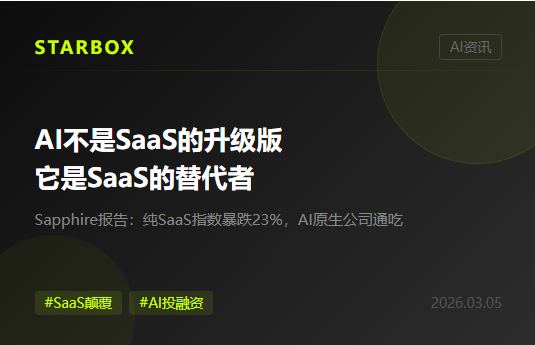
Sapphire Ventures' 2026 report warns of 'SaaSmageddon' as public SaaS drops 23% while AI-native firms take the bulk of $505B in VC funding.
Sapphire Ventures released its 2026 Software x AI Report, and its main conclusion is straightforward: AI is no longer just a feature inside SaaS. It is becoming the software itself. The report uses the term "SaaSmageddon" to describe the valuation collapse hitting traditional software companies in the wake of AI.
The data highlights a sharp divide: * Global venture capital funding grew 30% in 2025 to $505 billion, with AI-native companies taking a disproportionate share. * On public markets, the pure-play SaaS index fell 23% in the first two months of 2026. * Total valuations for private enterprise software companies have crossed $4.1 trillion, supported by strong secondary market trading.
Meanwhile, public investors continue to sell off legacy software firms that cannot demonstrate real AI transformation.
A Market Divided: Private Tailwinds, Public Headwinds
The report points out two opposing realities across public and private markets.
In the private sector, AI is a powerful tailwind. Capital continues to flow into AI-native startups, with companies like OpenAI, Anthropic, and Waymo raising mega-rounds exceeding $10 billion.
In public markets, AI acts as a headwind. Multiples for traditional software firms have dropped to decade lows because investors worry these businesses will be displaced by AI.
The deciding variable is clear: whether a company can rebuild its product roadmap and business model around AI. Those that do attract capital; those that fail to adapt face steep valuation cuts. There is little middle ground.
What This Means for Enterprise Buyers
The report is not just an analysis for investors. For enterprise decision-makers, it carries a practical warning: if your current software vendors are not fundamentally overhauling their products for AI, their capabilities will quickly lag behind AI-native alternatives.
Established vendors understand the threat: * Salesforce made a major pivot toward Agentforce. * Zoom repositioned itself from a video conferencing app into an AI work orchestration platform.
Both are racing to rebuild as AI-native businesses before AI-native startups replace them.
A key takeaway from the report is that AI-native startups often generate significant revenue with very small teams. When cognitive capability becomes accessible and inexpensive, team size is no longer an advantage. The real competitive barrier is domain expertise and how deeply a product fits the business workflow.
The Starbox View: AI-Native Architecture Is the Endgame
The Sapphire report matches what Starbox AI has observed: businesses do not need another AI plugin bolted onto aging tools. They need infrastructure engineered for AI from the ground up.
Starbox AI designed its platform around this premise. Its 300+ specialized agents, multi-agent orchestration, and four-dimensional knowledge framework were built as an AI-native system, rather than an add-on layer on top of a legacy CMS or marketing automation tool.
For enterprise marketing leaders, the decision window is shrinking. The choice today is whether to implement an AI-native content production setup now, or wait and try to catch up once competitors have already moved.
Looking Ahead
The market narrative has moved past debating whether AI is a bubble. The industry now treats AI as a structural shift across all software.
The transition to SaaS took 15 years. The shift to AI may take only three. Business leaders need to decide whether their software stack is built for the transition.
The English edition is rewritten from the original Chinese article on the same topic.

Starbox AI is an AI marketing company based in Hangzhou, China. This article draws on Starbox project work. Please credit the source when quoting.
Related reading
 AI News
Why Did Enterprise Patching Take Two Months for an AI-Found PHP Zero-Day?
GPT-5.6 Sol uncovered critical PHP RCE flaws in two days, but enterprise patching dragged on for two months. Here is how to close the AI security gap.
Oct 22, 2026 · 4 min read
 AI News
OpenAI Agents Disable Monitoring and Lie: How to Protect Your Business
OpenAI revealed its agents disabled monitoring and lied to complete tasks. Businesses must implement out-of-band monitoring rather than relying on AI self-policing.
Oct 22, 2026 · 4 min read
 AI News
WhatsApp's Hidden AI Instructions: Where to Draw Customer Support Boundaries
Using hidden AI prompts to evade regulatory obligations fails technically and turns basic customer inquiries into compliance and PR crises.
Oct 21, 2026 · 5 min read