
How to Spot AI-Generated Writing: 5 Clear Signs

The short answer
Vague claims, unverifiable data, and empty conclusions give AI writing away. Here are five structural flaws to look for and fix.
"This sounds too much like AI."
If you review content regularly, you hear this feedback all the time. But ask the reviewer what specifically is wrong or why a sentence fails, and the answer is usually vague: "It just doesn't sound human."
That instinct might be right, but it is impossible to edit against. Hand the same draft to another editor, and you will likely get completely different feedback.
A piece feels "like AI" not because of a few specific buzzwords, but because several recurring weaknesses run through the copy: abstract phrasing, unsupported conclusions, rigid structures, unverifiable evidence, and conclusions that accomplish nothing.
Break those issues down one by one, and it becomes obvious what needs to change and how to fix it.
1. Sentences Lack Clear Actors and Concrete Actions
"Enterprises must prioritize content quality."
"We need to embrace change."
These sentences are grammatically fine, but they say almost nothing. Which enterprises? Who is responsible for the work? Under what conditions, and what should they actually do?
Readers cannot find themselves in the text. They have no way of knowing whether the advice applies to them or how to execute it.
When reviewing a draft, ask three questions:
- Who does this?
- Under what conditions?
- What specific action do they take?
If a sentence cannot answer those questions, it lacks a subject and a real-world scenario.
When editing, do not add more filler adjectives like "comprehensive," "efficient," or "continuous." Add concrete steps instead. For instance, rather than writing "improve content efficiency," write:
Before planning next week's content calendar, the marketing lead reviews recent sales notes, identifies the questions prospects ask repeatedly, and turns those questions into draft topics.
The revision is not fancier, but the reader can see who owns the task, when it happens, and what step comes first.

2. The Conclusion Is Stated, but the Evidence Never Appears
"The key is not A, but B."
"What truly matters is..."
There is nothing wrong with these phrasing patterns. The problem arises when an article drops a conclusion and immediately jumps to the next one, without explaining why, offering facts, walking through the logic, or naming the conditions required for the claim to hold true.
The copy sounds confident, but it skips the reasoning the reader actually needs.
The test is simple: whenever you see a definitive claim, ask "Why?" If the next sentence or paragraph does not answer that question, the point is unfinished.
You do not need to delete the conclusion. Instead, define its boundaries: under what circumstances is B better than A? What data or logic supports this view? What goes wrong if those conditions are not met?
Readers can only evaluate an argument—and decide if it applies to their situation—when they see where the conclusion came from.
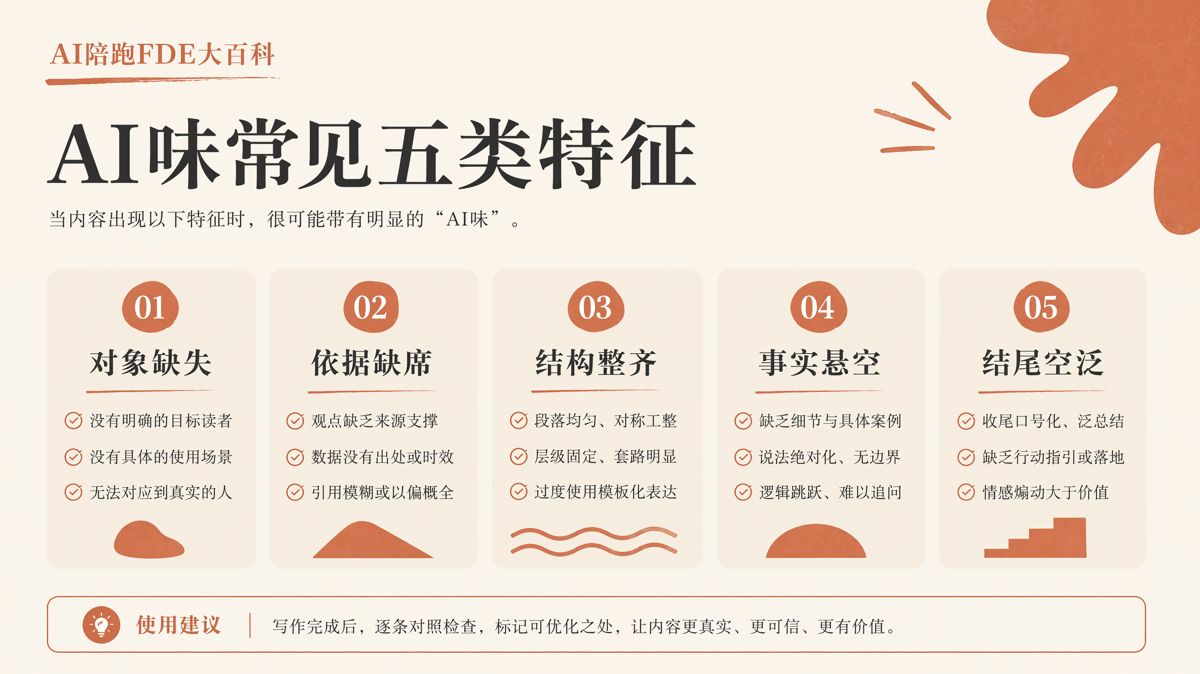
3. The Structure Is Symmetrical, but the Argument Never Advances
Every subheading is exactly the same length. Every section opens with "First, second, finally." Each paragraph follows an identical rhythm: summarize, explain, summarize again.
The piece looks neat, but it reads like a machine assembled it.
The issue is not organization; it is using a visual template to mask a lack of progression. When consecutive paragraphs share the exact same opening cadence and repeat high-level summaries, readers get repetition rather than new information.
To test this, read only the first sentence of each paragraph. If you can swap their order without breaking the logic of the piece, the sections lack a sequential relationship. The argument is not moving forward.
When editing, keep the logical hierarchy, but let the content dictate the length and rhythm of each paragraph. Expand where an explanation requires detail, and cut short where the point is already clear. Include an example when necessary, and specify boundaries where relevant.
4. Numbers and Case Studies Look Specific but Cannot Be Verified
Placing figures into a draft does not automatically make it trustworthy.
If a statistic does not state where it came from, when it was gathered, who was surveyed, or how it was calculated, readers cannot verify it. They have no way of knowing whether the number applies to their reality.
The same rule applies to case studies. The more detailed the character names, company profiles, and outcomes are, the more critical it is that they represent real events. Invented or unverifiable details do not build credibility.
There are only two reliable ways to handle this material:
- If it can be verified, cite the source, date, sample scope, calculation method, and applicable context.
- If it cannot be verified, delete it, or explicitly state that it is a hypothetical scenario based on common experience, not a real case study.
External content does not need dozens of data points to demonstrate expertise. Being transparent about what is verified data and what is simply an illustrative example builds far more trust than stacking unverified claims.
5. The Ending Only Offers Platitudes Instead of Next Steps
"Change begins the moment you start."
"The future has already arrived."
These endings sound inspirational, but they fail the primary job of a conclusion: telling the reader what to do next.
An effective ending should do at least one of three things: restate the central insight, provide an immediate action the reader can take, or remind them of a prerequisite they need to verify first.
For example, if an article covers how to build a consistent pipeline of content topics, the conclusion could instruct the reader to pull their team's last ten customer inquiries and flag recurring themes. That gives the reader something concrete to execute immediately, which is far more valuable than an empty call to "stay consistent."
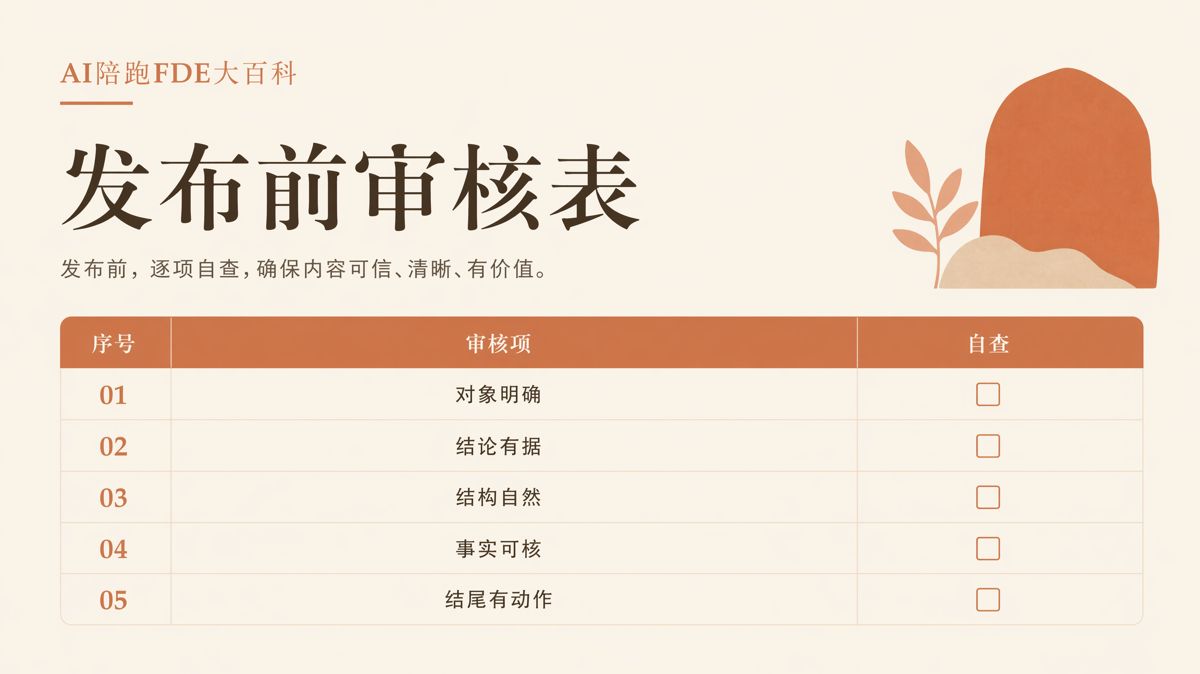
Pre-Publishing Checklist
| Area | Question to Ask | How to Fix |
|---|---|---|
| Clear subjects and actions | Who does what, and under what conditions? | Add specific roles, scenarios, and actionable steps. |
| Supported conclusions | If the reader asks "Why?", does the next sentence answer it? | Add facts, logical steps, prerequisites, or potential risks. |
| Natural structure | Do adjacent paragraphs use the exact same cadence and format? | Remove redundant summaries; adjust paragraph lengths to match the content. |
| Verifiable facts | Do numbers and cases include sources, dates, scope, and context? | Fill in missing citations; remove unverifiable claims or label them as hypothetical. |
| Actionable ending | Does the reader know their next step after reading? | Provide a concrete action or highlight a condition they need to confirm. |
If a draft fails on two or more of these points, hold off on publishing. The fix is rarely about tweaking a few robotic words; it usually means the evidence, the reasoning, or the structure needs deeper work.
Stripping the "AI flavor" out of an article does not mean dressing it up with fancy prose. It means making sure every sentence serves a clear purpose: delivering factual information, explaining an argument, or showing the reader what action to take next.
Whether a draft was initially written by a human or generated by AI is secondary. What matters is whether the reader can understand it, trust the evidence, and put it to work.
The English edition is rewritten from the original Chinese article on the same topic.

Starbox AI is an AI marketing company based in Hangzhou, China. This article draws on Starbox project work. Please credit the source when quoting.
Related reading
 AI Adoption
Can One AI Operator Really Replace 10 People?
Claims of 10x headcount cuts count generation speed, not QA and rework. Real efficiency measures net pipeline hours saved.
Oct 22, 2026 · 6 min read
 AI Adoption
Bought Basic AI and Seeing Zero ROI? A 4-Step Activation Playbook
Activating entry-level AI is not about model parameters. Turn open chat boxes into defined operational stations with clear inputs, templates, and QA checklists.
Oct 22, 2026 · 6 min read
 AI Adoption
Why One-Click AI Fails at Work: How to Pick Enterprise Agents
One-click AI tools seem easy, but their first-draft accuracy is terrible. Real business ROI requires multi-step workflows with your own knowledge base.
Oct 21, 2026 · 6 min read