
How to Edit AI Drafts Until They Are Ready to Publish

The short answer
A complete AI draft is rarely ready to publish. Here is a practical workflow to turn generic generated copy into concrete, publication-grade content.
Just because an AI-generated draft looks complete does not mean it is ready to publish.
Many teams blame this on "AI sound." But the real problem is rarely just robotic phrasing. The practical issue is that after reading the piece, your audience has learned nothing concrete.
You end up with a rambling opening that takes paragraphs to reach the point, arguments that sound right but offer no way to execute, sentences formatted like identical templates, case studies without sources, and a vague summary at the end. Swapping out a few adjectives does not fix these issues.
To turn AI copy into something you can publish, you cannot just polish the text. You need to inspect four stages: the prompt inputs, the source materials, the generation process, and the final editorial review.
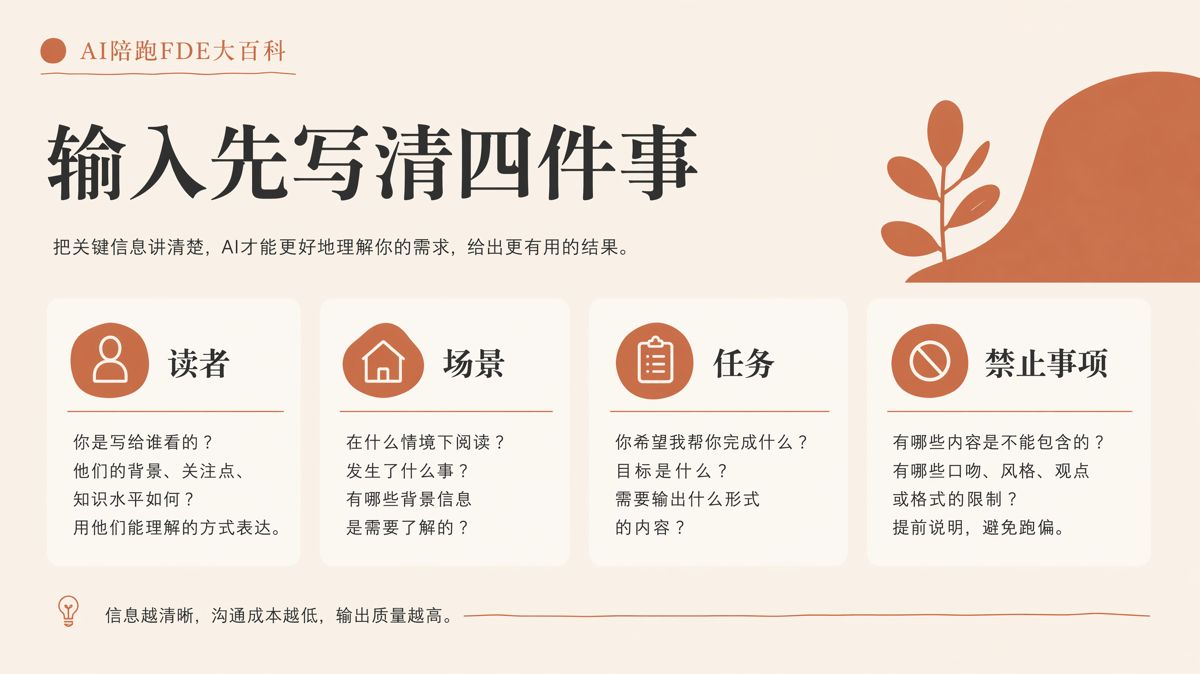
The first step is not polishing—it is clarifying the brief
AI produces empty fluff most often when given only a topic, without a clear audience, context, or goal.
For example, asking an AI to "write an article about using AI for marketing efficiency" gives it nothing to anchor to. It does not know who the reader is, what specific problem they face, or what action they need to take after reading.
A much clearer brief would be: write an article for a marketing director on how to manage editorial calendars when topic ideas dry up. The reader already has raw material and needs to publish weekly. The article should explain how to set up an editorial backlog and how to qualify which ideas to pursue.
The more specific the task, the more the AI focuses on solving a real problem instead of repeating generic advice.
At the same time, set explicit negative constraints:
- Do not include unverified metrics.
- Do not invent unsourced case studies.
- For conclusions that apply only to specific business models, state those prerequisites clearly.
Clarifying boundaries in your inputs cuts down editing time later.
Prompts without raw material still produce hollow drafts
The quality and specificity of an article depend heavily on the materials provided to the model.
Direct quotes from customer inquiries, actual workflow steps, verified client milestones, past articles, and internal glossaries should all go into your source materials. The model's job is to organize, synthesize, and structure that information—not to invent facts when the material runs out.
Organize your source materials into clear tiers:
Separate factual evidence from subjective opinions. For public data, cite the source and date. For internal team experience, state which business scenarios and conditions it applies to.
This distinction lets an editor immediately see where a claim comes from, which points are verified facts, and which are simply team judgment calls.
The cleaner your source material, the easier it is to verify every metric, case study, and conclusion.
Do not expect a single draft to do everything at once
Many teams ask AI to produce a draft that is authoritative, opinionated, adapted for multiple channels, and complete with headlines and image suggestions—all in one prompt. While the request sounds comprehensive, the result is usually mediocre across every dimension.
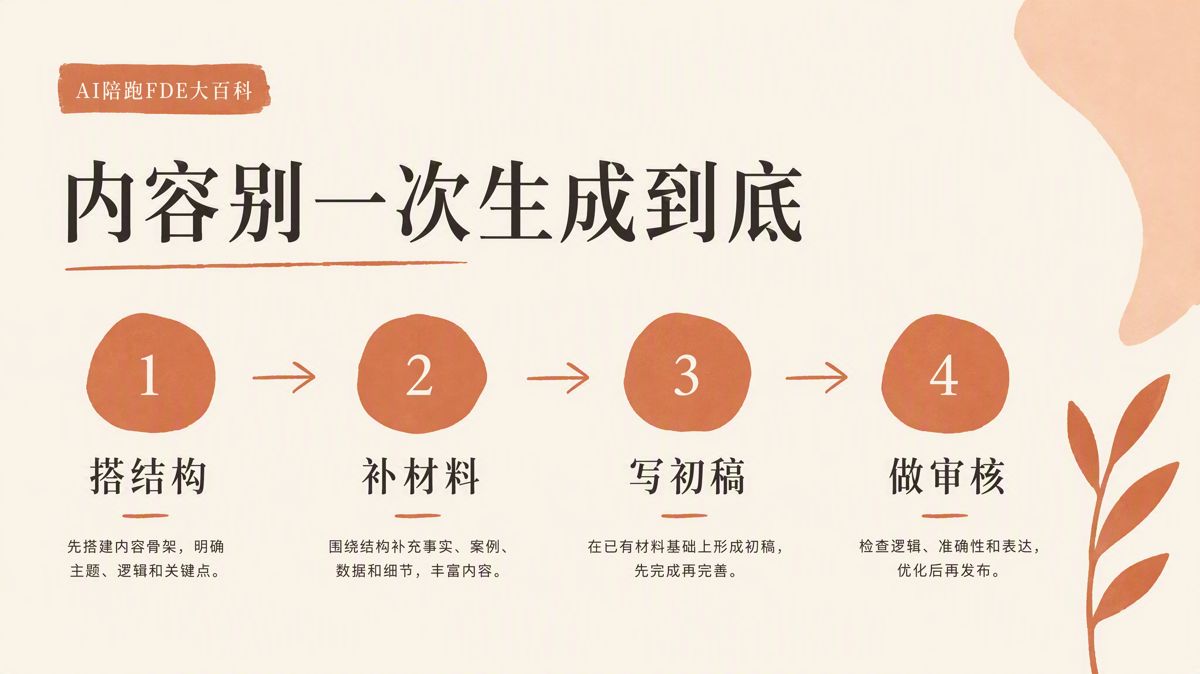
A more reliable approach breaks the writing process into distinct passes:
- Build the outline first: Check only whether the reader's core question is fully addressed.
- Add the source materials: Confirm every section has substantive points to support it.
- Generate the first draft: Review accuracy, logical flow, and pacing.
- Run final polish and fact-checking: Focus strictly on phrasing, tone, and claim verification.
Handling one issue per round allows editors to spot gaps and know exactly what to fix. Mixing structural editing, fact-checking, and line editing together usually leads to rewriting sentences while missing structural flaws.

Five checks to remove the "AI sound"
Rather than relying on intuition to decide whether a draft sounds artificial, run it against a systematic checklist.
1. Check if statements have a specific subject
Phrases like "organizations should pay attention to this" look like takeaways, but they say nothing about who should act, under what conditions, or what specific steps they should take.
When you spot vague phrasing, specify the role, the context, and the required action. If you cannot fill those in, the sentence does not provide useful information and should be cut.
2. Verify comparisons and conclusions
AI drafts frequently introduce dramatic contrasts without explaining the underlying conditions, or state conclusions as universal facts without backing evidence.
Instead of amplifying the tone, add the required conditions and reasoning. If your original materials cannot support the claim, narrow the scope of the conclusion or delete it.
3. Keep one main idea per paragraph
When a single paragraph attempts to answer three different questions, readers lose track of the core takeaway.
Limit each paragraph to one primary point. If an explanation runs long, split it into shorter paragraphs or use descriptive subheadings so readers can quickly navigate to what they need.
4. Audit numbers, case studies, and terminology
Review every metric, example, and technical term. Where did the data come from? Is the case study real? Are industry terms explained clearly?
Remove any claim you cannot verify. If a statement reflects only your team's internal experience, frame it as such rather than presenting it as an established industry standard.
5. Vary sentence rhythm and cadence
Reading a draft aloud is one of the fastest ways to catch mechanical writing.
If several sentences in a row share the same length, syntax, and tone, rewrite a few of them. Expand points that require thorough explanation, and keep direct conclusions brief. Sentences do not need uniform structure to be clear.
Keep updating your editorial checklist
This checklist should evolve based on how your published content performs.
If readers ask the same follow-up questions in comments, the original explanation was likely too vague. If someone questions a metric, your source tracking needs tighter documentation. If a term confuses readers, it should have been defined on its first mention.
Document these reader questions directly in your next editing checklist. Over time, your team builds a repeatable quality standard instead of relying on subjective judgment for every draft.
Before publishing, let subject matter experts sign off
AI can rephrase sentences, catch redundancies, and flag surface-level errors. It cannot confirm operational facts or take responsibility for your company's official point of view.
Before publishing, someone close to the actual business should verify three things:
- Does the workflow described match how the work is actually done?
- Did the piece omit any critical conditions that change the validity of the conclusion?
- Could any phrase be misinterpreted by a reader as a contractual promise or guarantee?
Publication-ready AI content is not content that requires zero human intervention. It is content constrained by clear source material, produced in deliberate stages, and refined with clear review standards—leaving only a few high-judgment decisions for your team.
Putting these standards in writing turns AI drafting from unpredictable guesswork into a reliable, repeatable editorial workflow.
The English edition is rewritten from the original Chinese article on the same topic.

Starbox AI is an AI marketing company based in Hangzhou, China. This article draws on Starbox project work. Please credit the source when quoting.
Related reading
 AI Adoption
Can One AI Operator Really Replace 10 People?
Claims of 10x headcount cuts count generation speed, not QA and rework. Real efficiency measures net pipeline hours saved.
Oct 22, 2026 · 6 min read
 AI Adoption
Bought Basic AI and Seeing Zero ROI? A 4-Step Activation Playbook
Activating entry-level AI is not about model parameters. Turn open chat boxes into defined operational stations with clear inputs, templates, and QA checklists.
Oct 22, 2026 · 6 min read
 AI Adoption
Why One-Click AI Fails at Work: How to Pick Enterprise Agents
One-click AI tools seem easy, but their first-draft accuracy is terrible. Real business ROI requires multi-step workflows with your own knowledge base.
Oct 21, 2026 · 6 min read