
Running Out of Content Ideas? Turn Raw Material into a System

The short answer
Most teams do not lack material. They lack a structured system to turn customer questions, team learnings, and daily workflows into ready-to-write topics.
Many marketing teams have no shortage of raw material, yet every Monday morning starts with the same question: "What are we publishing this week?"
Someone scribbles ten headline ideas on a whiteboard. By the third piece, every post starts to sound identical. As soon as the project lead gets busy with other priorities, the content calendar grinds to a halt.
The root cause is rarely a lack of inspiration. It is that content topics exist only inside individual heads and ad-hoc meetings. Without structured documentation, clear criteria for filtering, or an ongoing intake process, every new writer has to reinvent the wheel.
If you want steady, predictable content output, you must organize scattered notes into a reusable topic backlog.
A Usable Topic Clarifies Six Things
A topic is not a headline.
Writing down "AI for efficiency" is just a vague direction. It does not explain who the piece is for, what problem they face, or what stance the article takes. Anyone assigned to write it will have to guess their way through.
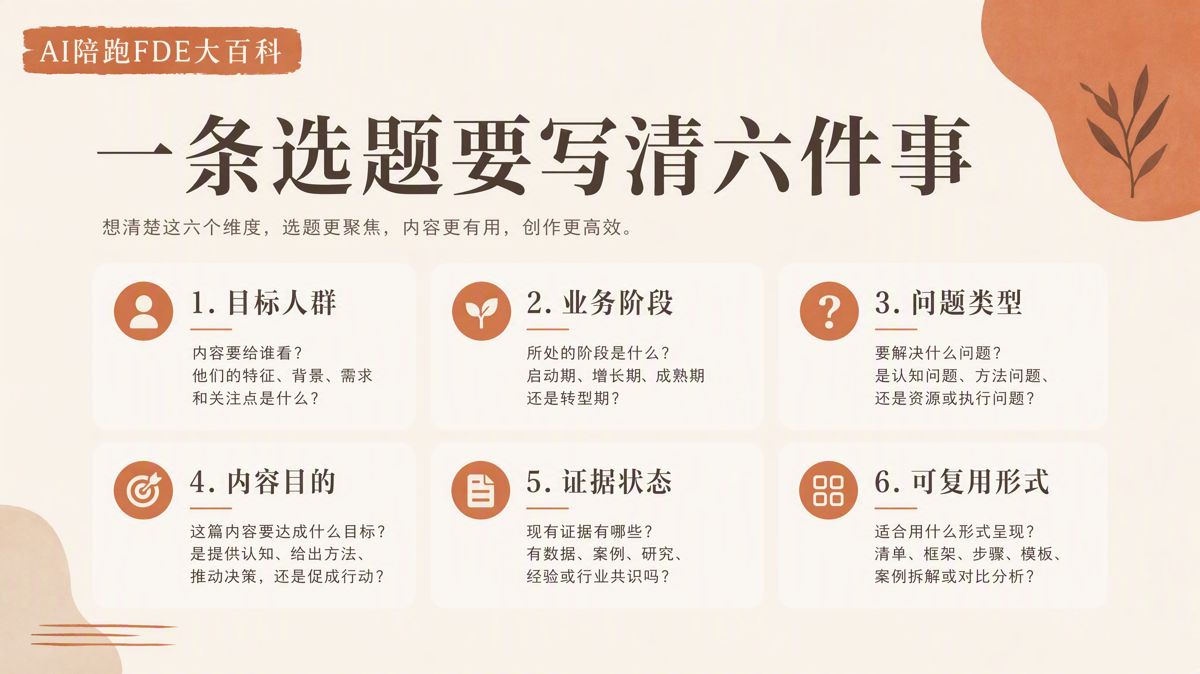
Before a topic enters production, it should define at least six elements:
- Target reader: Who is this written for?
- Scenario: When and where does this issue become urgent for them?
- Problem: Where are they currently stuck?
- Stance: What specific recommendation or viewpoint will this piece deliver?
- Proof: What real-world evidence, data, or operational examples back this claim?
- Format: Does this work best as a long-form breakdown, a short social post, or a live presentation outline?
For example: - Target: Head of Marketing. - Scenario: Struggling to lock in the quarterly editorial calendar. - Problem: Relying entirely on chasing hot industry trends to pick topics. - Stance: Tier your customer questions by buyer stage before deciding publish frequency.
Once recorded with this level of detail, the topic is no longer an isolated title. It can be drafted as an in-depth guide, adapted into a short post, or reused when a similar project comes up later.
Group Everyday Material into Four Buckets
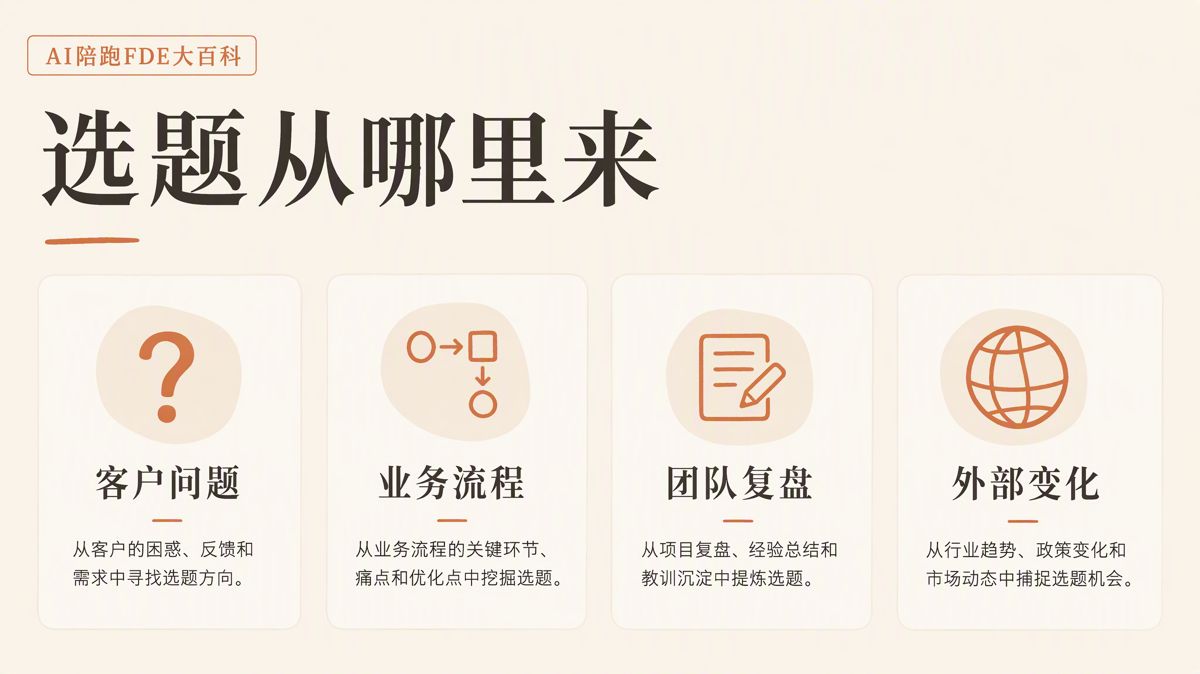
Topics should not come from brainstorming sessions alone. Sales conversations, client delivery, and internal debriefs generate a steady stream of insights. Your job is to collect them continuously into four core categories:
1. Customer Questions
Verbatim questions pulled from sales calls, discovery notes, and customer support tickets should always take priority. These come from live interactions and reflect genuine friction far better than internal assumptions.
2. Business Workflows
Map out the full buyer journey step by step: discovering a need, evaluating options, making a decision, adopting the product, and renewing. Every step breaks down into common confusions, frequent mistakes, and step-by-step checklists.
3. Team Experience
Lessons from project post-mortems, past implementation mistakes, and operational fixes make compelling content. Concrete internal experience is far more credible than generic industry commentary.
4. External Shifts
Industry policy changes, platform updates, and third-party research reports can also spark topics. However, avoid clipping a single sentence without adding context.
For every entry, always log the original source and date. That way, your team can easily tell whether an idea is backed by real customer conversations or an unverified internal hypothesis, while outdated regulatory or platform info can be replaced promptly.
Tag Your Topics so You Can Filter Them
Once raw material enters your backlog, add structured tags so team members can search and filter with clear intent. Every topic candidate should be labeled by:
- Target persona
- Buyer journey stage
- Problem type
- Content objective
- Proof status
- Reusable content formats
Problem types can be categorized into awareness, methodology, vendor comparison, risk reduction, or case studies. Objectives can include lead generation, building trust, product adoption, or customer retention.
These tags are not meant to make your spreadsheet complicated. They give you a systematic way to filter based on current business needs.
If this week's priority is addressing buyer objections before a contract sign-off, filter by "decision stage" and "risk reduction." If next month calls for short video scripts, filter by topics flagged as suitable for spoken delivery.
Without tags, a topic backlog quickly turns into an unmanageable to-do list where good ideas get buried.
Give Topics Lifecycle Stages and an Archive Rule
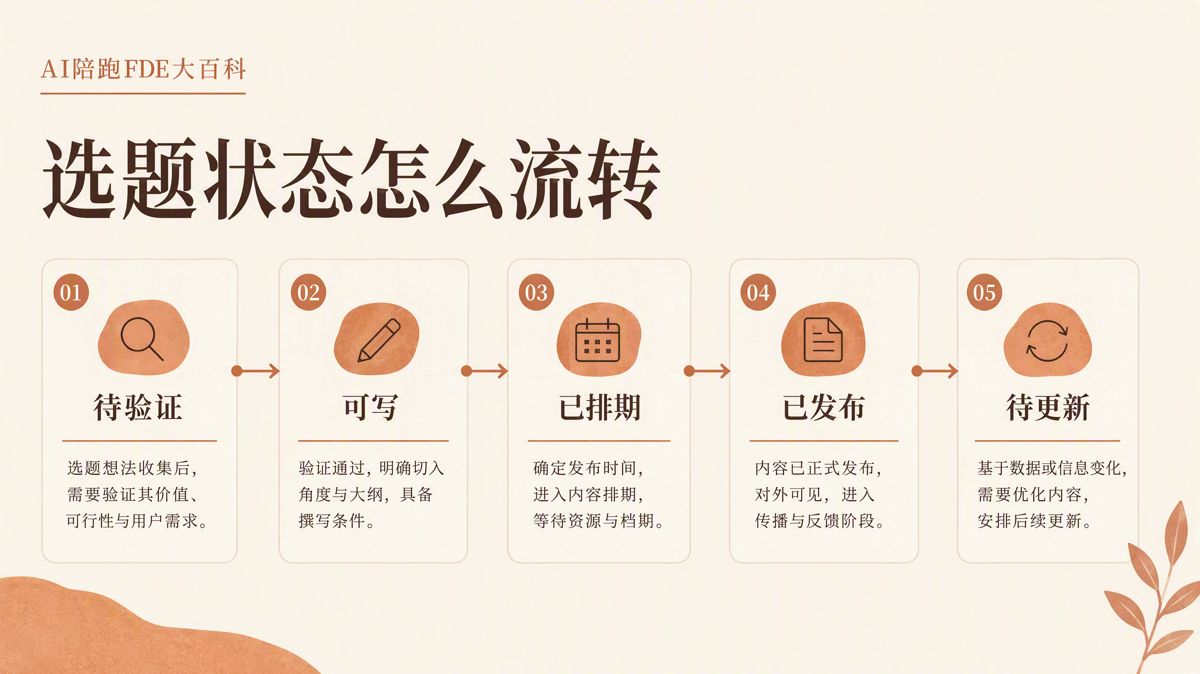
Topics do not end once they are jotted down. Track them across five distinct stages:
- Needs Validation: Requires an exact customer quote or external data source before moving forward.
- Ready to Draft: The core stance, angle, and outline are set.
- Scheduled: Assigned to an owner and on the editorial calendar.
- Published: Live across designated distribution channels.
- Needs Update: Log reader feedback and performance metrics to guide future revisions.
Topics should not stay in the backlog forever. If a topic sits untouched for three months, has no new proof to support it, and cannot be reframed from a fresh angle, archive it. Do not let dead ideas crowd your pipeline.
The goal of a content system is not to hoard as many ideas as possible. It is to ensure that on any given day, your team can pull verified, high-relevance topics aligned with current business goals.
Run Three Weekly Habits
To keep this topic engine running smoothly, embed three recurring actions into your team's weekly routine:
- Weekly batch collection: Spend dedicated time routing new customer chat logs, project post-mortems, and market updates into their respective source categories.
- Weekly selection: Filter the backlog against next week's distribution goals to pick the topics entering production.
- Post-publish logging: Feed performance numbers and reader comments back into the original topic card to inform future updates and spinoffs.
Content leads only need to review three questions each week: Which customer questions keep resurfacing? Which stage of the buyer journey lacks coverage? Which older topics need a refresh?
When every topic has a clear audience, verified proof, structured tags, and an active status, your content pipeline will not dry up when someone takes time off or a trending topic fades.
Sustainable content production does not require coming up with clever ideas every morning. It requires a system that reliably turns every piece of business intelligence into your next set of assets.
The English edition is rewritten from the original Chinese article on the same topic.

Starbox AI is an AI marketing company based in Hangzhou, China. This article draws on Starbox project work. Please credit the source when quoting.
Related reading
 AI Adoption
Can One AI Operator Really Replace 10 People?
Claims of 10x headcount cuts count generation speed, not QA and rework. Real efficiency measures net pipeline hours saved.
Oct 22, 2026 · 6 min read
 AI Adoption
Bought Basic AI and Seeing Zero ROI? A 4-Step Activation Playbook
Activating entry-level AI is not about model parameters. Turn open chat boxes into defined operational stations with clear inputs, templates, and QA checklists.
Oct 22, 2026 · 6 min read
 AI Adoption
Why One-Click AI Fails at Work: How to Pick Enterprise Agents
One-click AI tools seem easy, but their first-draft accuracy is terrible. Real business ROI requires multi-step workflows with your own knowledge base.
Oct 21, 2026 · 6 min read