
What Is a Content Factory, and How Does It Fix Publishing Delays?
The short answer
When teams manage multiple channels, daily posting bottlenecks rarely stem from writing alone. Here is how a content factory builds steady production.
When a team manages multiple marketing channels at once, what slows down daily publishing is rarely just the act of writing.
Before drafting starts, someone has to decide what to write each morning. Once a draft is ready, someone must verify facts, check brand voice, and flag compliance risks. After a piece goes live, performance metrics must be logged to guide the next batch of content. If these steps depend on ad-hoc coordination every day, a single sick day, resignation, or shift in priorities can derail the entire editorial calendar.
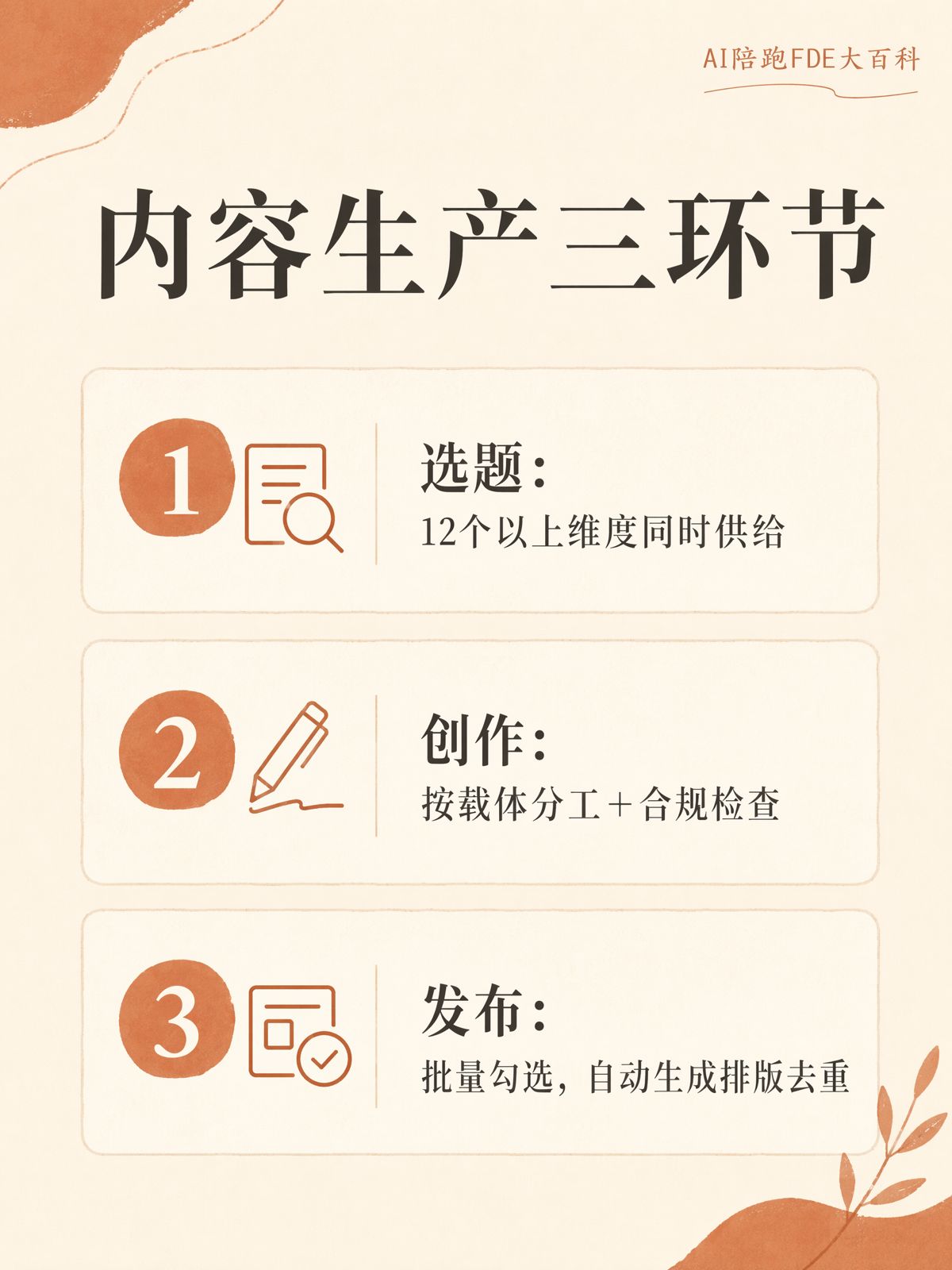
A content factory organizes topic ideation, production, quality control (QA), distribution, and retrospective review into fixed, repeatable stages. It establishes clear methods, standards, and owners for every step. Distribution delivers the finished content to designated channels, while retrospective reviews evaluate live performance data to adjust upcoming editorial plans.
The goal is not simply to speed up an individual draft, but to keep content operations running predictably over the long term.
Three Approaches to Content Production: How the Outcomes Differ
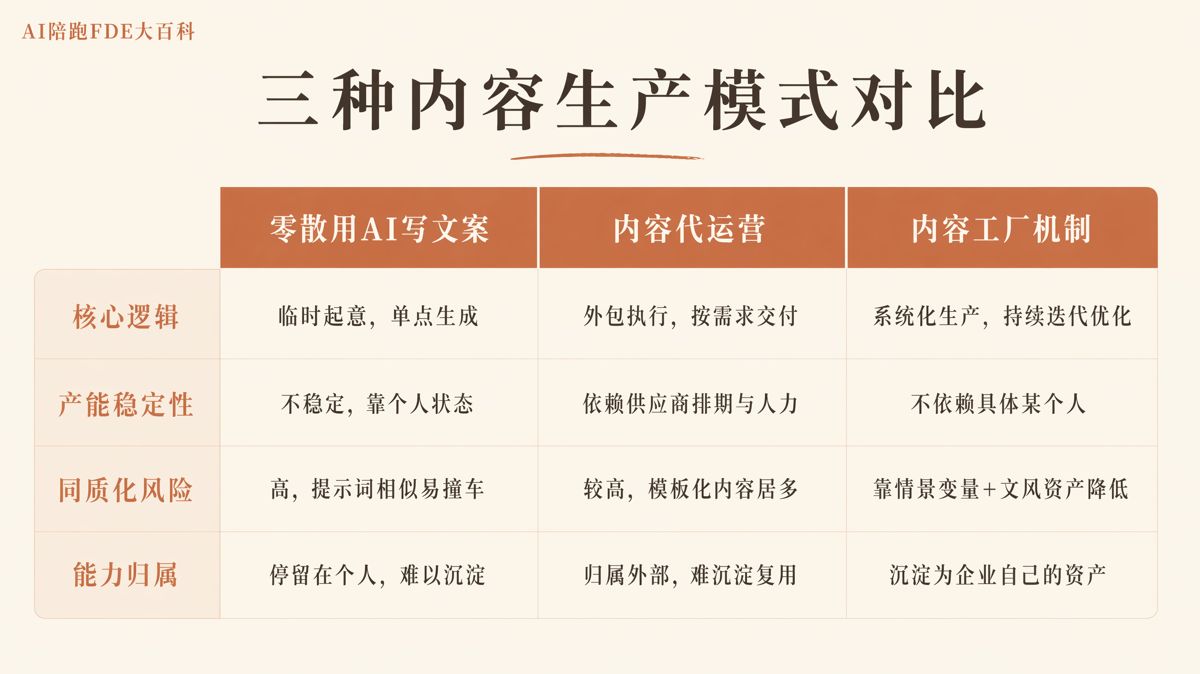
Using artificial intelligence (AI) on an ad-hoc basis typically solves a single writing task at a time. Outsourcing delegates writing and distribution to an external agency. A content factory manages the entire pipeline from topic selection to post-launch review.
| Dimension | Ad-Hoc AI Writing | Outsourced Content Agency | Content Factory System |
|---|---|---|---|
| Production Method | Writers decide what to cover on the spot, then prompt AI to generate copy | An external vendor produces and publishes the material | Ideation, drafting, QA, distribution, and review follow defined workflows and roles |
| Capacity Stability | Relies on individual experience and daily bandwidth; prone to missed deadlines | Depends on the agency's staffing and contract capacity | Production continues as scheduled even when team members change |
| Homogenization Risk | High; tends to recycle similar prompts, angles, and article structures | Moderate; can fall into predictable agency templates | Minimized through combinatorial topic frameworks, custom brand voice assets, and multi-tier QA |
| Ownership of Capabilities | Experience stays trapped with individual team members | Strategic judgment and editorial experience remain with the external agency | Editorial logic, voice assets, and QA criteria become proprietary company property |
The most critical factor here is where decision-making and expertise end up.
When individual employees experiment with AI on their own, their prompt tricks and editorial judgment leave when they leave. When relying on an agency, editorial insights remain on the agency's servers. A content factory consolidates this operational knowledge into internal knowledge bases, voice assets, and documented workflows. A knowledge base serves as a central repository for company facts, product specs, and positioning guidelines. Voice assets document existing brand tone, sentence structures, and approved copy samples.
When team members change, the company does not have to rebuild its operations from scratch. That is the core difference between a content factory and the other two models.
Why Teams Still Miss Daily Deadlines After Adopting AI
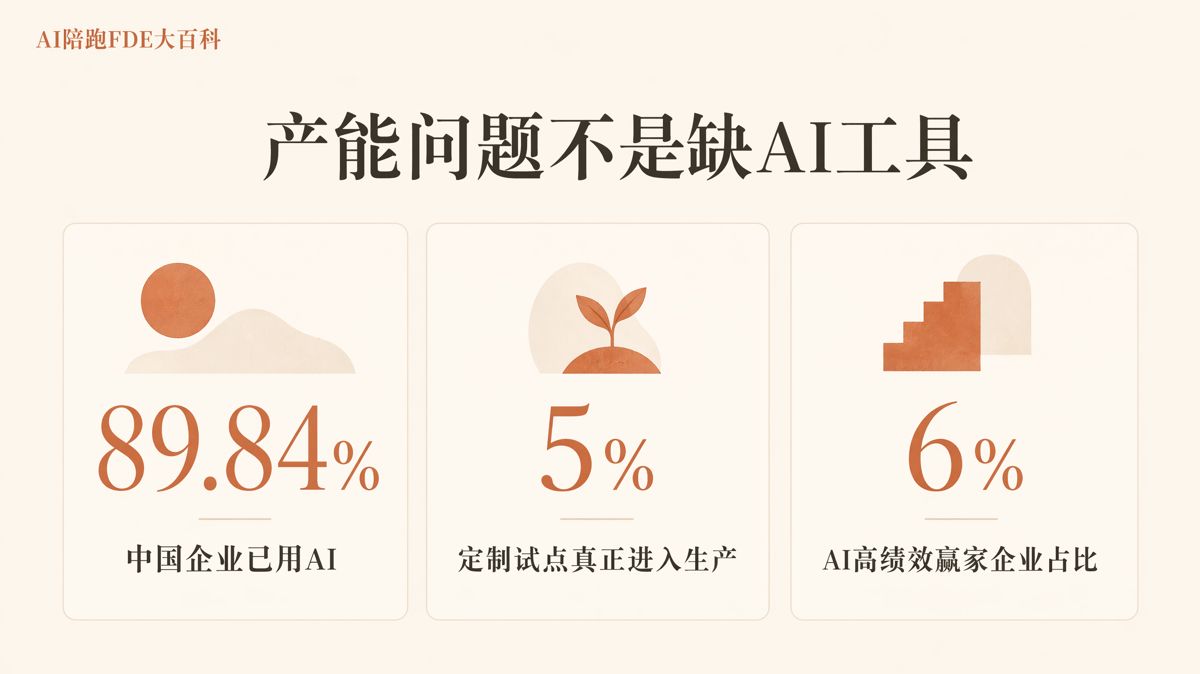
According to the China Entrepreneur Artificial Intelligence Application Survey Report (2025), 89.84% of surveyed enterprises in China have adopted AI tools. While access to AI is widespread, experimenting with software is very different from establishing steady production capacity.
In 2025, MIT's Project NANDA published The GenAI Divide, an enterprise generative AI adoption report. It revealed that while over 80% of enterprises had tested generative AI tools, only about 5% of custom pilots successfully integrated into ongoing production and delivered measurable business value. Customized pilots refer to AI setups tailored directly around a company's specific operating processes.
McKinsey's The State of AI in 2025 report found a similar gap: in Greater China, only 6% of enterprises qualify as "high-performing winners" capturing measurable business value from AI. According to The GenAI Divide, enterprises that co-developed AI applications with external specialized partners achieved an implementation success rate of roughly 67%. For internal teams attempting to build these systems entirely through trial and error, the success rate dropped to about one-third of that figure.
These benchmarks highlight that an AI tool's ability to generate text is only one part of operational success. Supporting data, standard workflows, organizational ownership, and trained staff dictate whether AI can sustain daily production.
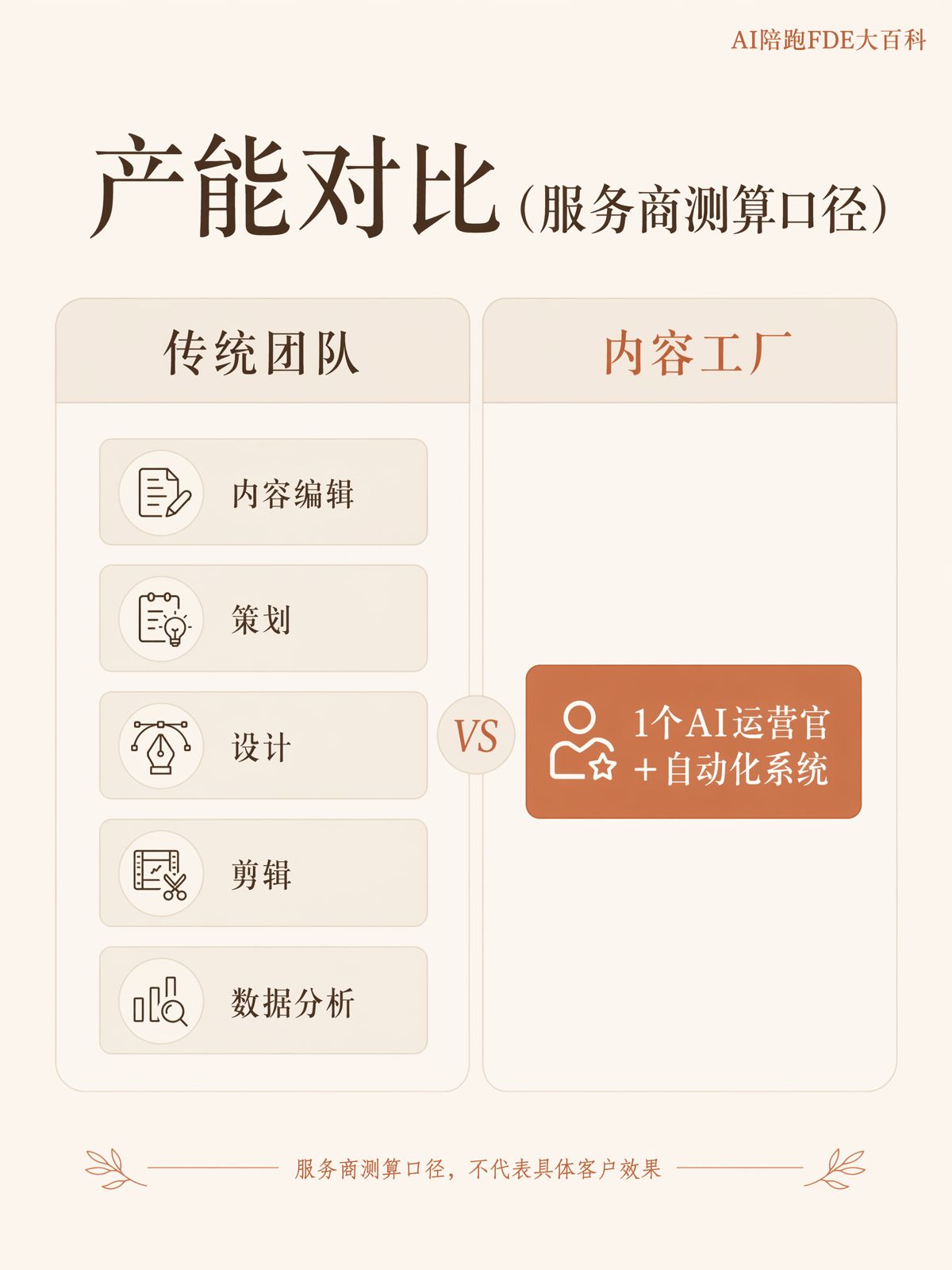
Within a marketing team, AI can drastically cut initial drafting time. However, it will not automatically supply a steady backlog of viable topics, run compliance checks, or review campaign analytics. If upstream and downstream steps still rely on manual, ad-hoc effort, daily publishing will inevitably stall.
How Content Shifts from Ad-Hoc Output to Systematic Production
Consider topic selection first.
Scrambling for inspiration every morning pushes writers into the same repetitive angles. A content factory breaks ideation into modular criteria: what decision the audience is trying to make, what scenario they are in, and what problem they are trying to solve. By systematically combining these elements, the team generates a continuous backlog of topics without repeating the same angle every week.
When content starts sounding generic, teams often attempt to fix it by tweaking their AI prompts. While altering a prompt may change surface-level vocabulary, it rarely fixes underlying issues with repetitive angles or predictable structures. Reducing homogenization requires changing how topics are selected and framed, not just adjusting writing commands.
Once a topic is approved, the tone must be managed. If AI defaults to standard conversational presets, different brand accounts begin to sound identical. Brand voice assets provide the model with proven, historical writing samples, ensuring style consistency across every output.
Post-draft inspection must also be segmented. Robotic AI phrasing and content homogenization are distinct problems. A robotic tone is an issue of phrasing and vocabulary, while homogenization stems from repetitive topic framing and predictable structures. The former requires line-level editorial guidelines; the latter requires adjusting topic criteria.
Before hitting publish, the draft must pass checks for regulatory compliance, advertising restrictions, and factual accuracy. Because large language models can produce hallucinations and legal liabilities, final human oversight remains non-negotiable. A content factory organizes human judgment; it does not eliminate it.
Once content is live, teams must track output volume, hours spent per asset, and publishing cadence. These numbers reveal where the pipeline is lagging: whether topic databases need fresh criteria, voice samples need updating, or review criteria need tightening.
This completes the four core mechanisms of a content factory: an ideation system to determine what to write, brand voice assets to govern expression, QA standards to approve publication, and a review rhythm to steer iteration. Distribution is built into the workflow so completed assets never sit idle waiting for someone to post them.
Where to Start When Building a Content Factory
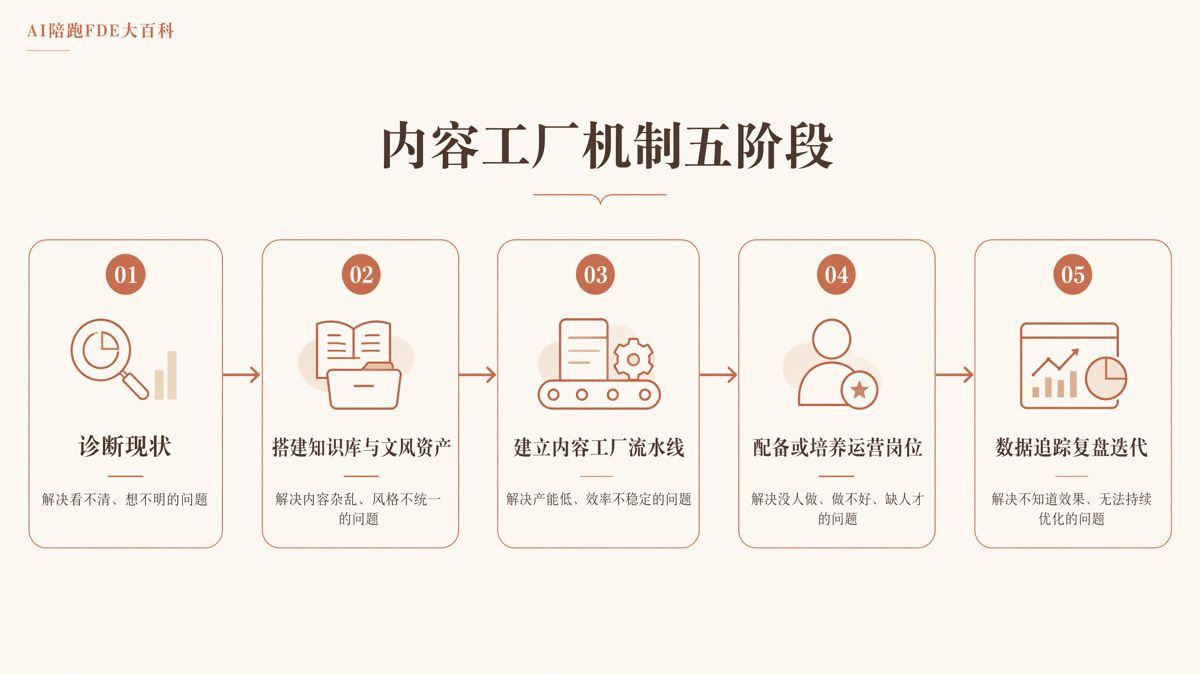
A standard implementation path follows five distinct stages:
- Diagnose bottlenecks: Determine whether production is stalling at topic selection, drafting, quality review, or retrospective analysis.
- Build knowledge and voice assets: Centralize business facts, product parameters, and brand voice samples so editorial choices have a reliable reference point.
- Connect the pipeline: Link ideation, production, QA, distribution, and review into a connected, end-to-end workflow.
- Assign roles: Appoint or train operators responsible for maintaining each step over the long term.
- Track performance metrics: Continuously monitor production throughput and iterate the system based on actual data.
Skipping stages creates problems. Generating bulk AI copy before organizing your business knowledge and voice parameters will only amplify repetitive topics, generic writing, and editorial bottlenecks.
A content factory does not require a large department. In smaller teams, existing staff can manage multiple stages. What matters is documenting who owns each step, what standards must be met, and who receives the handoff.
How to Tell if Your Content Factory Is Actually Working
You can audit your operational setup using four criteria:
- Can publishing continue on schedule when a key team member takes leave or resigns?
- Does the team maintain a reliable pipeline of topics without daily brainstorming meetings?
- Are there dedicated checks for AI tone, repetitive angles, advertising compliance, and factual accuracy?
- Does someone regularly log and review output volume, production time per post, and publishing cadence?
There is no universal timeline for when capacity gains will appear. Results depend on your baseline operational maturity and tracking standards. Progress should be measured by your own logged output volume, production hours, and schedule consistency.
If content starts sounding repetitive after running the system for a few months, check whether your topic generation criteria and voice assets have become stale. A content factory requires ongoing maintenance driven by performance data; it is not a set-it-and-forget-it project.
AI tools make text generation fast, but steady publishing depends on the steps before and after writing. When editorial logic, brand voice assets, QA standards, and review processes become proprietary operational systems, your marketing output will no longer reset every time your team changes.
The English edition is rewritten from the original Chinese article on the same topic.

Starbox AI is an AI marketing company based in Hangzhou, China. This article draws on Starbox project work. Please credit the source when quoting.
Related reading
 AI Adoption
Can One AI Operator Really Replace 10 People?
Claims of 10x headcount cuts count generation speed, not QA and rework. Real efficiency measures net pipeline hours saved.
Oct 22, 2026 · 6 min read
 AI Adoption
Bought Basic AI and Seeing Zero ROI? A 4-Step Activation Playbook
Activating entry-level AI is not about model parameters. Turn open chat boxes into defined operational stations with clear inputs, templates, and QA checklists.
Oct 22, 2026 · 6 min read
 AI Adoption
Why One-Click AI Fails at Work: How to Pick Enterprise Agents
One-click AI tools seem easy, but their first-draft accuracy is terrible. Real business ROI requires multi-step workflows with your own knowledge base.
Oct 21, 2026 · 6 min read