
Building AI Style and Knowledge Bases: Setup and Ownership

The short answer
Style libraries govern brand voice while knowledge bases ensure factual accuracy. Here is how to build, separate, and maintain both.
A style library governs how your brand speaks. A knowledge base governs whether what you say is factually accurate. These two assets must be built and maintained separately.
Key context:
- According to the China Entrepreneur Artificial Intelligence Application Survey Report 2025, 89.84% of Chinese enterprises have used AI, but only 16.41% have set up dedicated AI teams. This staffing gap is the primary reason knowledge bases and style libraries fall into neglect.
- MIT Project NANDA's 2025 report The GenAI Divide shows that 95% of enterprises see no measurable business return from generative AI, and only 5% of customized pilots ever make it into production.
- Bringing in specialized external capabilities yields an implementation success rate of roughly 67%—three times higher than relying solely on internal trial and error (MIT NANDA 2025).
- Across Greater China, only 6% of enterprises qualify as high-performing winners with AI (McKinsey, 2025 State of AI).
- Enterprise knowledge bases rely on Retrieval-Augmented Generation (RAG), which prompts the AI model to query proprietary internal data before generating an answer instead of relying on generic pre-training data (industry consensus).
Are Style Libraries and Knowledge Bases the Same Thing?
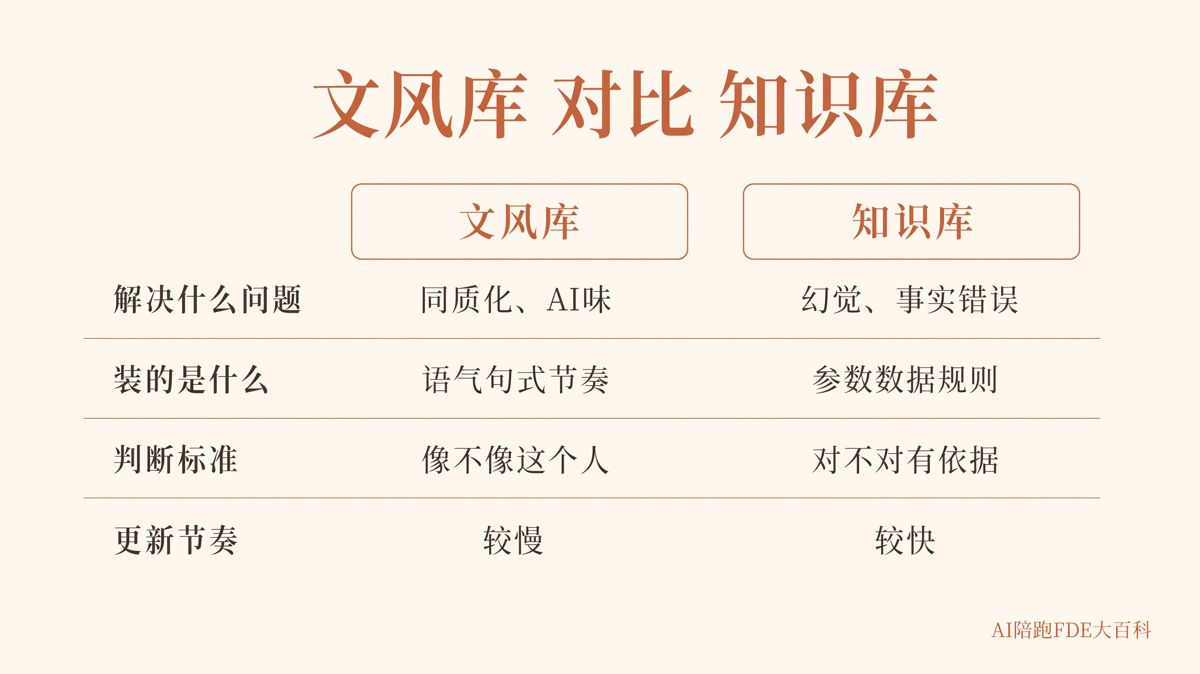
They address completely different problems. A style library ensures your AI writes in a voice authentic to your account. A knowledge base ensures your AI writes content that is factually correct and verifiable. One dictates tone; the other dictates facts.
| Dimension | Style Library | Knowledge Base |
|---|---|---|
| Core Problem Solved | Homogenization, generic "AI tone," loss of brand persona | Hallucinations, factual inaccuracies, off-topic answers |
| Content Stored | Tone samples, sentence structures, rhetorical pacing, emotional markers | Product specs, industry metrics, FAQs, internal policies |
| Evaluation Metric | Does it sound like this specific creator or brand? | Is it factually correct and backed by evidence? |
| Update Cadence | Adjusts as voice and format evolve (relatively slow) | Adjusts as business operations and data change (relatively fast) |
Teams often conflate these two assets. That explains why many companies load up a knowledge base yet see no improvement in content performance: the facts are present, but the voice remains untouched, resulting in factually accurate content that reads like default AI copy.
Why Content Stays Homogenized After Adding a Knowledge Base
Homogenization happens when a knowledge base fixes factual accuracy without an accompanying style library or a quality check to strip out AI clichés. The language defaults to the baseline voice of the foundational model.
Industry consensus indicates that prompt engineering alone cannot eliminate homogenization. You need three coordinated mechanisms:
- An editorial system that prevents repetitive, overlapping topics.
- A style library that enforces sentence structures, transitions, and tone.
- A review process that identifies and removes AI clichés line by line.
If any of these three layers is missing, content quickly reverts to generic phrasing (an industry methodology assessment, not institutional survey data).
Fixing facts without addressing presentation is the direct cause of the lingering "AI smell" in automated content.
What Goes Into a Style Library and How to Build One
A style library breaks language down into reusable components—sentence habits, connective phrasing, argument pacing, and emotional expression—rather than simply archiving a few sample articles.
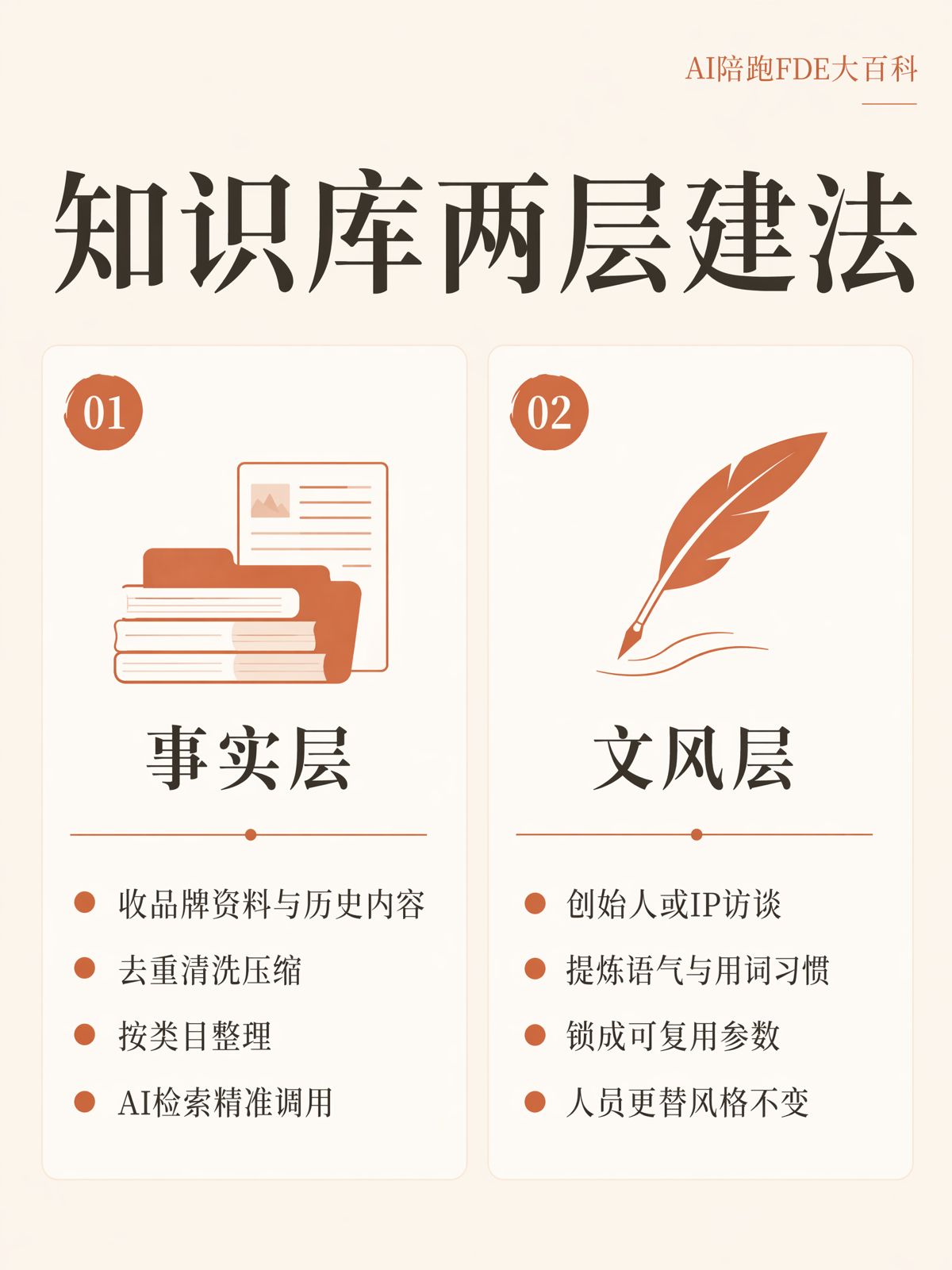
There are four key steps to building one:
- Use authentic, sufficient samples. Collect at least 10 to 20 original source pieces from the same creator or brand account. These can be verbatim video scripts or published articles. With too few samples, the model picks up coincidental phrasing rather than stable linguistic patterns.
- Deconstruct down to sentence structure and pacing. Document how sentences begin, how transitions are framed, and what words connect ideas. Do not focus on specific opinions. Opinions change; communication habits stay consistent.
- Categorize by content scenario. Keep different formats separate. A creator uses different phrasing when explaining technical topics than when sharing personal perspectives. Storing them in separate buckets prevents tonal bleeding during generation.
- Audit and retire outdated samples. Writing styles change over time. Reviewing the archive every 6 to 12 months to retire dated samples is standard practice.
What Goes Into a Knowledge Base and How to Build One
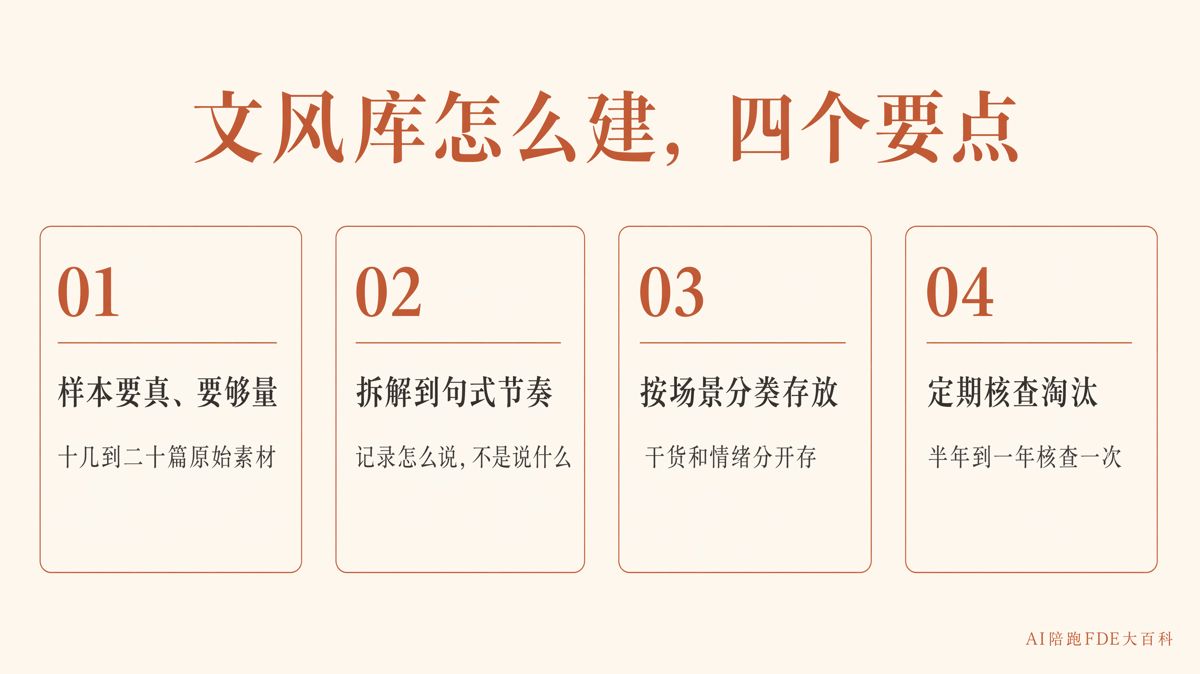
A knowledge base holds proprietary information that an AI cannot reliably guess: product parameters, industry data points, internal policies, and standard FAQs. Using RAG technology, the model retrieves these materials first and grounds its answers in the retrieved records.
RAG prevents generic models from fabricating claims about internal corporate details. The knowledge base serves as the verified retrieval foundation.
A common mistake is treating a knowledge base as a dumping ground for raw documents. Production quality depends on retrieval precision, data governance, and access controls. If retrieval is inaccurate, a comprehensive library helps little; if access controls are absent, sensitive internal materials risk exposure.
Follow three priorities when setting up your knowledge base:
- Prioritize high-frequency, high-stakes information. Focus first on standard pricing, compliance rules, and trademarked terminology. The operational cost of an error in these areas far exceeds the cost of documentation.
- Tag every entry with a source and timestamp. Untracked knowledge bases deteriorate over time, leaving teams unsure of which documents remain valid.
- Establish tiered access permissions. Not all users should see every document. Internal operating procedures and unreleased product data must be segregated from public-facing knowledge assets.
Who Maintains Both Libraries Once Built?
Building the libraries is only the starting point. Without ongoing maintenance, output quality deteriorates within months.
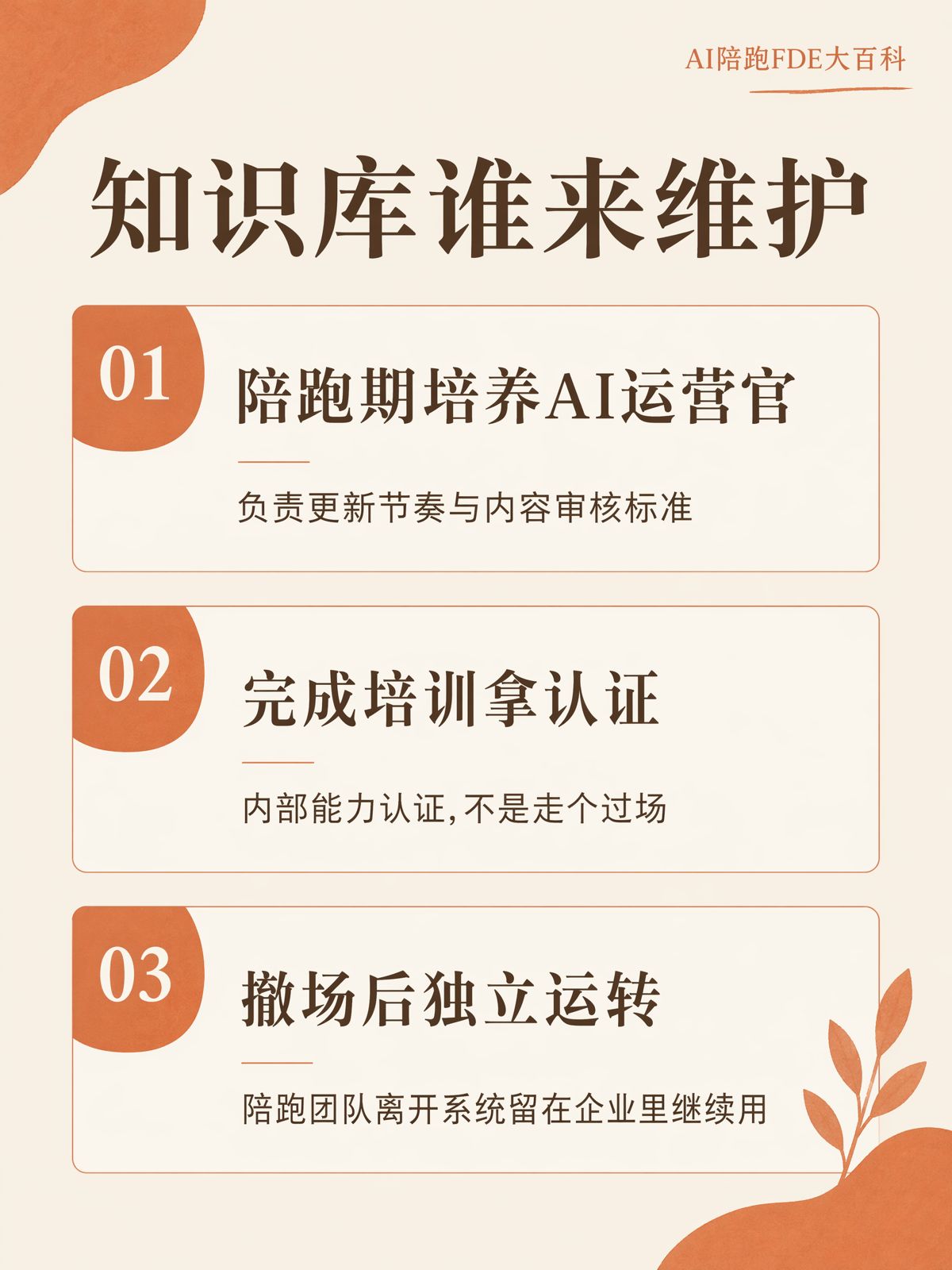
An operational role is emerging across the industry to address this: the "AI Operations Officer." While not yet an official occupational classification, this role typically manages the daily content pipeline, updates style and knowledge assets, adjusts AI tooling, and monitors output performance metrics.
Long-term stability depends on two factors:
- A dedicated owner. Avoid assigning maintenance as a secondary duty. Without clear personal accountability, teams usually stop updating knowledge bases within months of launch.
- A structured handover process. If an external vendor builds your initial system, all operating methodologies, prompt templates, and update procedures must be transferred to internal staff. This determines whether your organization retains the capability or loses it when the partner leaves (methodology assessment).
Vendors often claim that one person using their tools can match the output of an entire team. These multipliers depend heavily on individual company baselines and do not serve as reliable operational benchmarks.
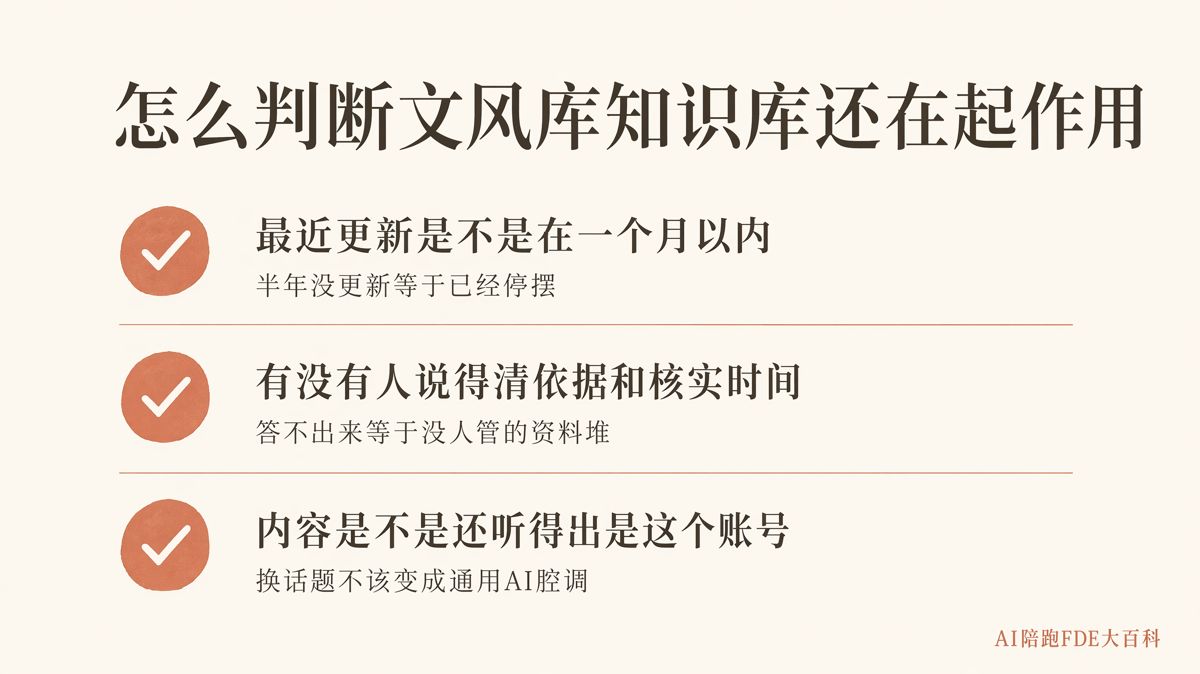
How to Tell If Your Libraries Are Actually Working
Success is not measured by whether a library was built. It is measured by whether someone actively uses, edits, and verifies it.
Use these three operational signals to audit your setup:
- Was the knowledge base updated within the last 30 days? If the last update was six months ago, the system is dormant, regardless of how thoroughly it was originally structured.
- Can your team identify the source and last verification date of any generated claim? If they cannot, the knowledge base has deteriorated into unmanaged documentation.
- Does recent content still sound distinctly like your brand? Pull a random sample of recent drafts. If changing the subject immediately reveals a generic AI tone, your style library is no longer being applied properly.
These three checkpoints evaluate the health of any operating AI content system without requiring specialized software.
Whether an AI content workflow succeeds comes down to daily operational use. If team members use, edit, and check these libraries every day, the system works. If no one opens them, they are just static files.
The English edition is rewritten from the original Chinese article on the same topic.

Starbox AI is an AI marketing company based in Hangzhou, China. This article draws on Starbox project work. Please credit the source when quoting.
Related reading
 AI Adoption
Can One AI Operator Really Replace 10 People?
Claims of 10x headcount cuts count generation speed, not QA and rework. Real efficiency measures net pipeline hours saved.
Oct 22, 2026 · 6 min read
 AI Adoption
Bought Basic AI and Seeing Zero ROI? A 4-Step Activation Playbook
Activating entry-level AI is not about model parameters. Turn open chat boxes into defined operational stations with clear inputs, templates, and QA checklists.
Oct 22, 2026 · 6 min read
 AI Adoption
Why One-Click AI Fails at Work: How to Pick Enterprise Agents
One-click AI tools seem easy, but their first-draft accuracy is terrible. Real business ROI requires multi-step workflows with your own knowledge base.
Oct 21, 2026 · 6 min read