
Turn Senior Staff Expertise into AI Knowledge Assets

The short answer
AI cannot answer company-specific questions if internal judgment criteria remain unwritten. Here is how to turn tacit experience into enterprise knowledge.
What kind of machine rattle requires an immediate shutdown? At what price point is a customer still likely to close? Which customer complaints require a callback within the hour?
These questions directly affect business outcomes. Yet the answers rarely appear in standard operating procedures, manuals, or databases. They exist almost exclusively in the heads of senior employees. When veteran staff leave, a company loses more than headcount; it loses years of hard-won judgment criteria.
For personal experience to become a corporate asset, it must satisfy clear standards: it must be documented clearly, easily retrievable, verifiable by others, maintainable as business conditions evolve, and reusable in day-to-day work.
In this context, "AI" refers to systems that query internal corporate documentation before generating an answer. What AI can handle depends entirely on what the organization has documented in advance. If internal experience has never been written down, an AI model cannot know how your business prices products, manages escalations, or assesses operational risk.
What AI Can Solve Depends on What You Document
McKinsey's 2025 AI adoption survey and MIT Project NANDA's 2025 report, The GenAI Divide, evaluate different subjects and metrics, making direct percentage comparisons unwise. However, both highlight the same operational reality: using AI and having AI reliably participate in core business processes are two very different milestones.
Having employees ask AI questions only proves adoption of a tool. To let AI resolve internal business problems, an organization must extract business rules, decision criteria, conditions of applicability, and edge cases, then integrate them into daily workflows.
Without this proprietary foundation, AI relies solely on public data and generic knowledge. It will produce complete, articulate answers, but it will have no visibility into your real cost constraints, customer tiering, or internal handling thresholds.
Choosing the right AI platform matters, but the accuracy, completeness, and structure of your internal knowledge govern the final outcome.
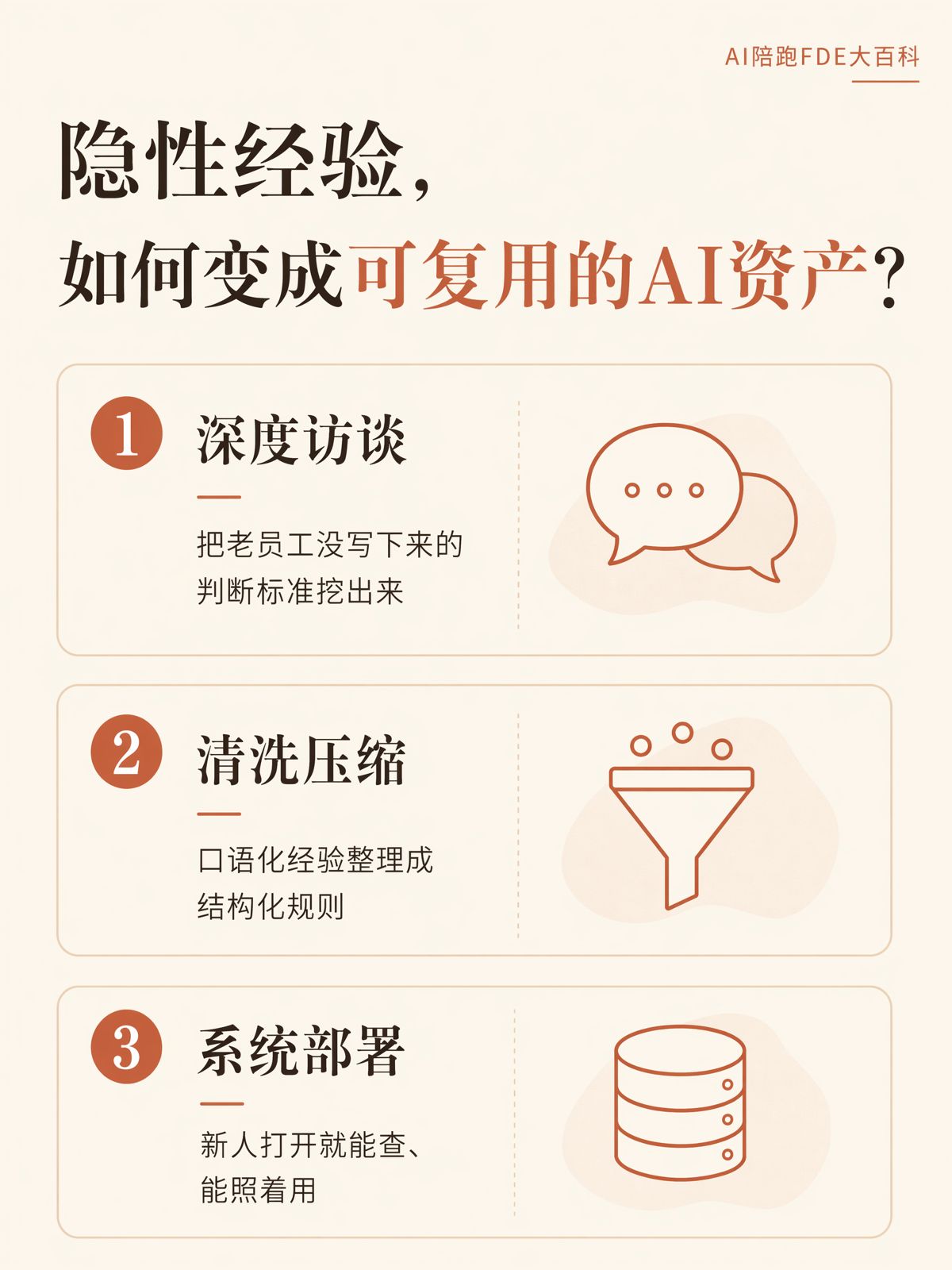
The Hardest Part of Knowledge Transfer Is Judgment Logic
Management theory splits knowledge into two categories.
Explicit knowledge exists in policies, manuals, process diagrams, and databases; anyone can read and use it. Tacit knowledge represents the accumulated experience of veteran workers that has never been fully articulated or recorded.
When senior staff hand over work, the bottleneck is rarely the physical action. It is the judgment behind the action:
- What signals did they notice?
- Which signal mattered most?
- Why did they choose this specific approach?
- Under what conditions should this approach be repeated?
- Which exceptions require an entirely different response?
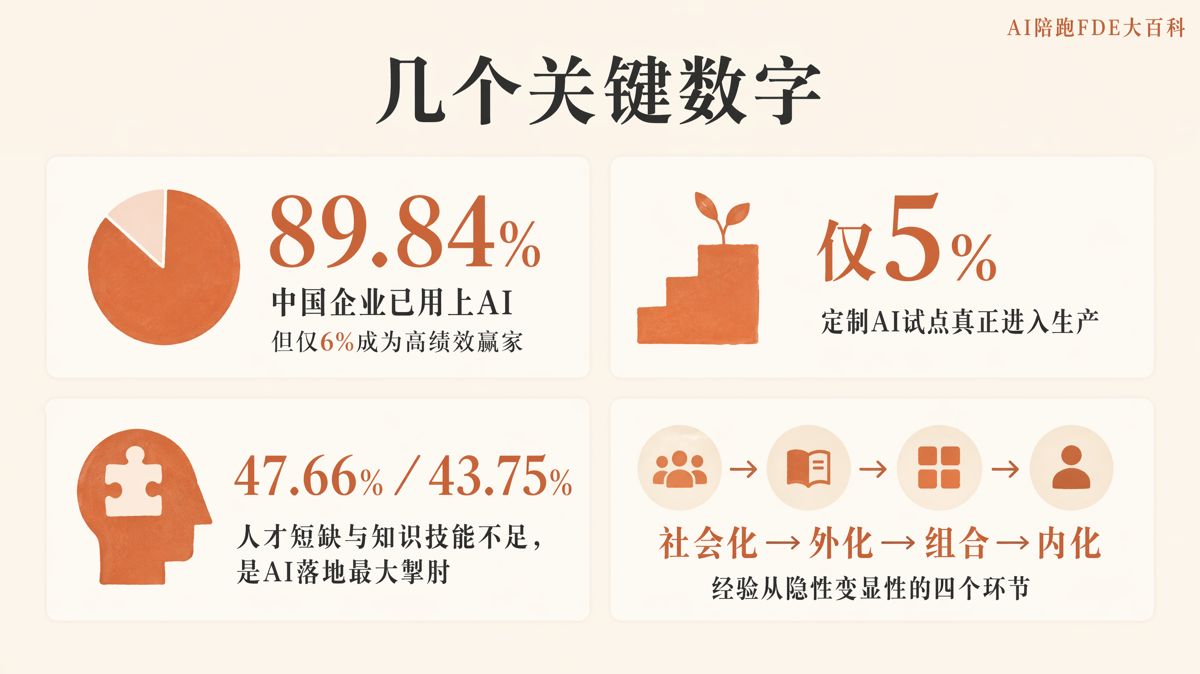
In The Knowledge-Creating Company (1995), Ikujiro Nonaka and Hirotaka Takeuchi outlined organizational knowledge creation through socialization, externalization, combination, and internalization. In short, experience transfers socially through collaboration, gets articulated and documented, combines with existing records, and returns to daily work.
Most businesses fail at the externalization step. When asked to write a summary, senior employees describe what they did, rarely explaining why. The assumptions they view as basic common sense are precisely what junior staff—and AI models—lack.
ISO 30401:2018 defines knowledge management as an auditable management system. It emphasizes organizational mechanisms: companies must systematically acquire, apply, maintain, and update knowledge rather than relying on spontaneous employee sharing.
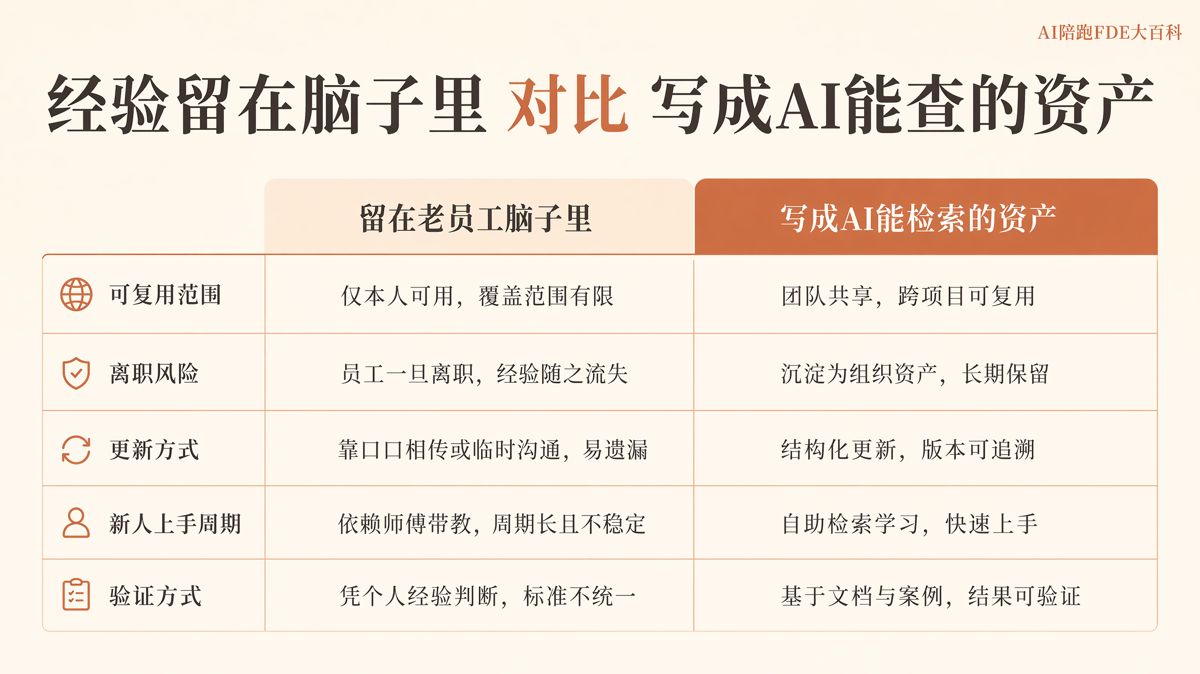
Mentorship and Training Videos Only Solve Half the Problem
Apprenticeships have real value. They allow newcomers to shadow experienced practitioners. But one mentor can only guide a few people at a time, mentoring takes months, and verbal explanations frequently skip edge cases. When a company scales, or when key staff retire, transfer, or resign, one-on-one passing of the torch cannot prevent institutional knowledge loss.
Workshops and recorded training videos help employees understand operations, but they do not create searchable, verifiable, updatable corporate assets. A video records a lecture. When an employee encounters a specific issue on the job, they must search through hours of footage. Without codified rules, it is difficult to determine whether a recorded tactic applies to the current situation or remains valid today.
Training focuses on individual capability—whether an employee knows how to perform a task or prompt an AI tool. Turning experience into an asset ensures the company owns reusable decision criteria. The latter requires knowledge extraction, rule codification, cross-validation, system integration, and performance audits.
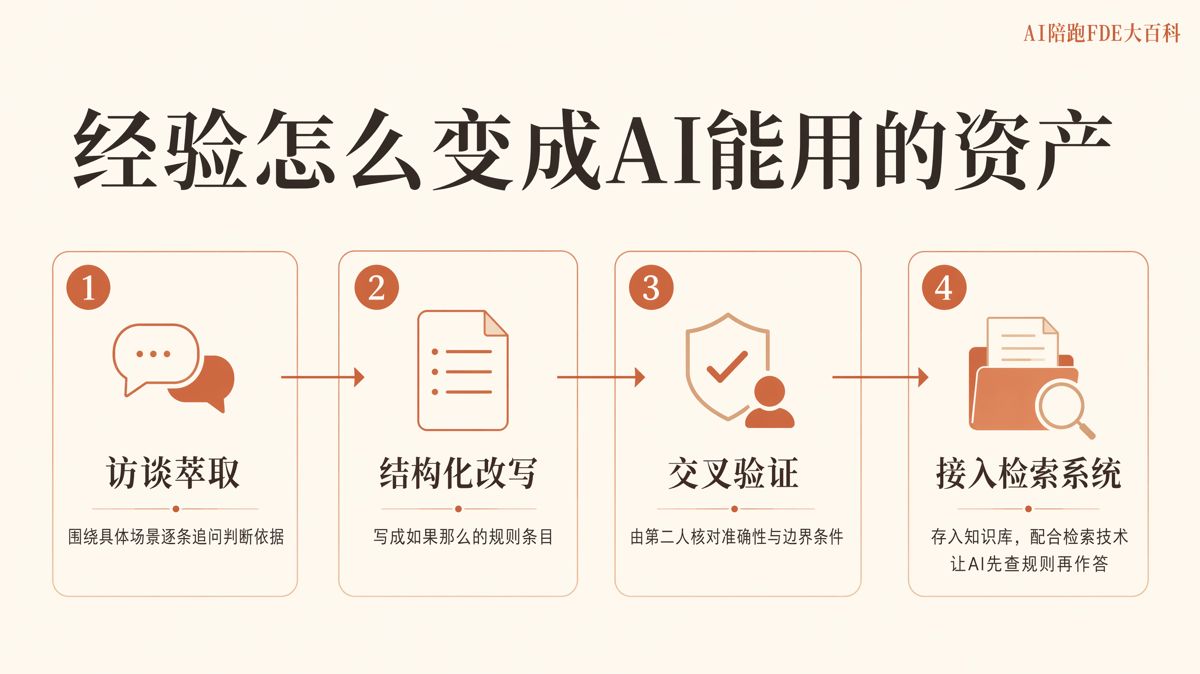
How Tacit Experience Enters an AI System
Turning an expert's intuition into an AI-retrievable rule requires four practical stages.
1. Interview Around Specific Incidents
Do not ask senior employees for general reflections or broad summaries. Anchor interviews to specific historical incidents and trace the decision path:
- What happened?
- What did you notice first?
- Which signals influenced your decision?
- What action did you take?
- Why did you choose that action?
- In what circumstances would you avoid that approach?
Document both the conclusion and the conditions under which it holds true. Whenever an expert says "that goes without saying," dig deeper. That is usually where unwritten decision rules hide.
AI can analyze historical support tickets and chat logs to spot recurring questions, common resolutions, and high-impact scenarios. This sharpens interview prep. However, logs record outcomes, not the cognitive rationale behind them. The reasoning must still be uncovered through structured interviews.
2. Translate Spoken Insights into Executable Rules
Interview transcripts are raw source material, not usable rules. When structuring an asset, every rule should document five elements:
- Applicable context;
- Observable signals;
- Trigger conditions for action;
- Underlying rationale;
- Exceptions and operating boundaries.
A simple "if X, do Y" statement is incomplete. Safe execution depends on explicit boundaries and exceptions. Without them, junior staff and AI models will apply valid advice to the wrong situations.
3. Cross-Validate with Peer Experts
Individual judgment can be durable, but it can also be skewed by personal habits, historic role boundaries, or outdated context. Once drafted, rules must be reviewed by another experienced peer or process owner to confirm factual accuracy, complete conditions, and check for overlooked edge cases.
Validation turns personal preference into institutional policy. Loading unverified notes into a knowledge base simply scales one person's blind spots.
4. Connect to Retrieval Systems and Evaluate Output
Validated rules are imported into an enterprise knowledge base and indexed for Retrieval-Augmented Generation (RAG). When an employee submits a prompt, the system queries the internal knowledge base first, then instructs the language model to synthesize an answer based on the retrieved documentation.
RAG prevents the model from hallucinating generic answers, but it cannot fix broken rules. If the underlying documentation is outdated, inaccurate, or missing boundary conditions, the model will faithfully produce flawed guidance.
After integration, track two metrics: retrieval accuracy (did the system retrieve the correct rule?) and generation quality (did the model interpret and synthesize the rule accurately?). Both are required for reliable operations.
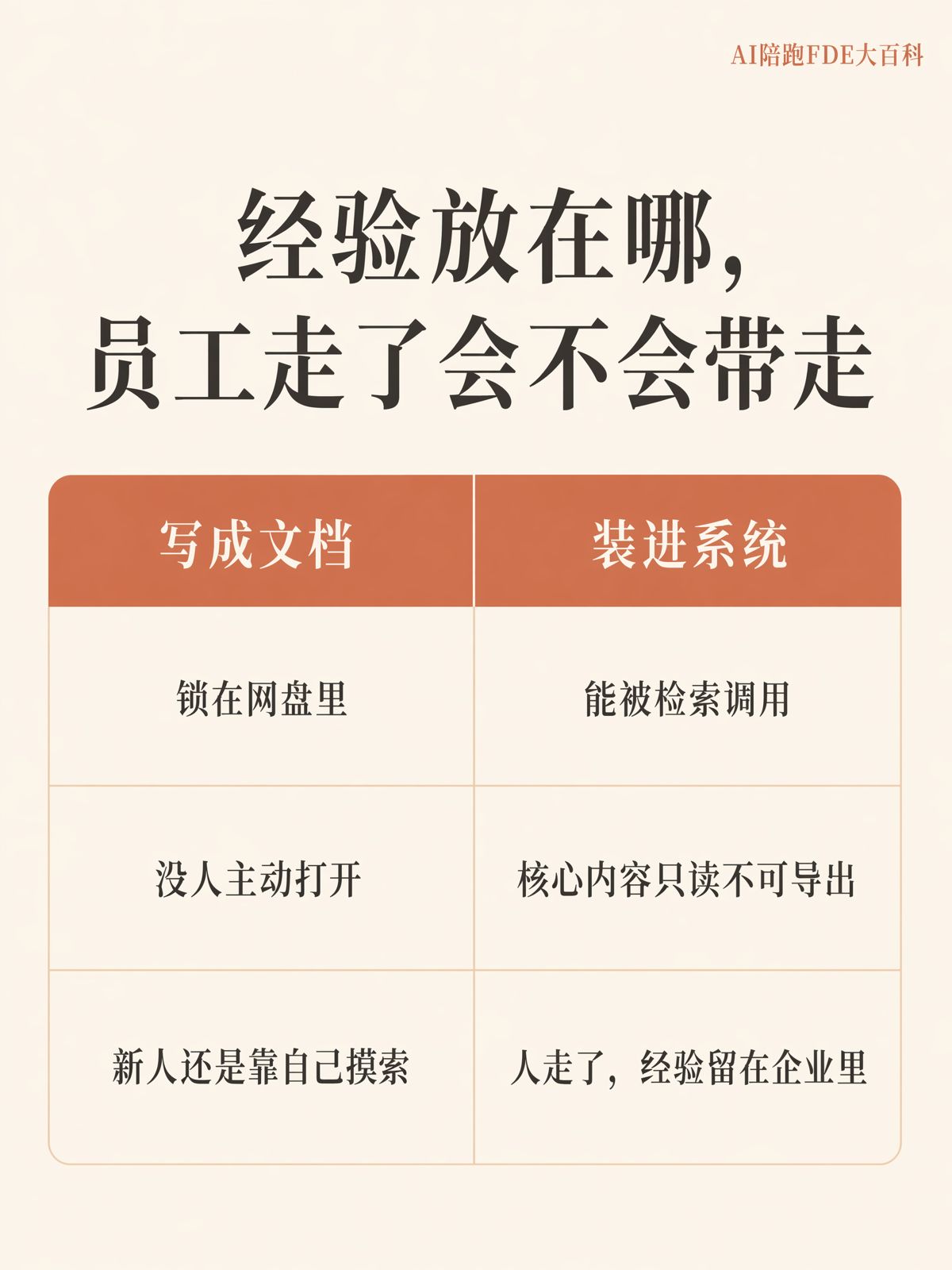
What Deliverables Should the Organization Retain?
Assetization is not measured by the number of interviews conducted, video hours recorded, or folders created. A completed initiative leaves behind concrete operational assets:
Standard Operating Procedures (SOPs). SOPs turn validated decision logic into step-by-step procedures specifying preconditions, precise actions, and exceptions, rather than narrative summaries.
Rule and Case Repositories. Rules categorized by business scenario with clear scopes, trigger conditions, action steps, and exceptions; paired with case studies showing practical application. Every entry must include version history for traceability.
A Unified Glossary. Cross-departmental terminology alignment. If sales, engineering, and support use different names for the same issue, staff face friction and AI retrieval fails. Standardize terminology, abbreviations, and exact definitions.
Retrieval and Accuracy Logs. Retrieval hit rate measures how often the system surfaces the correct rule for a user prompt. Pair this with answer accuracy evaluations to verify that outputs meet operational standards.
Once codified, rules must undergo regular reviews. As markets, products, and customer requirements shift, old logic expires. Designate clear owners and review cadences to keep knowledge current.
Once completed, knowledge distribution changes fundamentally: from ad-hoc mentoring of a few individuals to searchable access for entire teams; from oral tradition to version-controlled documentation; from blind trust in individuals to peer-reviewed, auditable operational standards.
Start with High-Frequency, High-Impact Scenarios
Prioritize knowledge capture by query frequency and business impact, not employee seniority.
If a decision arises daily and affects multiple departments, address it first. Rare edge cases that occur once every few years with minimal fallout can wait. Do not attempt to build a comprehensive knowledge base for every task a veteran handles. Select one high-friction, high-value scenario.
Interview, structure, validate, and integrate the rules for that single scenario. Verify that AI retrieves the right data and delivers accurate responses. Once proven, expand to the next workflow.
Knowledge codification has no universal timeline. Complexity, team size, and stakeholder availability dictate velocity. Rather than setting an arbitrary completion date, set auditable milestones: Are the rules documented? Have peers verified them? Is the system indexing them? Does live retrieval pass accuracy checks?
Modern AI Knowledge Bases Are Not Just Converted PDFs
Traditional handbooks force workers to skim tables of contents, offering little visibility into usage or outdated content. An AI knowledge base integrated with a retrieval engine matches specific user queries to relevant rules and generates context-aware answers.
The shift is not about moving from Word docs or binders to an AI interface. It is about structuring knowledge, making it searchable by user intent, and implementing continuous review, update, and validation loops. Uploading an unorganized PDF into an AI tool will not turn it into an enterprise asset.
Codifying tacit experience is also distinct from managing standard explicit knowledge. Explicit assets like product specs or compliance policies can be organized directly. Extracting tacit judgment requires structured interviews, codification, and peer validation—a more demanding, yet vital, operational investment.
Validate with Real Questions, Not Document Counts
To evaluate your knowledge assets, have junior employees ask real, frontline business questions. Check four fundamentals:
- Can the system retrieve the exact relevant rule?
- Does the answer articulate applicability boundaries and exceptions?
- Do experienced domain experts endorse the generated response?
- Is there a designated owner responsible for updates when business conditions change?
When every question yields clear, documented, peer-reviewed answers with logged version histories, tacit knowledge has officially become an institutional asset. Personnel may change, but the business will never have to relearn the same hard-won lessons from scratch.
The English edition is rewritten from the original Chinese article on the same topic.

Starbox AI is an AI marketing company based in Hangzhou, China. This article draws on Starbox project work. Please credit the source when quoting.
Related reading
 AI Adoption
Can One AI Operator Really Replace 10 People?
Claims of 10x headcount cuts count generation speed, not QA and rework. Real efficiency measures net pipeline hours saved.
Oct 22, 2026 · 6 min read
 AI Adoption
Bought Basic AI and Seeing Zero ROI? A 4-Step Activation Playbook
Activating entry-level AI is not about model parameters. Turn open chat boxes into defined operational stations with clear inputs, templates, and QA checklists.
Oct 22, 2026 · 6 min read
 AI Adoption
Why One-Click AI Fails at Work: How to Pick Enterprise Agents
One-click AI tools seem easy, but their first-draft accuracy is terrible. Real business ROI requires multi-step workflows with your own knowledge base.
Oct 21, 2026 · 6 min read