
Don't Roll Out AI Across Marketing: Win One Narrow Use Case First

The short answer
To drive marketing efficiency with AI, prove measurable ROI on one small, high-leverage workflow before scaling company-wide instead of buying tool subscriptions.
Key Facts - Research from MIT Project NANDA (2025) reveals that 95% of organizations have seen no measurable business return on their generative AI investments. The findings are based on 150 executive interviews, 350 employee surveys, and 300 public enterprise deployment cases. - The same MIT study found that companies purchasing mature AI solutions combined with external implementation partnerships achieved an adoption success rate of approximately 67%. Purely internal teams trying to figure it out alone succeeded only about a third as often. - The China Entrepreneur AI Application Survey Report (2025) found that while 89.84% of surveyed enterprises already use AI tools, only 16.41% have a dedicated AI team. - McKinsey's "State of AI in Greater China 2025" report notes that only 6% of surveyed enterprises qualify as "high-performing winners" extracting significant financial returns from AI. - Marketing is the most common starting ground for enterprise AI adoption for a simple reason: feedback cycles are short, output translates directly into content capacity and headcount efficiency, and it does not require rebuilding core backend IT infrastructure.
Here is how to break down these dynamics and structure an AI roadmap that actually works.
Why Buying Tools First Usually Leads Nowhere
Nearly 90% of enterprises report using AI tools, yet fewer than 17% have established dedicated teams to run them. That gap explains the difference between dabbling with AI and generating actual business value.
The MIT finding that 95% of companies see zero ROI points to the same root cause: software procurement is never the bottleneck. The real bottleneck is integrating AI into an operational workflow that runs every day. The most common mistake marketing leaders make is confusing "buying seats on an AI platform" with "launching an AI transformation project." Six months later, content output has barely moved, and the licenses sit unused.
Your team did not fail because they lacked effort. The sequence was wrong. Jumping straight from purchasing tools to a full company-wide rollout skips the most critical step: running a single, contained workflow until it consistently delivers measurable output.
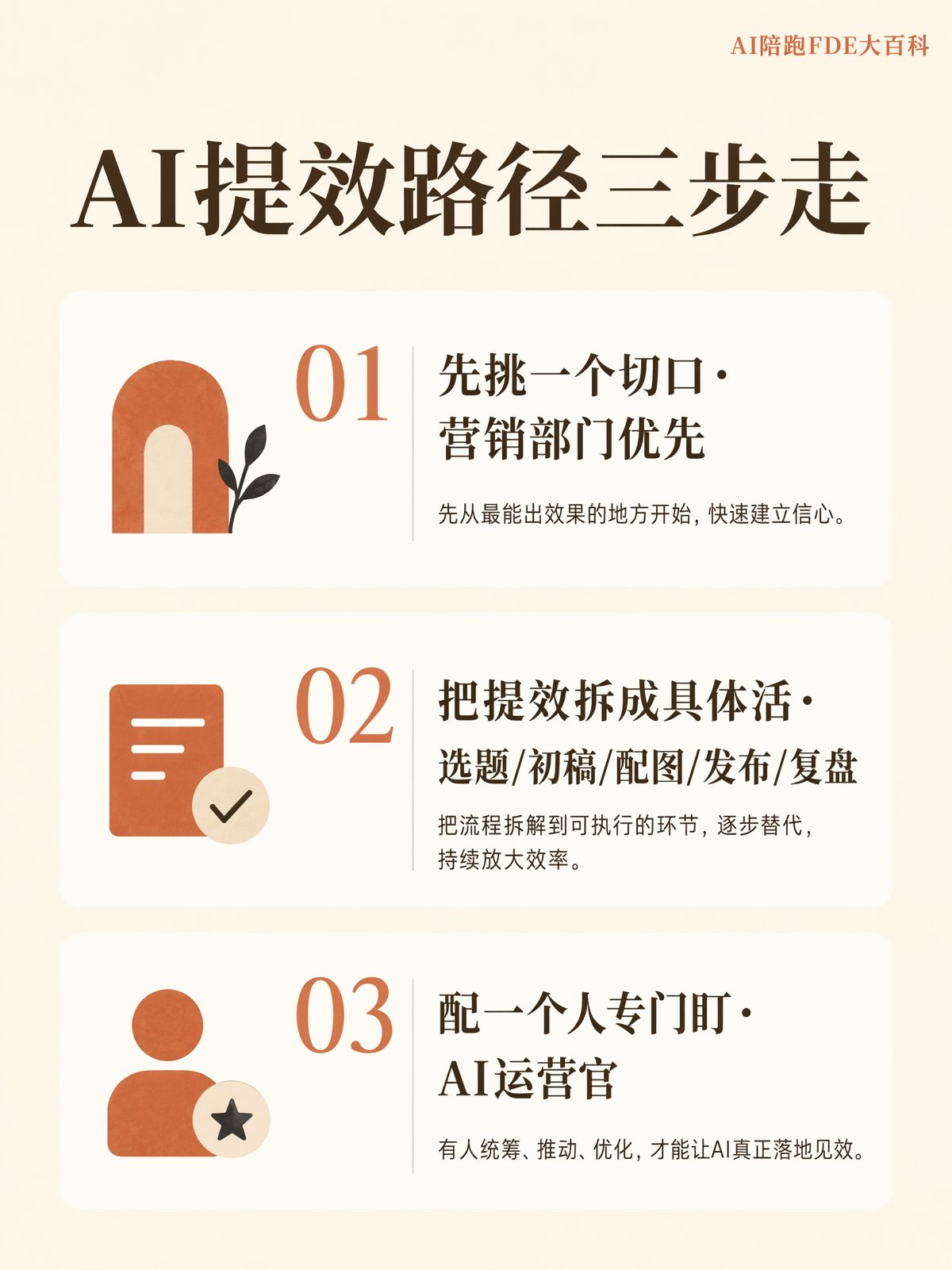
The Single-Point Entry Model: A Proven Starting Point
The MIT NANDA data highlights an important strategic choice: enterprises that combine mature software with external delivery support hit a 67% success rate—roughly three times higher than teams working in isolation. Most internal marketing teams lack the specialized experience and time required to engineer AI workflows from scratch. Instead of burning months on trial and error, the smarter path is identifying where to validate value first.
A practical implementation starts with four steps:
- Conduct an AI readiness audit. Identify the precise stage where content production currently stalls.
- Select a single point of entry. Target the step in your content pipeline that consumes the most human hours and is the easiest to quantify.
- Set measurable KPIs. Pick one or two concrete metrics, such as total output volume, production time per asset, or publishing frequency.
- Appoint an owner. Put an operational lead in charge of driving the pilot to completion.
Marketing departments are ideal testbeds because their outputs are inherently numerical: how many hours an asset used to take versus how long it takes now, and how many pieces were published this month compared to last. You do not need to build complex tracking dashboards; your team already monitors these metrics daily.

"Using AI for Copywriting" vs. "Systematizing Marketing with AI"
Teams often confuse these two concepts when planning their AI roadmaps. Opening an AI tool occasionally to generate a few captions is fundamentally different from building an automated, reliable content production engine.
- Using AI for Copywriting: Individual team members use tools whenever they remember. Output quality varies widely, capacity fluctuates, processes break down when an employee leaves, and results cannot be replicated across the organization.
- Systematizing Marketing with AI: The entire pipeline—from topic discovery to generation, QA, distribution, and performance analysis—runs on a standardized workflow. Output is steady, progress is tracked against clear metrics, and the process operates independently of individual team members.
The distinction is not whether you use AI models. It is whether you have embedded those models into a repeatable, scalable operational mechanism that delivers steady output without constantly adding headcount.
How to Set Definitive Metrics for Your Pilot
Most pilot projects fail not because the technology underperforms, but because success criteria were left undefined. If metrics are vague, nobody can agree on whether the project succeeded.
Effective pilot metrics follow three rules: narrow scope, quantifiable outputs, and a short timeline. Choose a focused scenario, set a clear performance threshold, and aim to produce verifiable data within a 3- to 6-month window. Leadership teams look for concrete numbers; drawn-out pilots lose organizational momentum and risk cancellation.
Focus on one or two metrics tied directly to current bottlenecks: - Volume capacity: Assets produced per unit of time. - Unit cost: Production hours or labor spend per completed asset. - Publishing velocity: Ability to support multi-channel daily distribution. - Quality consistency: First-pass compliance rates and rework percentages.
Do not try to move every metric at once. Focus on the single operational constraint holding your pipeline back.

What AI Replaces—and What It Doesn't
Setting clear expectations determines where your implementation boundaries lie.
In practice, AI handles throughput; humans handle judgment. An internal role built around managing these workflows—often referred to as an AI operations lead—shifts the operational model from adding headcount to engineering workflows. Content volume scales through the system rather than through hiring.
However, this does not eliminate the marketing team. Strategic topic selection, brand voice governance, and editorial compliance still require experienced humans.
Treating AI adoption as an immediate headcount reduction plan is a recognized trap. Sustainable, high-performing AI marketing teams are built around a structure of fewer people orchestrating structured workflows, rather than fully autonomous, human-free operations.
Three Common Misconceptions
Misconception 1: Purchasing software equals successful deployment. Over 80% of organizations have tested ChatGPT or Copilot-style tools, according to MIT NANDA (2025), yet only 5% of customized pilots ever make it into continuous production. Buying software is simply the starting line.
Misconception 2: An AI strategy document guarantees execution. The same MIT research shows that partnerships with experienced external providers succeed at a rate of 67%, while purely internal attempts succeed only a third as often. A high-level strategy without execution capabilities inflates failure rates.
Misconception 3: Homogeneous AI content is caused by weak prompting. Generic output is rarely a prompt engineering issue. It is typically caused by the absence of structured contextual asset libraries paired with variable design. Fine-tuning individual prompts cannot solve what is fundamentally an architectural flaw in your production system.
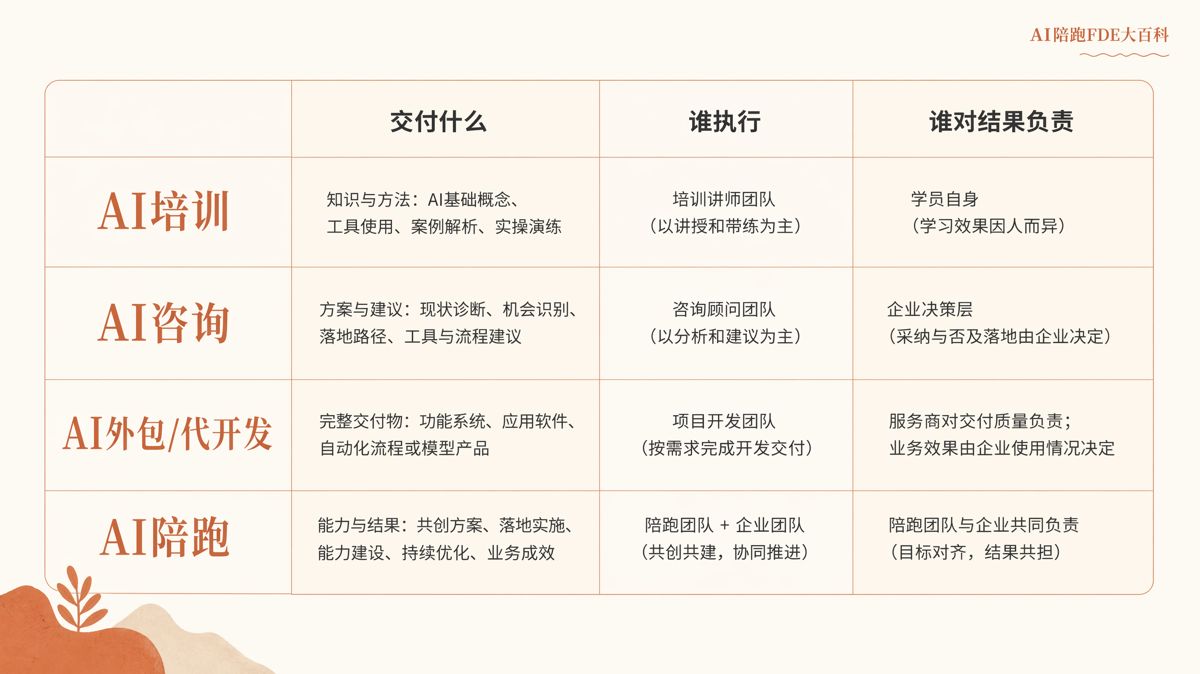
Four External Partnership Models: Which One Fits?
Marketing organizations evaluating external support generally encounter four service models, each offering distinct deliverables and accountability structures:
| Model | Deliverable | Execution Owner | Result Accountability |
|---|---|---|---|
| AI Training | Knowledge and methodology | Internal team | No |
| AI Consulting | Strategic roadmaps and recommendations | Internal team | No |
| AI Outsourcing / Dev | Custom systems or completed assets | External vendor | Responsible for deliverable specs |
| AI Co-Piloting (Vendor-Defined) | Measurable operational outcomes + internal capability transfer | Vendor alongside internal team | Responsible for outcomes (vendor claim) |
The core distinction lies in what is handed over and who carries responsibility for business impact. Training transfers knowledge; consulting delivers advice; outsourcing delivers software or assets; co-piloting models aim to deliver both verified outcomes and internal operational capability.
Before choosing an external partner, determine whether your gap is knowledge, strategy, capacity, or the operational leadership needed to execute the workflow.
Note: In regional enterprise markets, terms like "AI co-piloting" remain emerging service categories without standardized third-party certifications. Promotional claims such as "results within 30 days" or "300% order growth" reflect self-reported vendor marketing rather than verified industry benchmarks.
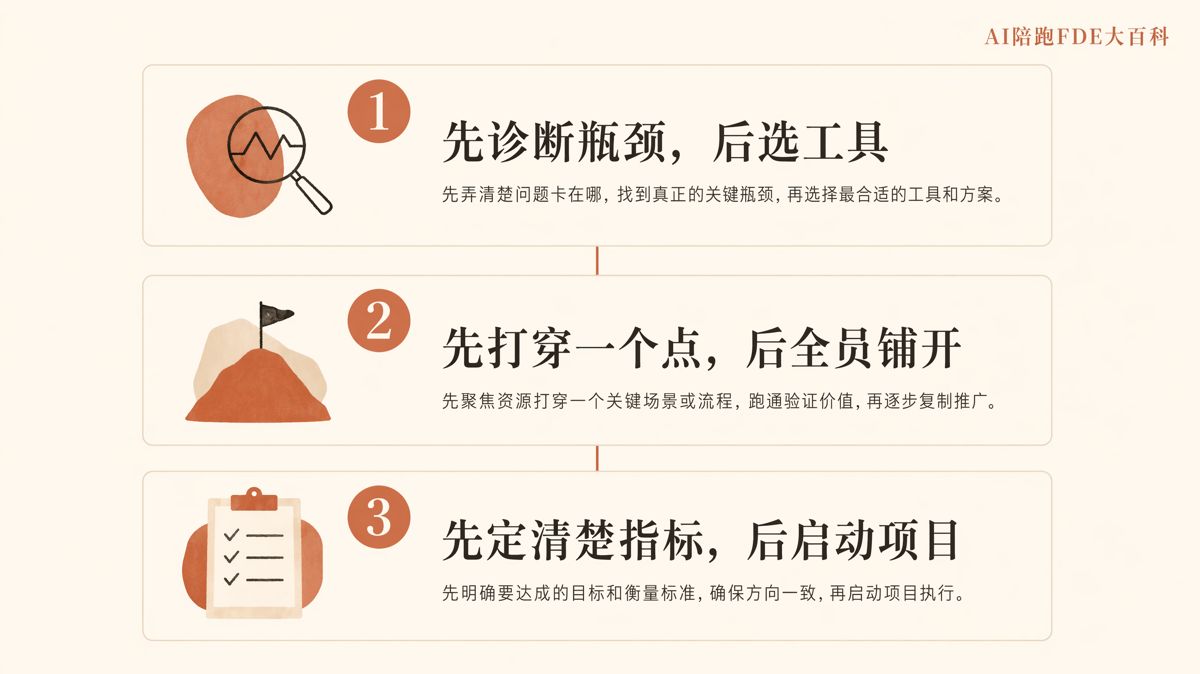
The Three Rules of AI Sequence
To build a marketing AI implementation that actually delivers ROI, follow this sequence:
- Diagnose bottlenecks before buying software. Do not buy tools simply because peers use them; map where your content workflow actually breaks down first.
- Win one use case before expanding company-wide. Validate tangible, quantified returns on a single narrow workflow before attempting to scale across other teams.
- Define hard metrics before kicking off. If you cannot quantify what success looks like on day one, you will not be able to defend the project's value at month six.
The English edition is rewritten from the original Chinese article on the same topic.

Starbox AI is an AI marketing company based in Hangzhou, China. This article draws on Starbox project work. Please credit the source when quoting.
Related reading
 AI Adoption
Can One AI Operator Really Replace 10 People?
Claims of 10x headcount cuts count generation speed, not QA and rework. Real efficiency measures net pipeline hours saved.
Oct 22, 2026 · 6 min read
 AI Adoption
Bought Basic AI and Seeing Zero ROI? A 4-Step Activation Playbook
Activating entry-level AI is not about model parameters. Turn open chat boxes into defined operational stations with clear inputs, templates, and QA checklists.
Oct 22, 2026 · 6 min read
 AI Adoption
Why One-Click AI Fails at Work: How to Pick Enterprise Agents
One-click AI tools seem easy, but their first-draft accuracy is terrible. Real business ROI requires multi-step workflows with your own knowledge base.
Oct 21, 2026 · 6 min read