
A 5-Step SOP for Embedding AI into Your Marketing Team

The short answer
Adopting AI is not about testing tools. Here is a 5-step SOP to turn AI into a reliable, repeatable marketing workflow that outlasts employee turnover.
If a key team member goes on leave, does your content calendar freeze? If your primary copywriter resigns, does content quality drop overnight? If monthly output increases, can your team clearly explain whether AI drove the gain or if employees simply worked overtime?
These questions reveal whether a marketing department has genuinely integrated AI far better than asking how many AI subscriptions the company pays for.
Genuine AI adoption means integrating AI into daily workflows for ongoing research, data retrieval, and content production. Achieving this requires a Standard Operating Procedure (SOP): documenting how each step is executed, who owns it, and what standards determine acceptance, so the workflow can run repeatedly and be evaluated objectively.
For a marketing department, this transformation spans topic ideation, information retrieval, content drafting, quality assurance, multi-channel distribution, and performance reviews. Writing copy is only one step. The ultimate objective is stable, measurable output and a working methodology that does not rely on any single employee's personal experience.
Most companies do not lack AI tools. They lack the ability to convert tools into business outcomes.
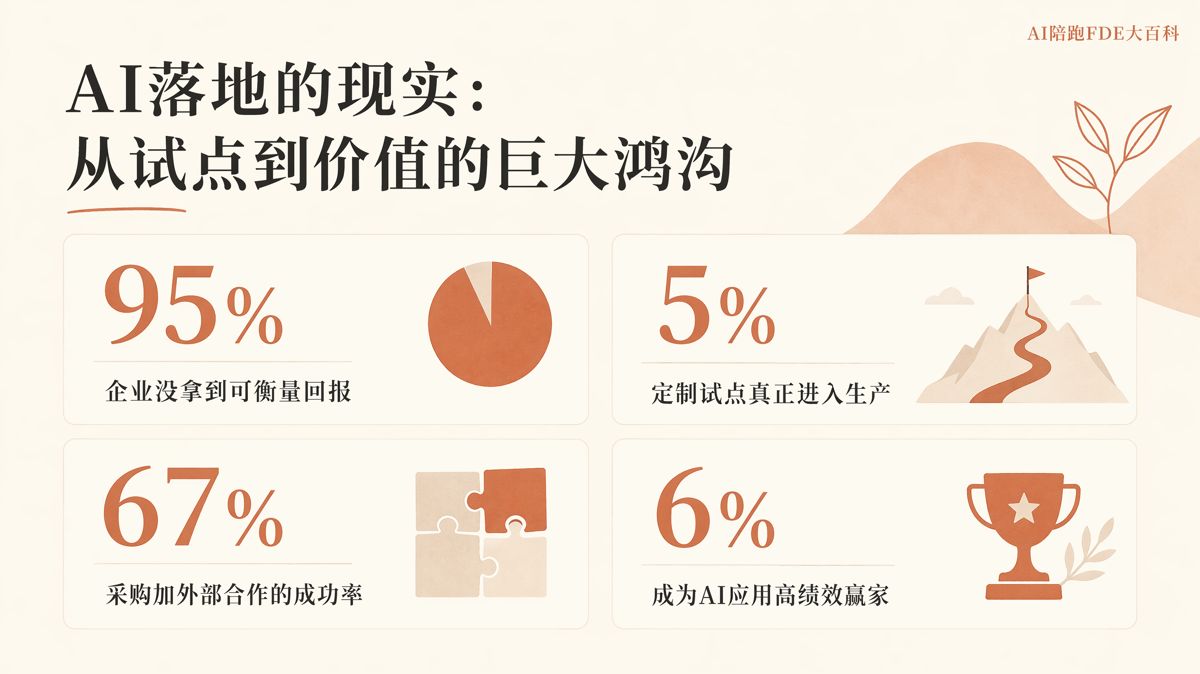
According to the MIT Project NANDA 2025 report, 95% of enterprises investing in generative AI have seen no measurable business return. Generative AI refers to AI systems capable of generating content based on user instructions. The report also noted that only 5% of customized pilot projects have entered real production use, even though over 80% of companies have tested general-purpose AI tools like ChatGPT and Microsoft Copilot. These generic tools serve broad audiences and are never customized for a specific company's proprietary data and workflows.
The China Enterprise AI Application Survey Report (2025) showed that while 89.84% of Chinese enterprises use AI tools, only 16.41% have established dedicated AI teams. Similarly, McKinsey's 2025 State of AI in Greater China report found that only 6% of surveyed companies qualify as "high-performing winners" capturing significant business impact from AI.
Tools have entered the enterprise, but consistent operational capacity has not followed. Transforming a marketing department with AI must begin with workflow design.
Why Marketing Is the Best Starting Point for an AI Pilot
When an enterprise prepares to deploy AI, it should select the business scenario before purchasing software.
Marketing departments are frequently chosen as the testing ground for practical reasons. Content volume, publishing frequency, and production hours per asset can be tracked directly, making before-and-after comparisons straightforward. Marketing content production also operates relatively independently; unlike finance or supply chain workflows, it rarely requires connecting multiple enterprise systems or coordinating extensive cross-departmental handoffs. Even if early results miss targets, the core business remains unaffected, allowing the team to refine processes and upskill personnel on live work.
The MIT Project NANDA 2025 report highlights an instructive comparison: enterprises adopting a path of "procuring mature solutions combined with external collaboration" achieved an AI deployment success rate of roughly 67%. Building entirely in-house succeeded only about one-third as often.
This data does not suggest that enterprises should depend on external support indefinitely. Rather, it shows that starting with the most complex, in-house build is unnecessary during an early pilot. Teams should define a tightly scoped marketing scenario where changes can be observed quickly, lean on proven external experience where needed, and systematically internalize team skills, workflows, and proprietary assets to build lasting internal capability.
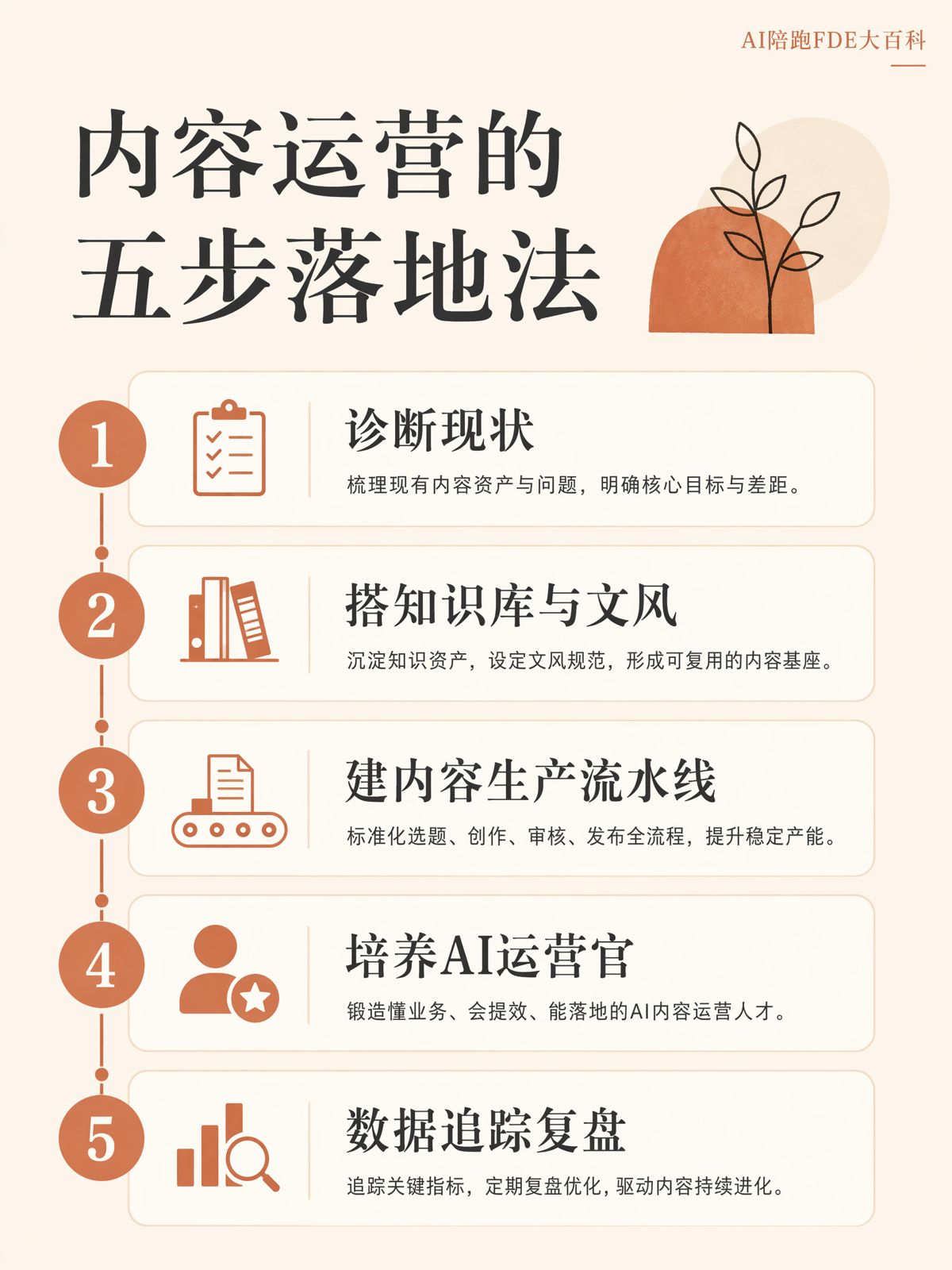
Step 1: Capture Baseline Data Before Making Changes
Diagnostic work clarifies what problem the pilot is actually meant to solve. Tool procurement belongs after diagnosis, never before.
Before starting, answer three foundational questions:
- Where is the core bottleneck in current production: topic ideation, raw capacity, inconsistent quality, or distribution efficiency?
- How does the team currently understand and use AI, and what is their practical skill level?
- Which specific scenario is best suited for small-scale validation?
Next, compile a baseline audit. Document team headcount and role allocations, current content output, format breakdowns, average production time per piece, and the primary obstacles limiting output. These metrics form the benchmark for comparison. Without this record, even if the team eventually produces more content faster, it will be impossible to pinpoint where the gains originated.
Express goals as specific numbers. For example, define the targeted weekly output volume and the planned reduction in hours spent per asset. These targets should reflect internal operational realities; efficiency multipliers achieved by other companies cannot simply be copied.
Structure the timeline in two phases: use months 1 through 3 to verify whether the workflow runs smoothly, and months 3 through 6 to evaluate whether output and business outcomes meet milestone goals.
By the end of the diagnostic phase, the company should have clear answers regarding the problem being solved, the project owner, and the acceptance metrics. If these answers remain vague, the initiative will degenerate into a cycle of switching tools without ever measuring their impact.
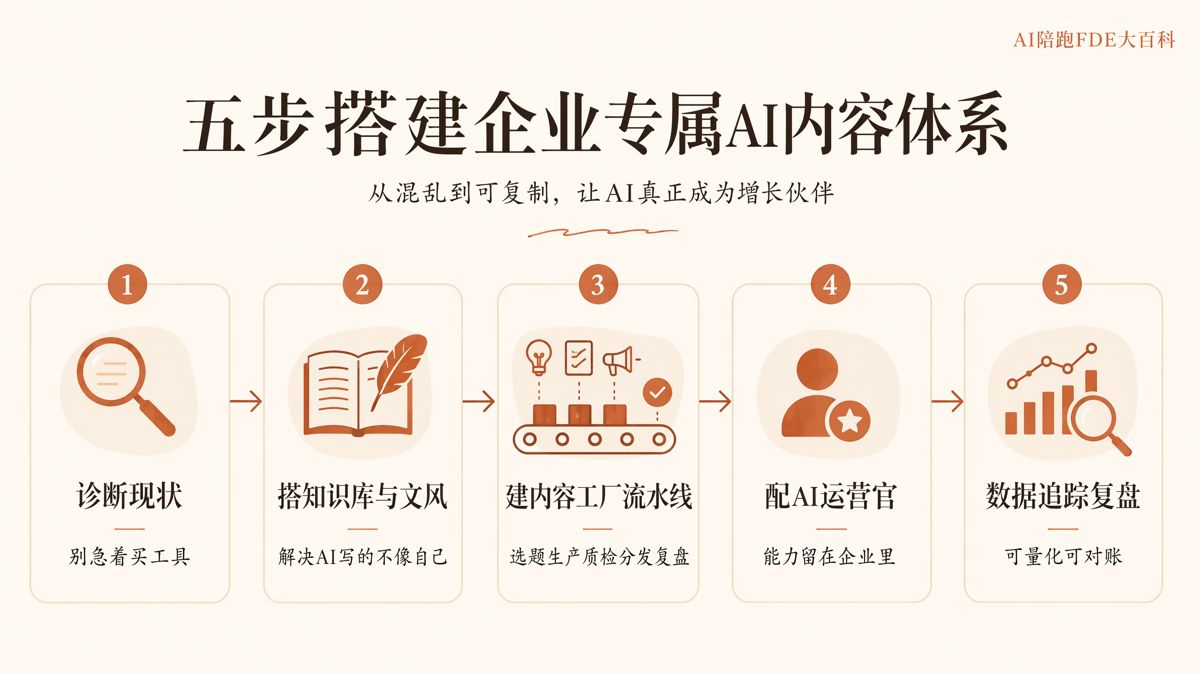
Step 2: Give AI the Right Data and the Right Voice
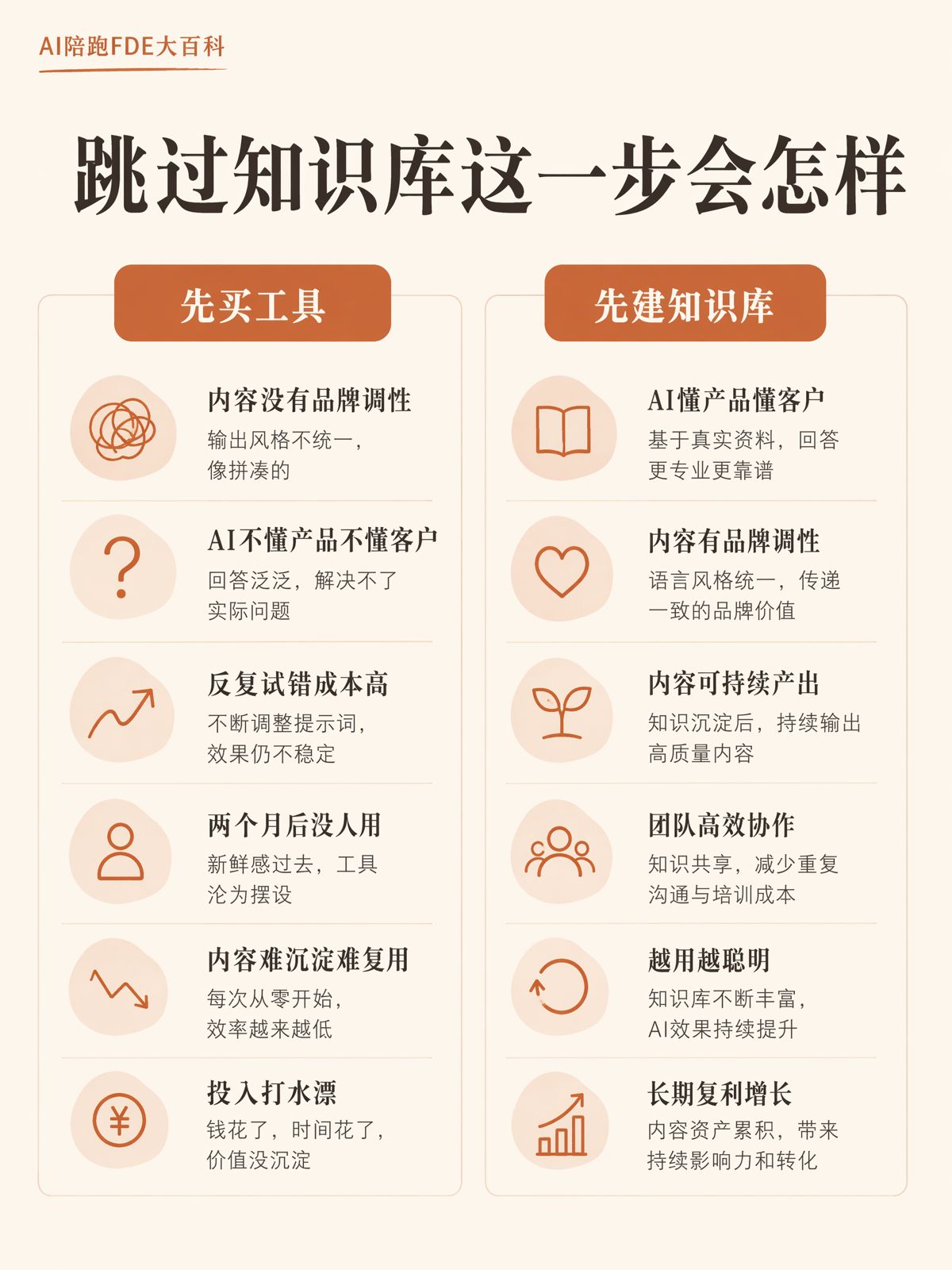
When teams start using AI, they usually run into two core problems: the generated content does not understand the company's business, and it does not sound like the company's brand.
A knowledge base solves the factual grounding problem. It stores organized enterprise documentation that the AI can reference when answering questions or drafting material.
This setup relies on Retrieval-Augmented Generation (RAG). Before drafting, the AI searches the company's repository for information relevant to the task, then generates copy based strictly on what it retrieved. This minimizes hallucinations where the AI invents business details.
Uploading a folder of documents is only the first step. How documents are categorized, whether long texts are chunked effectively for search, retrieval accuracy, and user access controls all dictate whether the knowledge base functions properly.
A style library solves the brand voice problem. It stores approved company articles and messaging samples, teaching the AI how the brand explains concepts, structures arguments, and presents points.
Prompt engineering alone cannot solve stylistic uniformity. To prevent bland, generic content, three complementary mechanisms are required:
- Maintain a scenario seed library containing distinct business contexts, ensuring every piece begins from a different practical angle.
- Use a randomization mechanism to avoid pulling the same scenario repeatedly, which creates repetitive narrative structures.
- Provide style benchmarks paired with rule-based checks and human review to eliminate formulaic parallelisms, empty adjectives, and telltale AI transitions such as "this means" or "in other words."
With these foundations in place, the AI has reliable facts to query and explicit brand guidelines to follow. Together, the knowledge base and style library determine whether an AI output is merely a generic first draft or an asset ready for review and publication.
Step 3: Connect Ideation, Production, and Distribution
Once reference materials are organized, connect ideation, production, QA, distribution, and reviews into a single workflow. In this framework, a "content factory" means these five stages operate continuously under unified standards.
- Ideation: Build a rolling topic backlog to eliminate ad-hoc brainstorming stalls. In addition to a working title, every topic entry should clearly state the target audience and the specific problem the content solves.
- Production: Feed the selected topic, knowledge base references, and style requirements to the AI to generate an initial draft. AI accelerates research and drafting, but human editors must still verify factual accuracy, assess the validity of arguments, and decide if the piece is worth publishing.
- QA: Review drafts for both regulatory compliance and editorial quality. Compliance checks focus on advertising law risks, such as absolute claims or unsupported guarantees. Editorial checks target formulaic rhetoric, vague summaries, and overused sentence structures like "it's not X, but Y."
- Distribution: Define publishing channels and posting cadences to ensure output volume aligns with distribution capacity. Without structured scheduling, higher production merely creates content backlogs or chaotic, uncoordinated posting across channels.
- Review: Feed performance metrics back into ideation and production. Let engagement data determine which topics warrant follow-up pieces, which phrasing needs adjustment, and which formats underperform on specific channels.
Building this workflow does not eliminate human work; it removes operational reliance on individual personal memory. When employees take leave or move roles, other team members can continue producing and publishing content to the exact same standard.
Step 4: Train People to Maintain the System
While an SOP can be written down, day-to-day operations require dedicated ownership. The role responsible for this is often called an AI Operator.
Traditional marketing personnel typically focus on drafting and publishing individual pieces. An AI Operator manages the system: updating the knowledge base and style library, operating and tuning pre-configured AI toolchains, auditing output quality, tracking metrics, and driving process optimizations based on results.
To retain this operational capability internally, companies must address three areas: personnel, role definitions, and digital assets.
Job responsibilities and skill requirements should be documented, and relevant personnel must receive structured training. Companies can establish an internal certification process to verify whether staff can independently manage the workflow. (This certification serves as an internal corporate evaluation, not an official occupational credential.)
Knowledge bases, style libraries, and SOP documentation must remain company-owned and continuously usable. Completing training only proves that staff attended sessions; comprehensive process documentation, accessible repositories, and verified internal certification records provide proof that operational capability has taken root inside the organization.
A pilot creates real enterprise capability only when internal staff and assets can sustain the workflow after external consultants or service partners complete their engagement.
As for how many people a single AI Operator can replace, there is no universal ratio. Content complexity, baseline productivity, and quality requirements vary widely across companies, leading to different efficiency gains. Organizations should compare verified pre- and post-pilot data to calculate actual hours saved and capacity shifts; promising arbitrary efficiency multiples upfront has no factual basis.
Step 5: Let Data Decide When to Scale
Once the workflow is operational, track results continuously.
Start by monitoring content output, production time per asset, and publishing frequency. These operational metrics are straightforward to capture and show whether the workflow is functioning properly. Once production stabilizes, observe whether output shifts correspond with commercial outcomes, such as increases in qualified leads, inquiries, and customer orders. The closer a metric is to final revenue, the more external variables influence it, requiring longer observation periods.
Break down tracking into distinct intervals:
- Month 1: Check for measurable shifts in output volume, turnaround time, and publishing frequency.
- Months 1 to 3: Complete the first formal pilot evaluation.
- Month 3 onward: Assess the overall impact across a standard content lifecycle of roughly three months.
Distinguish between "observing measurable changes" and "guaranteeing business results." Teams can commit to recording and evaluating pilot metrics under agreed standards, but guaranteeing commercial outcomes without baseline data is not credible.
Define success criteria before the pilot begins. If performance targets are met, evaluate expanding the SOP to other departments. If targets are missed, first check whether the pilot scope was too broad, ownership was unclear, or operational coaching was lacking during execution. A single missed pilot target does not mean AI has no application within the enterprise.
Three Pitfalls That Derail AI Pilots
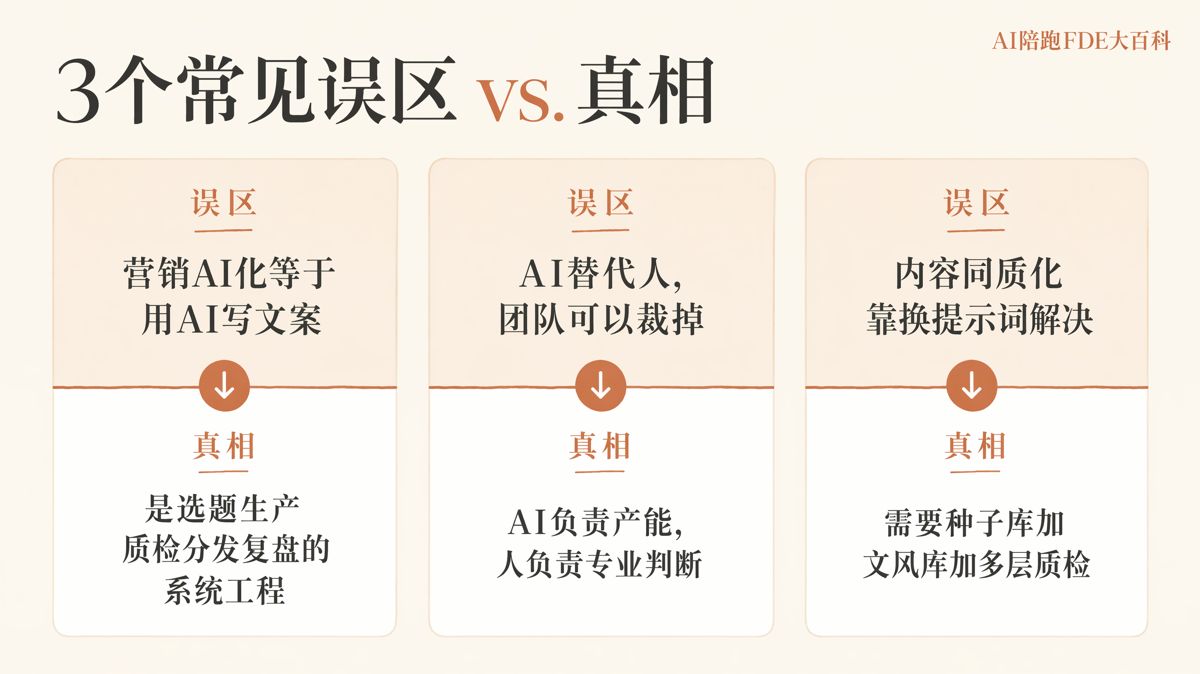
Reducing AI adoption to copywriting. Writing copy is only one step in content production. Ad-hoc AI usage cannot sustain an ideation pipeline, maintain output quality, or ensure structured distribution, nor does it create durable enterprise assets.
Equating efficiency gains with immediate headcount cuts. AI is suited for handling repetitive research and initial drafting tasks, but human editors remain indispensable for professional judgment and final oversight. Maintaining knowledge bases, auditing quality, and optimizing workflows requires people who understand both the underlying business and AI tools.
Blaming generic content solely on prompt engineering. When content repeatedly sounds monotonous, the problem usually stems from narrow business scenarios, missing style benchmarks, and inadequate QA filters. Without addressing these supporting systems, endlessly revising prompts will continue to yield similar structures and phrasing.
Audit Your AI Adoption with Three Types of Evidence
To verify whether a marketing department has genuinely transformed its operations with AI, look for three clear forms of evidence:
Process evidence: When an individual team member is away, the team still maintains its publishing cadence and baseline content standards.
Asset evidence: The enterprise owns organized, actively maintained knowledge bases, style libraries, and living SOP documents, rather than isolated chat histories and sample prompts.
Data evidence: Output volume, turnaround times, and publishing frequencies show documented comparisons against pre-pilot baselines, reviewed on a set schedule and used to adjust ongoing work.
When all three forms of evidence are present, AI has entered the marketing department's daily operational fabric. If an organization only possesses software subscriptions and tool histories without repeatable workflows, proprietary assets, and baseline data, the marketing department's AI transformation remains incomplete.
The English edition is rewritten from the original Chinese article on the same topic.

Starbox AI is an AI marketing company based in Hangzhou, China. This article draws on Starbox project work. Please credit the source when quoting.
Related reading
 AI Adoption
Can One AI Operator Really Replace 10 People?
Claims of 10x headcount cuts count generation speed, not QA and rework. Real efficiency measures net pipeline hours saved.
Oct 22, 2026 · 6 min read
 AI Adoption
Bought Basic AI and Seeing Zero ROI? A 4-Step Activation Playbook
Activating entry-level AI is not about model parameters. Turn open chat boxes into defined operational stations with clear inputs, templates, and QA checklists.
Oct 22, 2026 · 6 min read
 AI Adoption
Why One-Click AI Fails at Work: How to Pick Enterprise Agents
One-click AI tools seem easy, but their first-draft accuracy is terrible. Real business ROI requires multi-step workflows with your own knowledge base.
Oct 21, 2026 · 6 min read