
How to Convince Your CEO to Pilot AI Before Going All-In

The short answer
MIT data shows company-wide AI rollouts multiply failure rates across departments. Here is how to persuade leadership to prove one use case first.
Where the Urge to Roll Out AI Everywhere at Once Goes Wrong
The flaw in going all-in on AI is not the desire to adopt it. It is the urge to launch everywhere at the exact same time.
Executive logic usually goes like this: if AI is transformative, the sooner every team uses it, the sooner the business captures an advantage. That logic is sound when deciding whether to adopt AI. It falls apart when deciding how to implement it.
Research published in 2025 by MIT Project NANDA in The GenAI Divide tracked this exact challenge: while more than 80% of companies have experimented with general tools like ChatGPT and Copilot, only 5% of customized pilots ever reached production and delivered measurable business value. The researchers named this gap the "GenAI Divide."
That gap is not caused by weak models, nor is it blocked by regulation. The report found that the divide is determined by delivery methodology—the path chosen to take AI from technically viable to operational and genuinely useful.
Rolling AI out across the entire company at once happens to be the path with the highest failure rate.

Why a Company-Wide Rollout Is a Probability Problem, Not an Attitude Problem
It helps to separate two things: executive commitment and implementation strategy. Executive commitment is necessary. A simultaneous company-wide rollout is not.
The MIT NANDA findings quantify this difference: companies that purchase mature AI solutions and partner with external specialists see project success rates around 67%. Companies that attempt to build and roll out solutions purely in-house see success rates of roughly one-third of that figure. Furthermore, 95% of organizations have seen zero measurable business return from their GenAI investments, based on MIT's study of 150 executive interviews, 350 employee surveys, and 300 public deployments.
By mid-2025, 42% of US enterprises had abandoned the majority of their AI projects, up sharply from 17% just one year earlier, according to S&P Global. The trend is similar in Asia: McKinsey's 2025 Greater China AI adoption survey and the 2025 Chinese Entrepreneurs AI Application Survey Report revealed that while 89.84% of enterprises had used AI tools, only 6% qualified as "high-performing AI winners."
Success depends on deployment architecture, not on executive enthusiasm.
Consider the math: if one department implementing AI in isolation has a success probability of x, then five departments launching simultaneously without shared operational playbooks see their joint success rate drop precipitously. A broad rollout does not spread your risk; it multiplies the same failure rate across several fronts at once.
Piloting a single use case does the opposite. By proving how AI works within one department, your team isolates the workflow, defines evaluation standards, and turns tribal knowledge into a documented operating model. When you expand to department two and department three, you are no longer replicating unhedged risk—you are scaling a validated methodology.
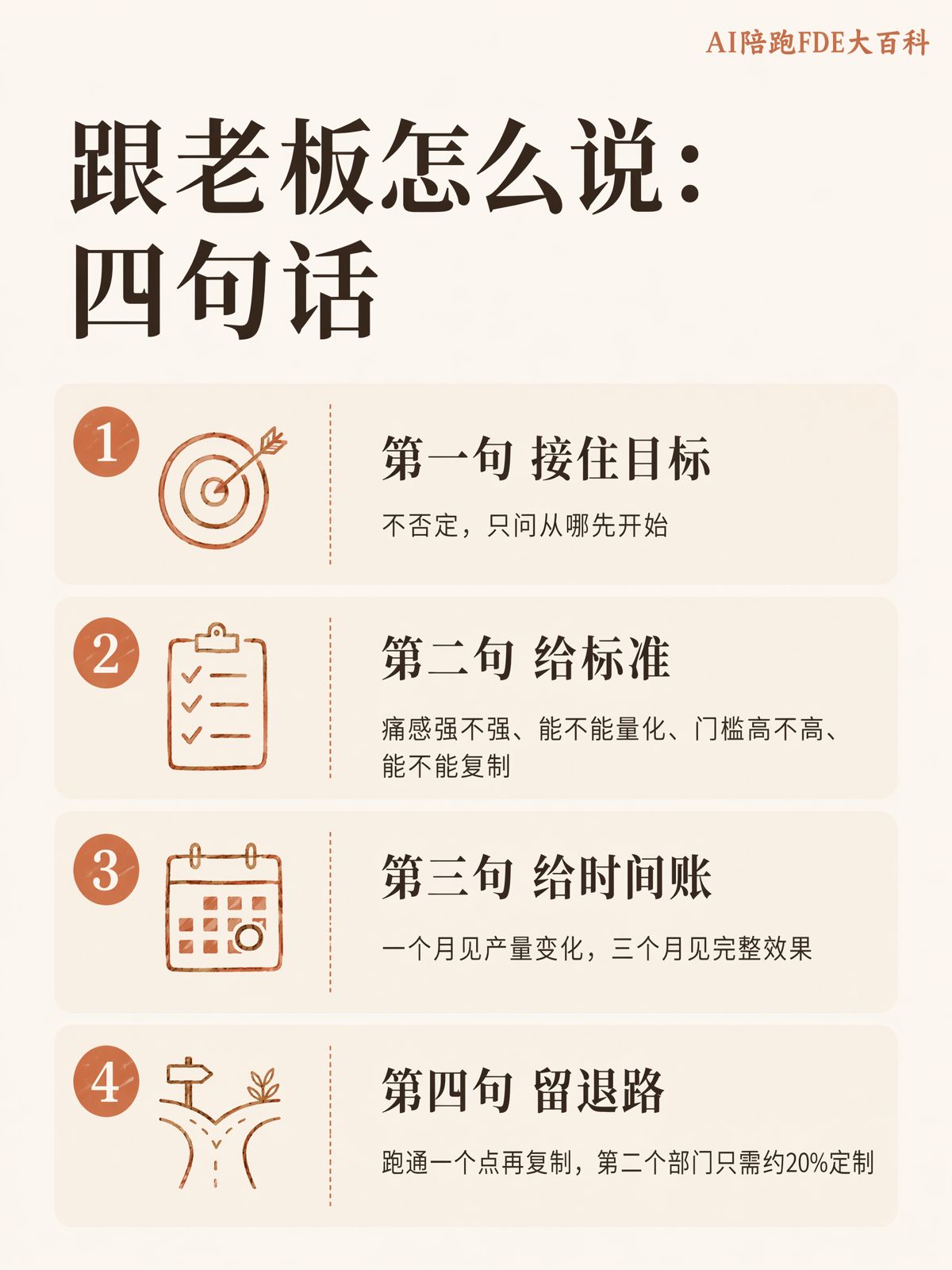
The One-Sentence Pitch: Shift the Debate from "If" to "Where First"
When speaking with your CEO, never push back against the ambition to adopt AI company-wide. That turns the meeting into an ideological debate about company vision.
Instead, pivot the discussion from whether to go all-in to where to prove it first. You validate leadership's strategic direction while grounding the execution in a manageable first step.
"Going all-in on AI is the right objective, but industry benchmarks show that rolling it out everywhere at once multiplies failure rates across every department. If we select one unit that can deliver auditable data within 3 to 6 months, we can lock down the workflows and standards first—making our company-wide rollout far more likely to succeed."
This framing gives an executive a concrete decision to approve, rather than an abstract operational debate to argue over.

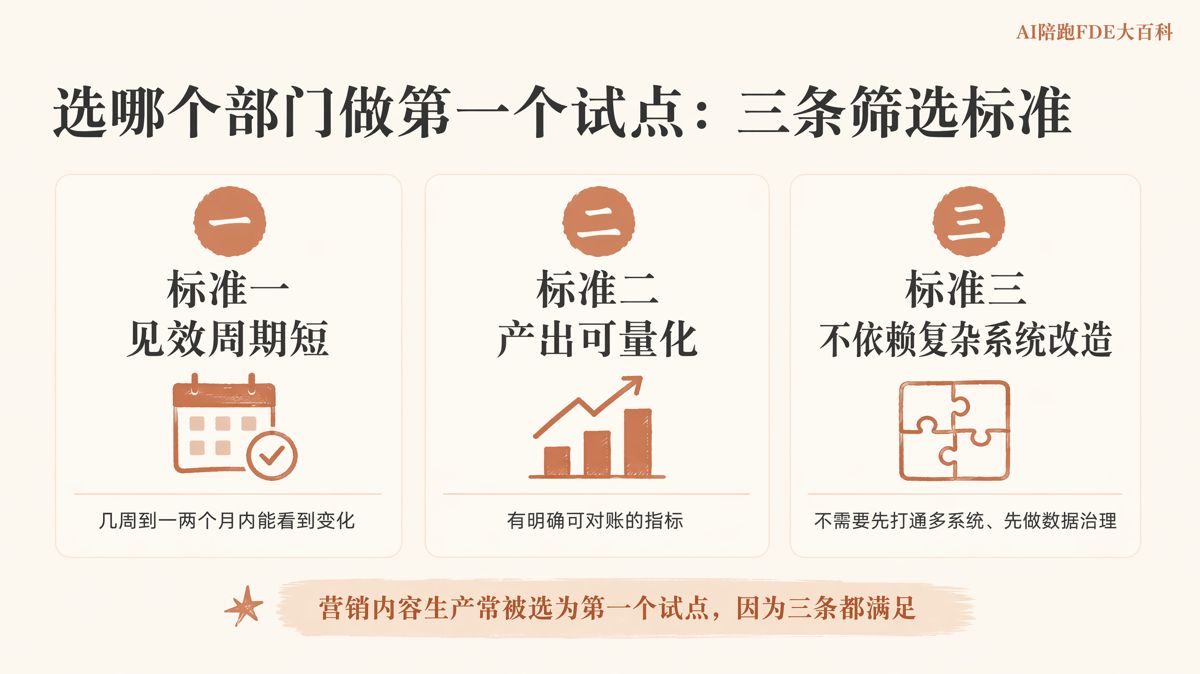
How to Pick the First Pilot: Three Selection Criteria
Not every business function makes a sensible starting point. Successful pilots typically meet three strict criteria. Missing any of them slows validation down.
1. Short feedback loops
Prioritize operational loops where performance shifts can be observed in weeks rather than quarters. Marketing content workflows and customer service triage respond much faster than core supply-chain overhauls or plant scheduling optimization. Faster output means faster iteration.
2. Quantifiable outputs
The pilot must track hard, auditable metrics: asset output volume, turnaround time per deliverable, first-response latency, or resolved ticket capacity. If an operational area has vague success metrics, skip it for pilot one. Otherwise, leadership will still be debating whether the pilot worked six months later.
3. Minimal legacy architecture rework
Avoid workflows that require complex cross-database integrations or extensive data cleaning before testing can even start. Heavy infrastructure prerequisites drag pilots into multi-quarter engineering projects, defeating the purpose of fast validation.
Marketing content generation frequently serves as an ideal initial pilot because it checks all three boxes: quick production cycles, directly quantifiable metrics (volume, turnaround hours, distribution cadence), and zero need to re-architect internal transactional databases. Other operational areas can work too, provided they satisfy these same three filters.
Setting Up the Pilot: Timeline, Metrics, and Clear Off-Ramps
Without strict timelines and pre-set targets, pilots drift into perpetual experimentation without reaching an executive conclusion.
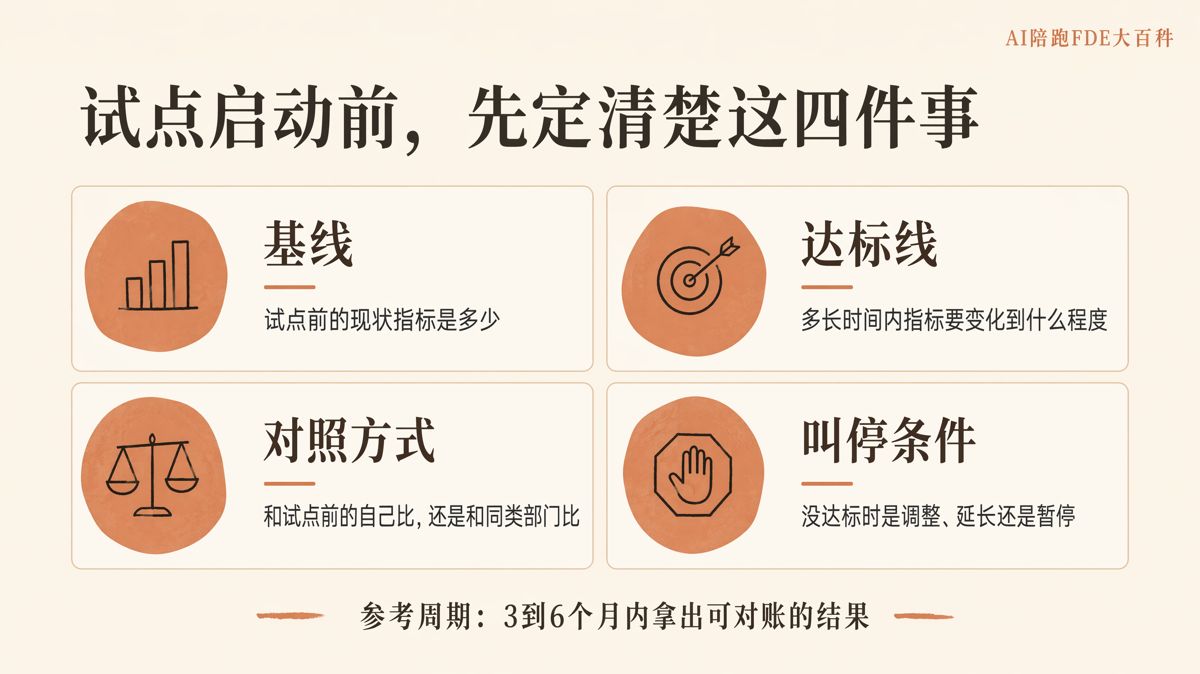
A pilot should produce auditable performance data within 3 to 6 months. If it cannot, executive leadership will lose patience and reallocate resources. Decisions at the executive level are made on numbers, not progress narratives.
Before launching, document four elements: - Baseline: Current operational throughput and efficiency metrics before AI intervention (e.g., historical monthly output, average turnaround hours). - Target threshold: The precise quantitative improvement required within the agreed timeframe to declare the pilot a success. - Control comparison: How performance will be benchmarked—against historical departmental data, or against a parallel team operating manually. - Exit criteria: The protocol if the pilot misses its benchmark at the deadline—refine the approach, extend the test, or shut it down.
When these four boundaries are established upfront, leadership can evaluate expansion objectively when the pilot ends, avoiding subjective debates.
How to Pitch Phase Two: Scaling the Validated Model
Pitching the expansion of a successful pilot requires a completely different narrative than proposing the initial test. The first pitch relies on market data and risk mitigation. The second pitch relies on your own operational numbers.
When presenting pilot results to leadership, bring three deliverables: 1. Audited comparative data: Documented baseline performance measured directly against pilot outcomes. 2. The codified workflow: Clear operational standard operating procedures (SOPs), prompt templates, review rubrics, and quality-control guardrails—not abstract claims of AI readiness. 3. The next department proposal: A business case explaining which unit should adopt the model next, evaluated against the same three selection criteria used for the initial pilot.
These three assets turn company-wide adoption from an executive gamble into an evidence-backed operational rollout. Proving a single workflow does more than reduce initial risk; it builds the blueprint for every department that follows.
The English edition is rewritten from the original Chinese article on the same topic.

Starbox AI is an AI marketing company based in Hangzhou, China. This article draws on Starbox project work. Please credit the source when quoting.
Related reading
 AI Adoption
Can One AI Operator Really Replace 10 People?
Claims of 10x headcount cuts count generation speed, not QA and rework. Real efficiency measures net pipeline hours saved.
Oct 22, 2026 · 6 min read
 AI Adoption
Bought Basic AI and Seeing Zero ROI? A 4-Step Activation Playbook
Activating entry-level AI is not about model parameters. Turn open chat boxes into defined operational stations with clear inputs, templates, and QA checklists.
Oct 22, 2026 · 6 min read
 AI Adoption
Why One-Click AI Fails at Work: How to Pick Enterprise Agents
One-click AI tools seem easy, but their first-draft accuracy is terrible. Real business ROI requires multi-step workflows with your own knowledge base.
Oct 21, 2026 · 6 min read