
How Soon Can You Replicate AI Across Departments?
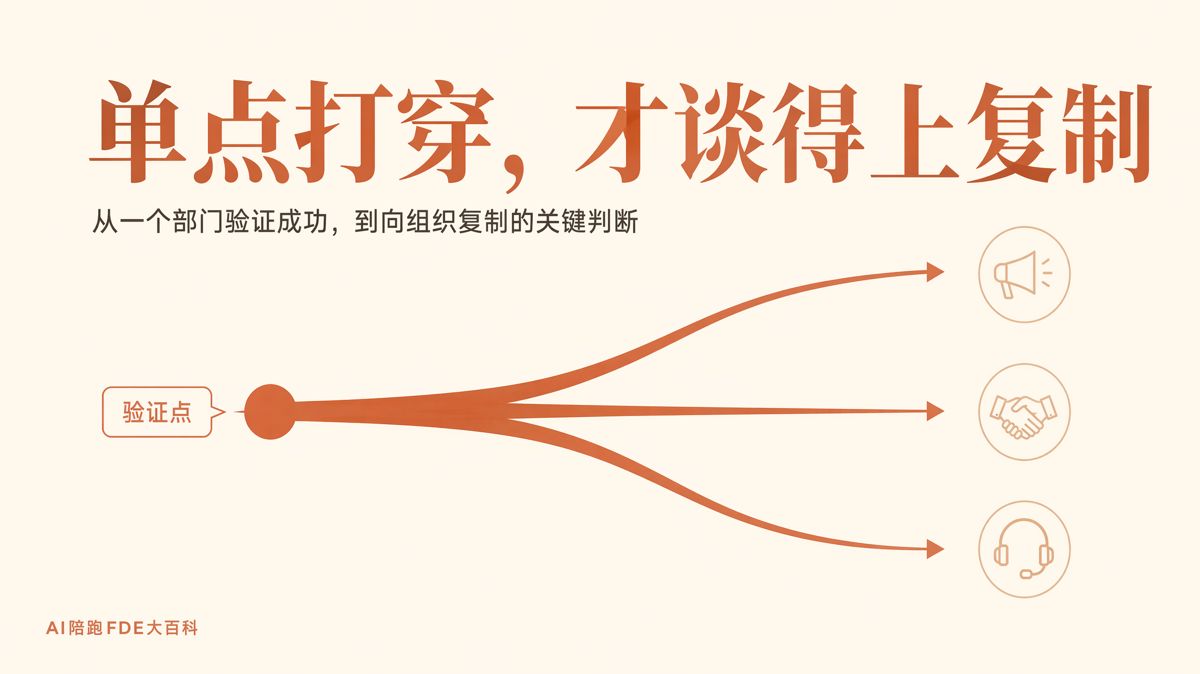
The short answer
Scaling an AI pilot across departments is not about calendar days. Look for verifiable data, repeatable workflows, and internal ownership—typically 3 to 6 months.
Why "How Long" Is the Wrong Question
Asking how long it takes to replicate an AI workflow across departments bypasses the real question: has your initial pilot actually broken through?
The proven industry path for enterprise AI adoption is straightforward: start with a single entry point, establish clear data, and only then replicate. Trying to roll out AI across multiple departments simultaneously spreads risk too thin. Any stalled workflow can derail executive confidence, whereas an isolated pilot keeps risk contained.
Marketing is almost always the best first entry point. It yields fast feedback, delivers measurable outputs like content volume and operational efficiency, and requires minimal cross-departmental integration. These factors make it easier to prove success and demonstrate tangible business value.
A true breakthrough does not mean staging a polished one-off demo. It means producing consistent, verifiable data week after week. Until your initial pilot reaches that steady state, setting a calendar date for department-wide expansion is meaningless. You cannot replicate what has not yet stabilized.
Three Signals You Are Ready to Scale, Not Calendar Days
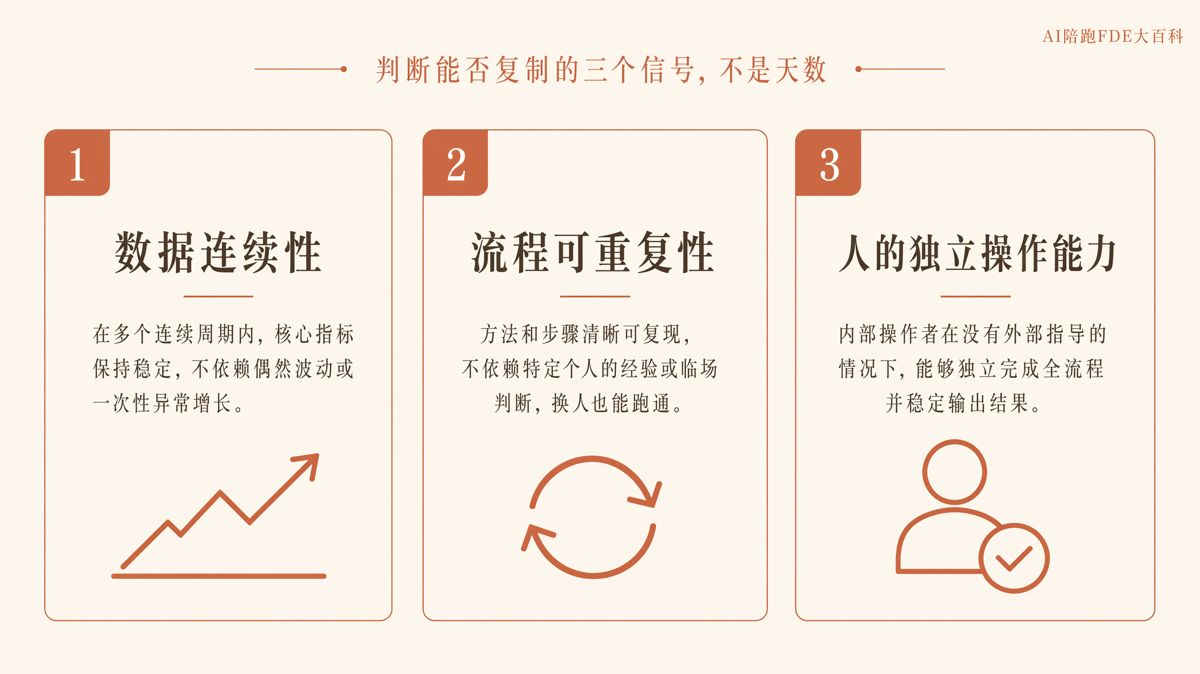
There is no universal calendar milestone that marks when a pilot is ready to expand. Instead, look for three operational signals.
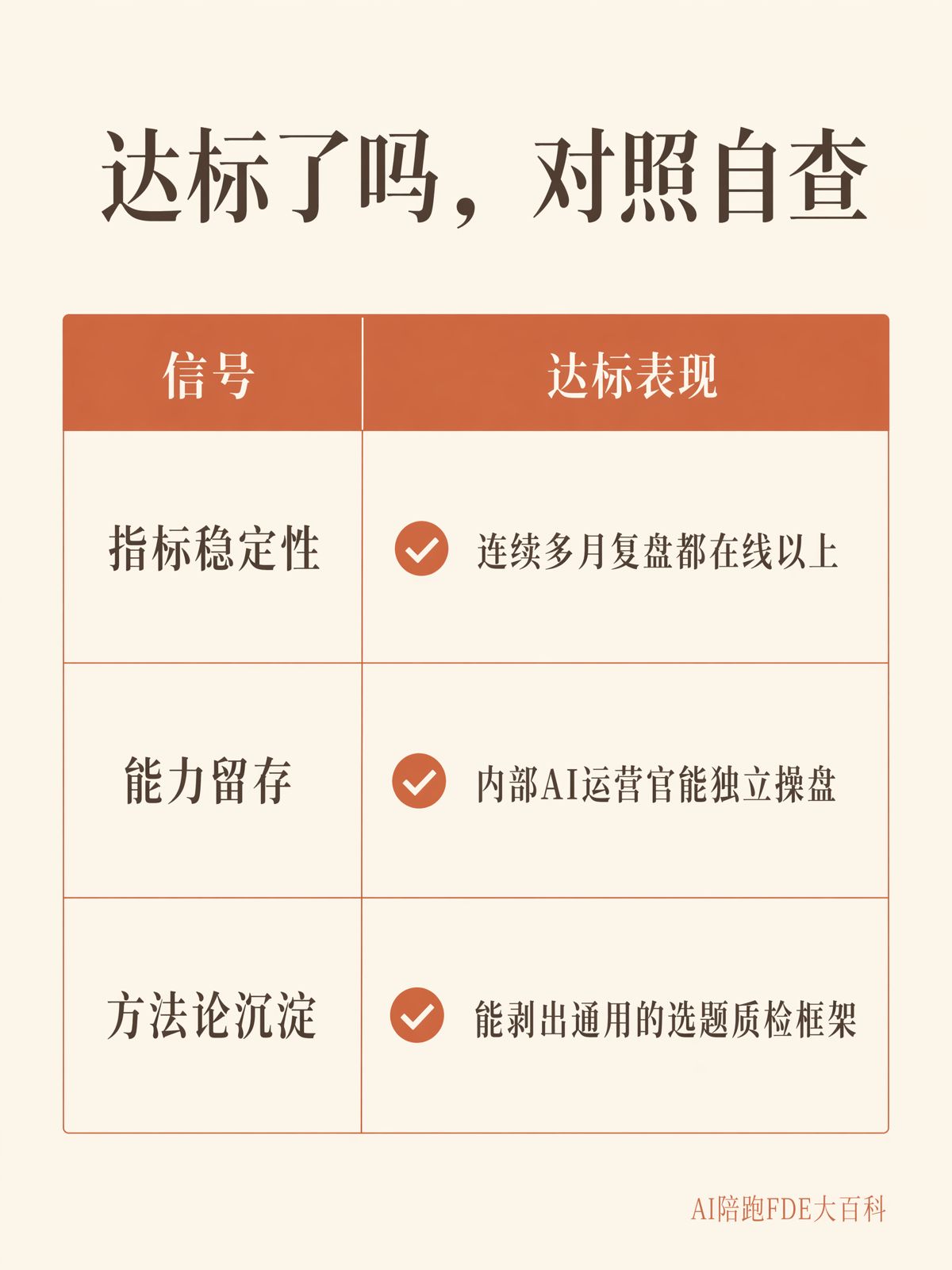
Signal 1: Data continuity. You need more than isolated performance spikes. Key metrics—such as output volume, turnaround time per asset, and publishing frequency—must show sustained improvement across consecutive cycles. Early efficiency gains often appear within the first month, but performance typically requires a full content cycle (around three months) to stabilize. A one-time surge is not a signal; sustained consistency is.
Signal 2: Process repeatability. The workflow must function independently of the specific team members or creative inputs that built it. If new team members can take unfamiliar prompts or topics and maintain consistent quality and output, the workflow has matured into a reliable system rather than an individual stroke of luck. This repeatability determines whether you are exporting a working methodology or just wishful thinking.
Signal 3: Internal operational independence. Once external consultants or implementation partners begin to step back, can your internal team run and maintain the workflow without day-to-day guidance? This requires an internal owner—often an AI Operations Officer—who manages the pipeline and reliably delivers department-level capacity. Without internal ownership, even impressive metrics represent temporary external support rather than lasting enterprise capability.
All three signals must be present. Expanding with only one or two in place usually forces the next department to start over from scratch.
From Pilot to Rollout: What the Timeline Actually Looks Like
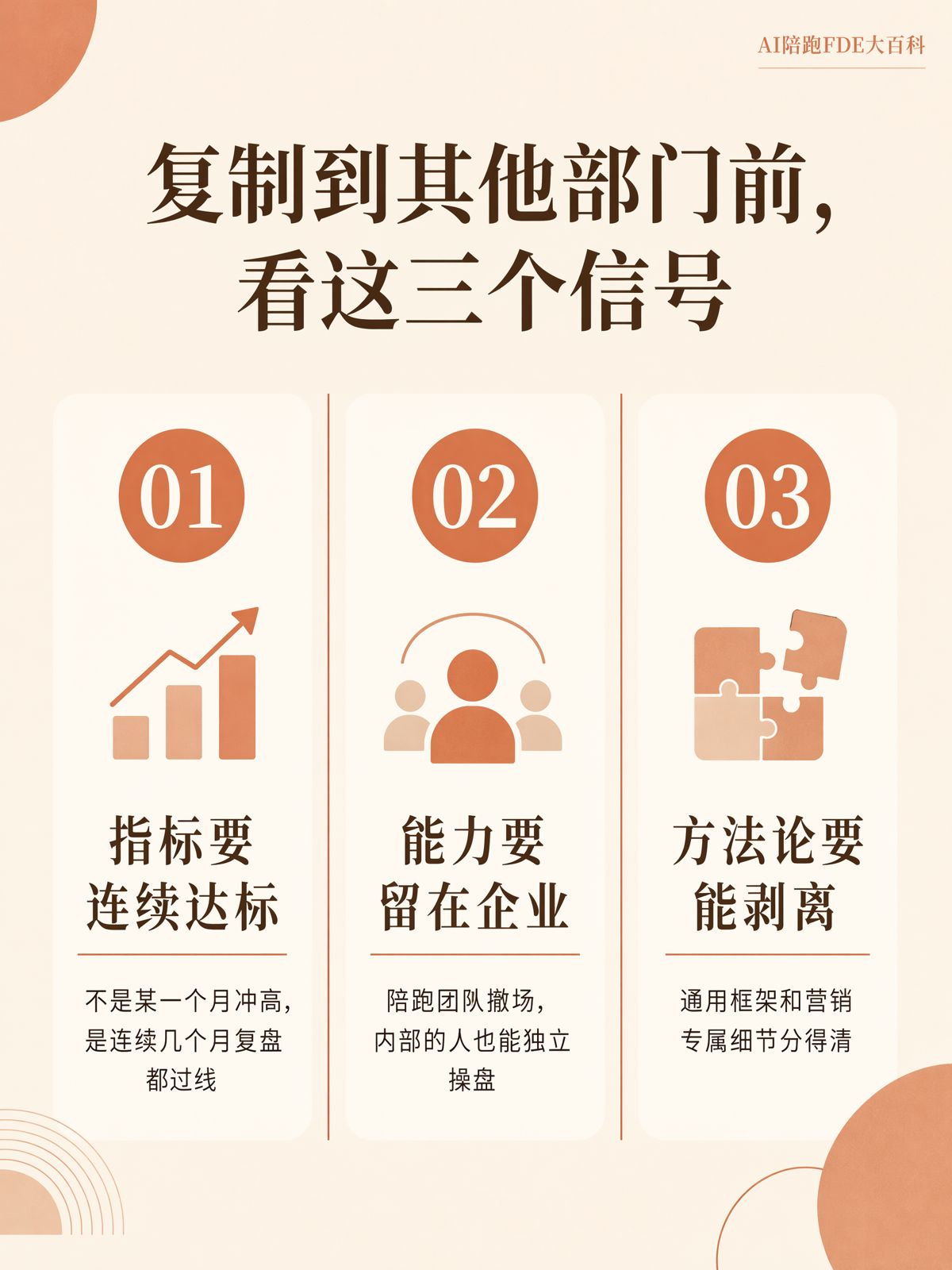
The journey from initial pilot to secondary rollout consists of two distinct phases:
Phase 1: Single-point validation (typically 1 to 3 months). This low-risk phase establishes measurable benchmarks before committing to broader enterprise investments. Because marketing offers rapid feedback loops and focused operational scopes, marketing pilots usually hit validation targets toward the shorter end of this window. Complex business units take longer.
Phase 2: Preparation for the new department (knowledge base reconstruction). Teams routinely underestimate this step. Replicating AI into sales or customer support is not as simple as granting new logins to the marketing tool. Every department operates with different domain knowledge, conversation paths, business logic, and quality standards. Expanding requires rebuilding the department's knowledge base and restructuring its specific workflows from the ground up. What carries over is the deployment methodology, not the raw data.
Taken together, industry benchmarks show that moving from an initial marketing pilot to launching in a second department typically takes 3 to 6 months. This is an empirical reference point, not an inflexible deadline. Your actual timeline should depend entirely on whether your pilot meets the three readiness signals.
Replicate the Playbook, Not Just the System
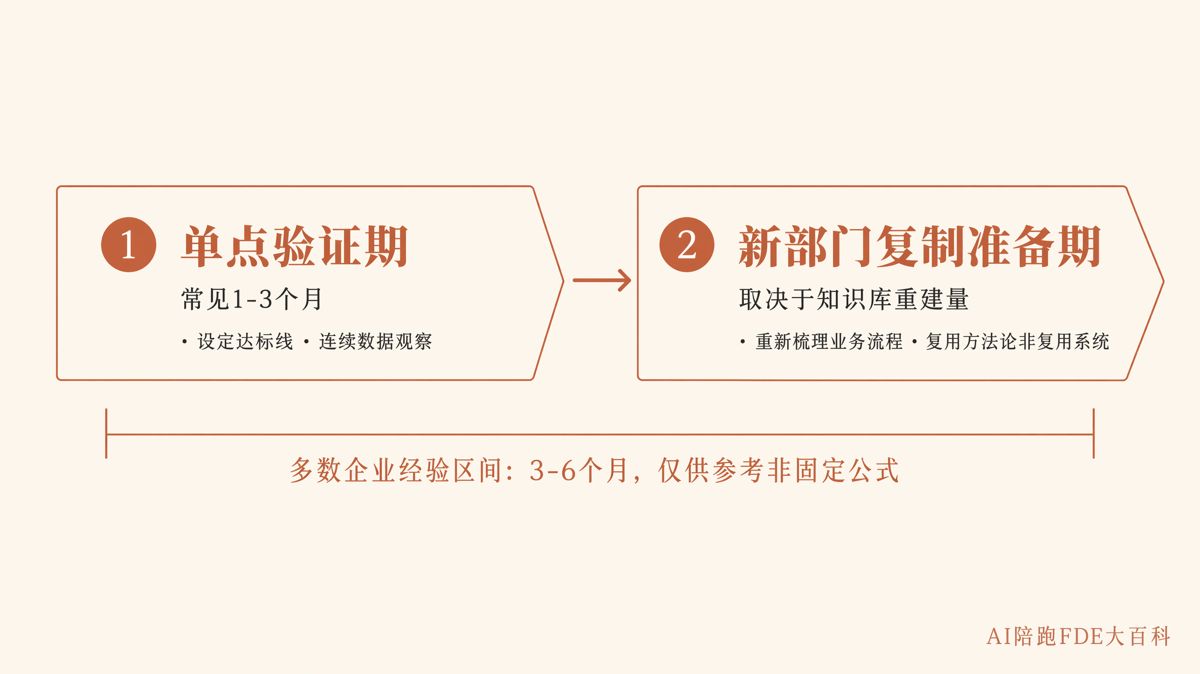
Many organizations stumble because they attempt to transplant marketing prompts and configurations directly into sales or customer service, only to find that performance collapses.
What you replicate is the proven execution framework: isolating high-impact, low-friction use cases, defining measurable validation targets, running a 1-to-3-month proof of concept, and assessing partner case studies. You do not copy marketing-specific knowledge bases and copywriting templates. Sales teams have distinct buyer personas and deal mechanics; customer support teams follow strict compliance scripts and resolution workflows. Each department requires bespoke knowledge engineering.
This explains why internal AI champions often face organizational friction during rollout. When leadership presents marketing wins to sales directors, the immediate pushback is almost always: "Our workflow is different." That objection is valid. The mistake lies in trying to duplicate tactical execution instead of applying the strategic playbook: assess existing friction, isolate a single high-value scenario, set quantitative targets, and train dedicated internal operators.
The Trap of Treating Speed as Success
Another frequent misstep is treating rollout speed as the primary measure of AI success, assuming that faster expansion reflects higher execution capability.
Data suggests otherwise. According to 2025 research from MIT Project NANDA, over 80% of surveyed enterprises had experimented with generative AI tools, yet only 5% of customized pilots reached full production and generated measurable business value. Pilots fail to scale not because teams move too slowly, but because initial pilots are never thoroughly validated. Rushing to expand with inconsistent data and dependent workflows simply exports unresolved operational flaws to the next department.
The same MIT Project NANDA study revealed that enterprises partnering with specialized service providers achieved an implementation success rate of roughly 67%—approximately three times higher than teams attempting purely in-house builds. That gap stems directly from having access to a tested, reusable deployment playbook.
The real metric to track is not how fast you scale, but whether the second deployment avoids the pitfalls of the first. If your marketing pilot leaves behind clear post-mortems detailing where bottlenecks occurred, why they happened, and how they were resolved, that institutional documentation is far more valuable than an accelerated launch date.
Three Self-Checks Before Expanding to Another Department
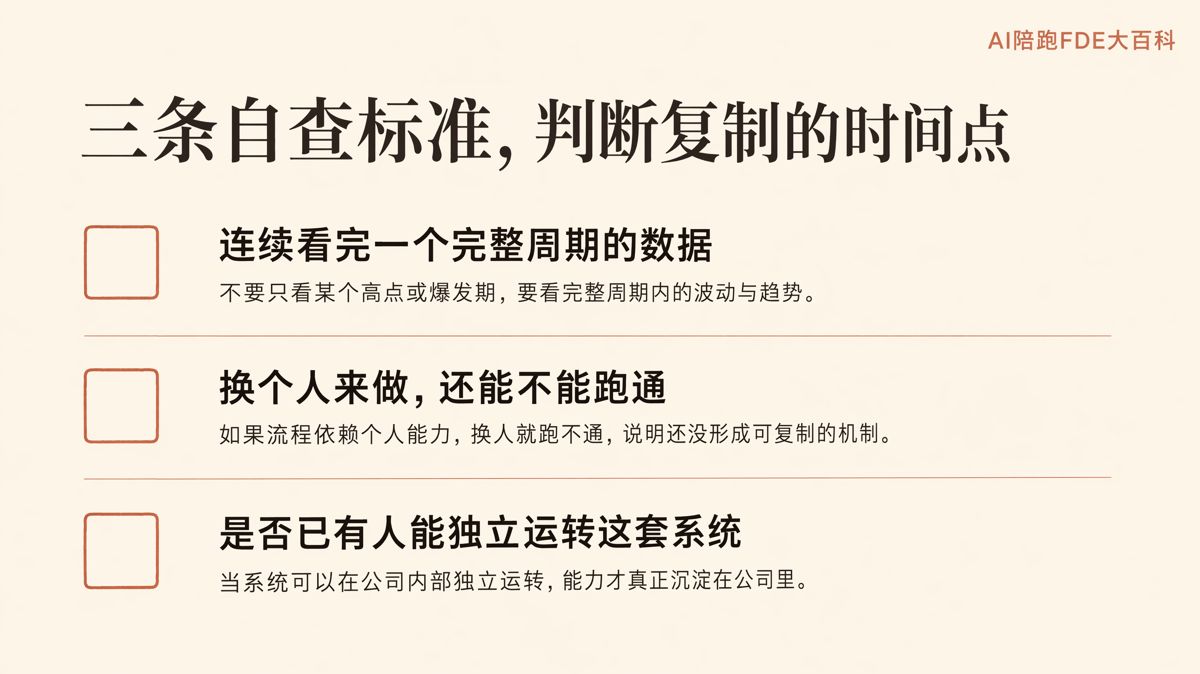
If your marketing AI pilot has been running for several weeks and you are debating whether to expand into another department, run these three checks:
- Review at least one full cycle of operational data. Look past short-term peak performances. Have core benchmarks—such as output volume, team efficiency, and production cost—remained steadily in an improved range over the past 1 to 3 months?
- Test team independence. If you assign the workflow to a different team member tomorrow, will it continue running without performance drops? If not, the process still relies on individual talent rather than institutionalized systems.
- Verify internal ownership. Can an internal operator run, troubleshoot, and adapt the system without ongoing direction from external partners? If an internal owner has not emerged, expanding will simply duplicate external dependencies in the next department.
If your pilot clears all three checks, you are ready to expand. If it falls short on even one, focus on strengthening your marketing workflow first. Securing a rock-solid foundation will save far more time and capital than prematurely forcing an enterprise-wide rollout.
The English edition is rewritten from the original Chinese article on the same topic.

Starbox AI is an AI marketing company based in Hangzhou, China. This article draws on Starbox project work. Please credit the source when quoting.
Related reading
 AI Adoption
Can One AI Operator Really Replace 10 People?
Claims of 10x headcount cuts count generation speed, not QA and rework. Real efficiency measures net pipeline hours saved.
Oct 22, 2026 · 6 min read
 AI Adoption
Bought Basic AI and Seeing Zero ROI? A 4-Step Activation Playbook
Activating entry-level AI is not about model parameters. Turn open chat boxes into defined operational stations with clear inputs, templates, and QA checklists.
Oct 22, 2026 · 6 min read
 AI Adoption
Why One-Click AI Fails at Work: How to Pick Enterprise Agents
One-click AI tools seem easy, but their first-draft accuracy is terrible. Real business ROI requires multi-step workflows with your own knowledge base.
Oct 21, 2026 · 6 min read