
Why 90% of Enterprise AI Rollouts Fail Before They Start

The short answer
Rolling out AI company-wide dilutes focus and accountability. The proven path starts with a single department beachhead to build visible ROI.
1. Rolling Out Company-Wide Looks Ambitious—In Reality, Everyone Fails Together
I have met countless executives who say the same thing about AI: "We need to go all-in across the whole company. If we do this, we do it big."
The ambition is admirable, but the outcome is predictable. The company buys enterprise licenses, pays for organization-wide training, and marches every team through a workshop. Three months later, everyone is back to their old routines.
This is not an isolated issue. According to MIT's 2025 report, The GenAI Divide, over 80% of enterprises have experimented with tools like ChatGPT, but only 5% of customized pilots ever reach production and generate measurable business value. In other words, 95% of companies spend time, budget, and executive attention without seeing a return.
Why? Because a company-wide rollout hides a fatal flaw: nobody is accountable for the outcome.
Marketing assumes implementation belongs to IT. IT assumes it belongs to business operations. Operations assumes it is the CEO's directive. Everyone is involved, but everyone is merely a spectator. The training ends, login credentials sit unused in inboxes, and momentum dies.
Worse, the wider you spread your rollout, the higher your cost of failure. Going company-wide means simultaneously altering workflows across multiple teams, training hundreds of employees, and absorbing pushback from every department at once. If any single stage stalls, the entire initiative freezes. When it does, diagnosing the failure is nearly impossible: Did the AI underperform? Did the team execute poorly? Or did you simply pick the wrong use case?
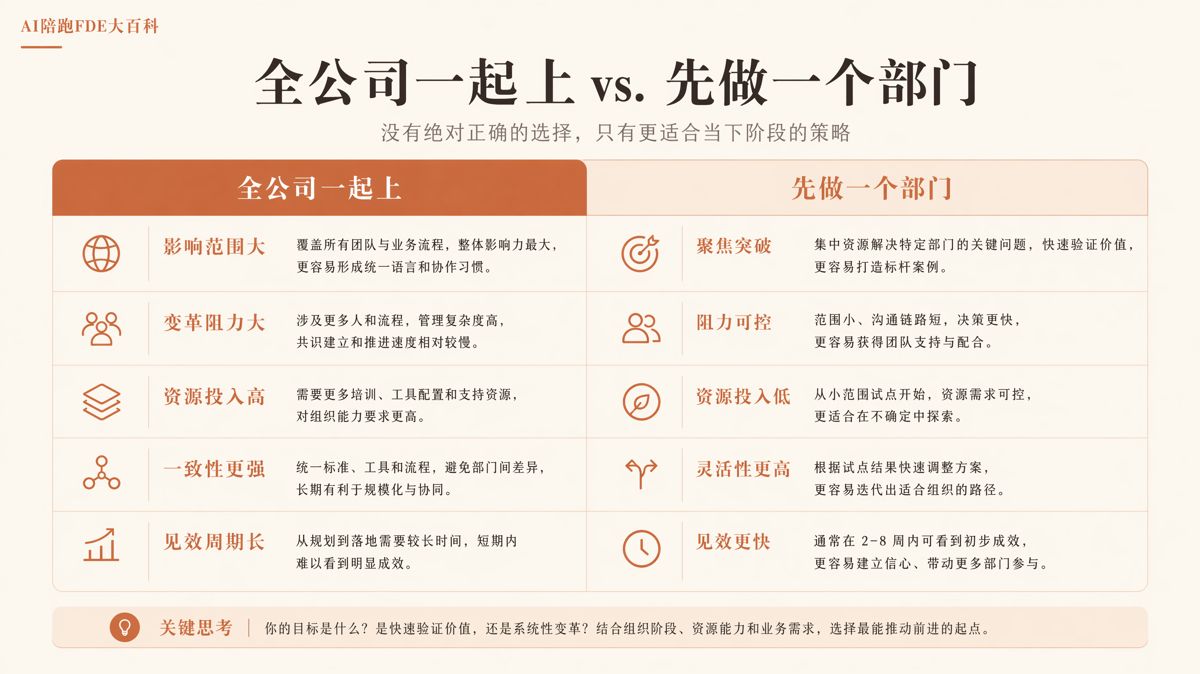
Capital flows toward efficiency. Spreading finite budget and focus across an entire organization dilutes your resources so thinly that no single department ever reaches a breakthrough.
2. Starting with One Department Is Not Timid—It Is Basic Math
The alternative is straightforward: pick a single department, target one specific workflow, push it all the way through until it yields measurable data, and then replicate that success across the business.
This approach gives you two critical advantages: clear boundaries and direct accountability.
Take your marketing department as an example. What are its core bottlenecks? Content output is too low, maintaining daily publishing schedules across multiple channels is unsustainable, and team turnover brings operations to a halt.
Your objective becomes concrete: deploy an AI content factory to allow one person to deliver the output previously requiring five.
Once the objective is locked, your KPIs become easy to measure: - How many assets were published this month? - How much did production time per asset decrease? - Did publishing frequency increase from weekly to daily?
These are hard, balance-sheet numbers. At the end of the month, whether the initiative worked or failed is indisputable.
When it succeeds, you have created a replicable internal benchmark. When other business units see Marketing radically expand output without adding headcount, they will naturally ask how to apply it to their own workflows. When you roll AI out to the next department, you face far less resistance. You are no longer selling an unproven concept; the numbers speak for themselves.
The MIT report highlights another telling metric: companies that partner with specialized external providers achieve an AI implementation success rate of roughly 67%. In-house builds succeed at only about one-third of that rate. The performance gap exists because experienced partners bring tested, battle-hardened operating playbooks rather than experimenting from scratch.
Starting with one department is not a compromise. It is disciplined risk management: validate the route at minimal cost, establish a working model, and scale only after you have proven returns.
3. How to Pick Your Beachhead Department: 3 Criteria
You cannot simply pick a department at random. Choosing the wrong beachhead will stall your rollout just as quickly as a company-wide launch.
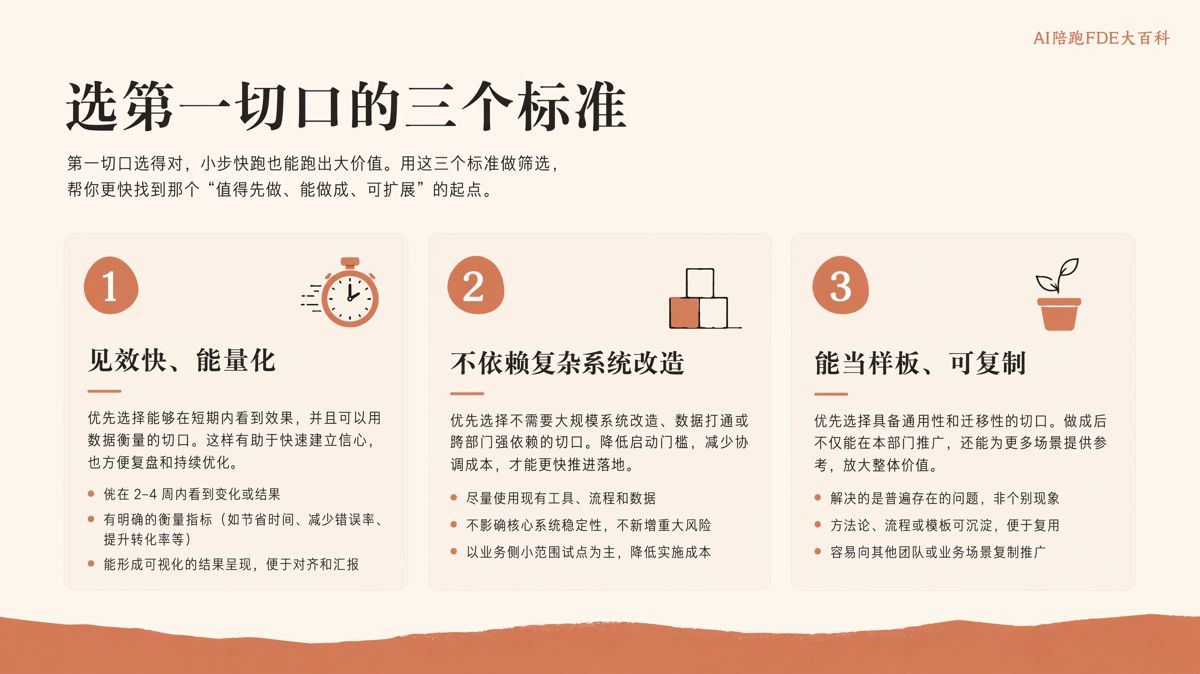
Filter your candidates against these three criteria:
1. Fast Results and Clear Metrics
Do not choose a department where success can only be evaluated six months down the line. Your first use case must deliver verifiable, auditable numbers within 30 to 90 days. Marketing content velocity, customer support resolution rates, and sales pitch production can all be measured in the near term.
2. Zero Reliance on Legacy System Overhauls
If your pilot requires deep integration across your ERP, CRM, and financial databases before going live, the deployment cycle is too long and carries too many variables. Choose a workflow that your team can set up quickly, use immediately, and generate output from day one.
3. Blueprint Value and Replicability
Once the first department hits its targets, can its operating methodology, SOPs, and prompt libraries transfer to another team? Can an automated content pipeline built for marketing be repurposed for customer support or sales enablement? If the answer is yes, you have found the right entry point.
For most businesses, marketing is the ideal first beachhead. Content bottlenecks are universal, speed to value is rapid, results are quantifiable, and the workflows translate well to adjacent functions.
However, marketing is not the only option. If your primary operational leak is slow customer support and high churn, customer service should be your beachhead.
Find the nail before you swing the hammer. Never deploy AI for its own sake; address the sharpest operational pain point your business currently faces.
4. Once the Pilot Works, How Do You Scale It?
Many leaders assume that once one team succeeds, the rest of the company will adopt AI organically. It does not work that way. Scaling requires operational structure, not passive enthusiasm.
I have watched companies run successful pilots in marketing, only for leadership to announce a company-wide expansion that immediately flatlines. Other departments did not understand what tools were used, how the workflows were engineered, or which mistakes were corrected along the way. Without structured documentation and capability transfer, "expansion" degrades into another generic training session that produces zero retention.
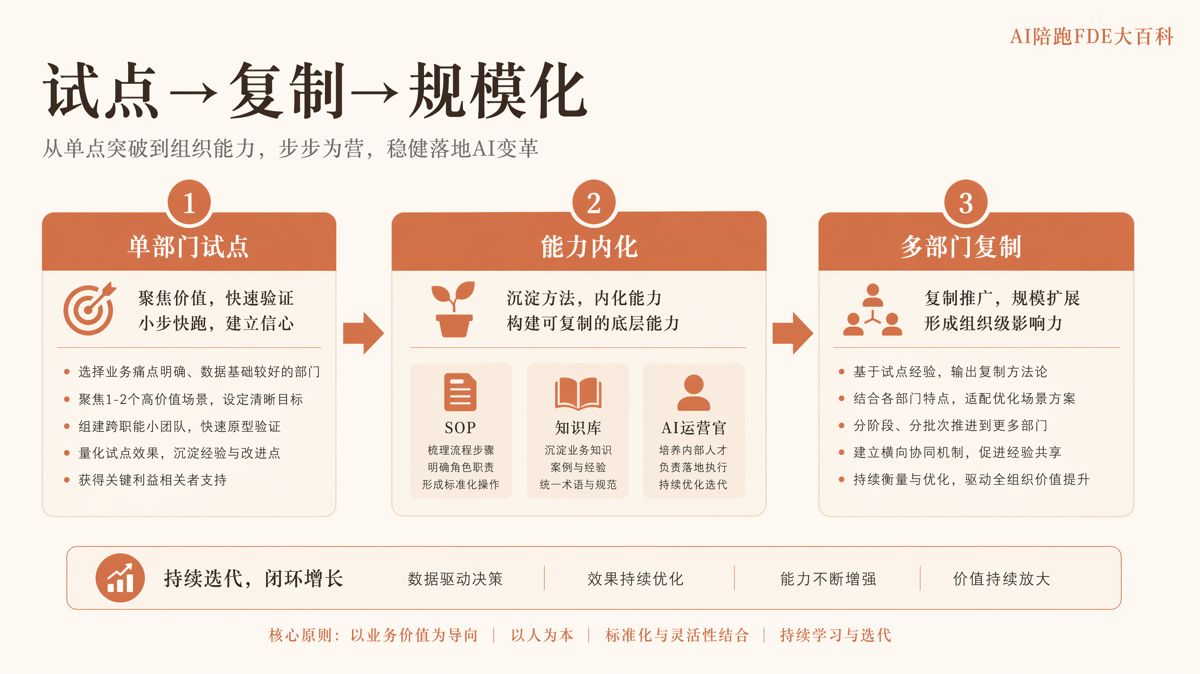
To scale successfully, plant the seeds of replication during the pilot phase:
Document Every Step in Real Time
Do not wait for a post-mortem report. As each stage of the workflow is validated, document the SOPs, prompt templates, knowledge bases, and brand voice guidelines immediately. These assets form the operational foundation for the next department.
Train an Internal AI Operator
Every pilot team needs at least one person who owns the workflow end-to-end. This person is not just a tool user; they maintain the internal knowledge base, optimize prompts, track production data, and lead performance reviews. When it is time to expand, they act as the internal champion who trains the next business unit.
Adapt Rather Than Copy-Paste
A content pipeline built for marketing cannot be dropped into customer support without changes. Customer communication involves completely different response structures, escalation protocols, and quality standards. You are replicating the underlying methodology and governance, not an identical toolchain.
This reflects what MIT calls the "learning gap": the technology itself works, but people, processes, and culture fail to evolve alongside it. That structural disconnect explains why 95% of organizations fail to realize real business value.
5. A Practical Diagnostic: What Is Your Next Step?
Use this framework to identify the right approach for your company's current stage:
| Your Current Situation | Recommended Strategy |
|---|---|
| New to AI, evaluating where to begin | Single-department pilot targeting Marketing or Customer Support |
| Purchased tools that are sitting idle | Run a root-cause review, pick one use case, and restart small |
| Completed broad training, but workflows did not change | Stop holding company-wide training; launch a focused pilot with hands-on enablement |
| One department is eager, but others are hesitant | Let the eager team build momentum; use their data to win over skeptics |
| Well-funded with strong executive commitment | Build a proven single-department benchmark before allocating capital at scale |
AI adoption is rarely a technology problem. It is an organizational design problem. If your organization cannot absorb a full-scale operational overhaul, change one workflow first.
6. Three Common Traps to Avoid
Trap 1: Confusing "Company-Wide" with Strong Commitment
Executive commitment is vital, but strategic clarity matters more. Wide rollouts fail far more often than targeted pilots because of organizational complexity, not a lack of willpower.
Trap 2: Treating Pilots as Low-Priority Experiments
A pilot is not an informal test; it is a disciplined effort to validate your highest-value hypothesis at the lowest possible cost. One fully executed benchmark delivers far more business value than ten half-finished enterprise projects.
Trap 3: Believing Marketing Is the Only Starting Point
Marketing is a proven beachhead, but it is not mandatory. Your pilot belongs wherever operational friction is costing your business the most money and time today.
Adopting enterprise AI is not a question of whether to start, but how to sequence your execution. Capital gravitates toward operational efficiency. Master one workflow, prove the return on investment with indisputable data, and the organizational buy-in will follow.
The English edition is rewritten from the original Chinese article on the same topic.

Starbox AI is an AI marketing company based in Hangzhou, China. This article draws on Starbox project work. Please credit the source when quoting.
Related reading
 AI Adoption
Can One AI Operator Really Replace 10 People?
Claims of 10x headcount cuts count generation speed, not QA and rework. Real efficiency measures net pipeline hours saved.
Oct 22, 2026 · 6 min read
 AI Adoption
Bought Basic AI and Seeing Zero ROI? A 4-Step Activation Playbook
Activating entry-level AI is not about model parameters. Turn open chat boxes into defined operational stations with clear inputs, templates, and QA checklists.
Oct 22, 2026 · 6 min read
 AI Adoption
Why One-Click AI Fails at Work: How to Pick Enterprise Agents
One-click AI tools seem easy, but their first-draft accuracy is terrible. Real business ROI requires multi-step workflows with your own knowledge base.
Oct 21, 2026 · 6 min read