
How Much Does the First Step of AI Adoption Actually Cost?

The short answer
AI adoption costs span diagnosis, tools, and talent. Real results take three stages: output shifts in month 1, results in month 3, and stable scale by month 6.
A marketing director friend recently vented to me. Her copywriter running their WeChat Official Account resigned, leaving their content calendar empty for two weeks while her CEO demanded daily updates. She wanted to hire a replacement, but onboarding someone capable takes at least a month. She looked into generative AI, but had heard too many horror stories of companies spending tens of thousands of dollars with nothing to show for it.
She asked me: "How much does the first step of AI adoption actually cost, and how long does it take to see results?"
I have asked myself that question many times. After working through numerous rollouts, I realized the answer is never just a single quote. The true cost of enterprise AI adoption involves three distinct layers, and the payoff comes in three stages. The key is understanding the structure before committing budget.
Layer 1: Diagnosis and Strategy
The first step in AI adoption is not buying a tool. It is diagnosis. Just like going to a doctor, you need an examination before writing a prescription.
A proper diagnosis answers three questions: 1. Where is your current content production bottleneck? 2. Can your existing team actually absorb and operate AI workflows? 3. Which marketing workflow is the best starting point?
Most companies do not suffer from a lack of tools. They suffer from a lack of conditions required to put those tools to work. A 2025 study from MIT found that 95% of enterprises failed to get measurable returns from generative AI. The main culprit was not subpar software, but the absence of an implementation process.
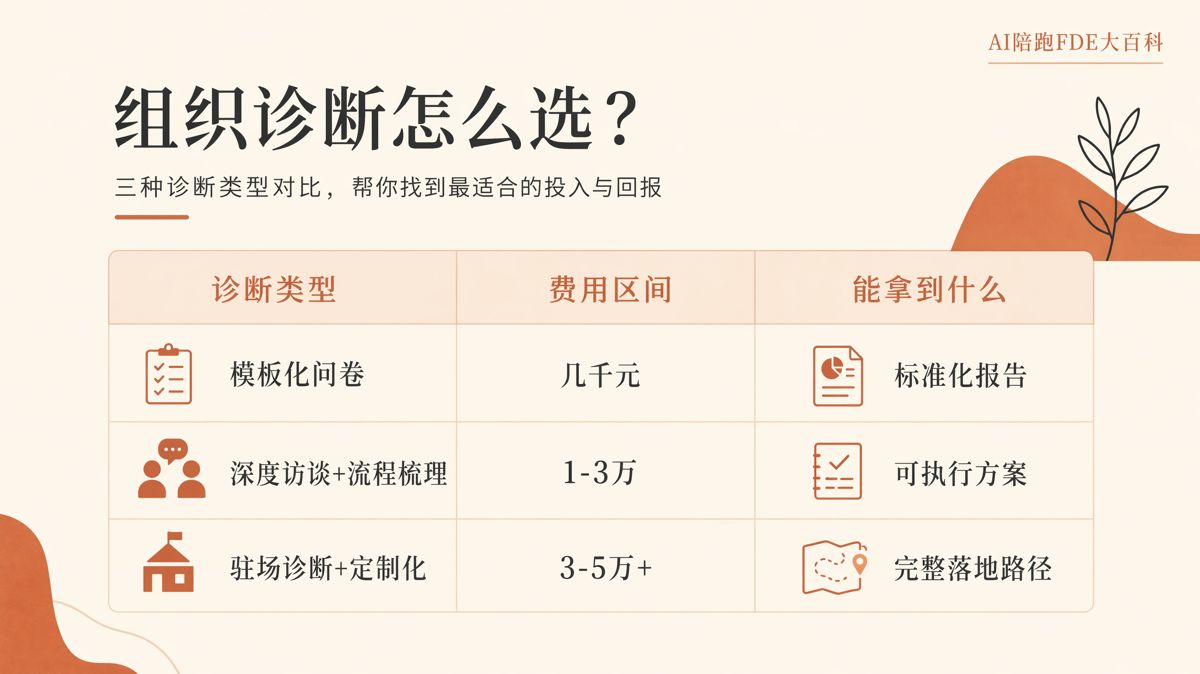
Diagnostic and strategy engagements across the market range from a few thousand to tens of thousands of dollars. On the lower end, you receive a templated survey and an automated report. On the higher end, you get on-site stakeholder interviews, workflow mapping, and a tailored roadmap.
The price point matters far less than whether the diagnosis delivers an actionable first step. If a report merely tells you "your company should use AI," that money was wasted.
Layer 2: Platforms and Tools
Once diagnosed, you need software to run your workflows. This layer shows the widest pricing variance, ranging from low-cost subscriptions to high-ticket custom builds.
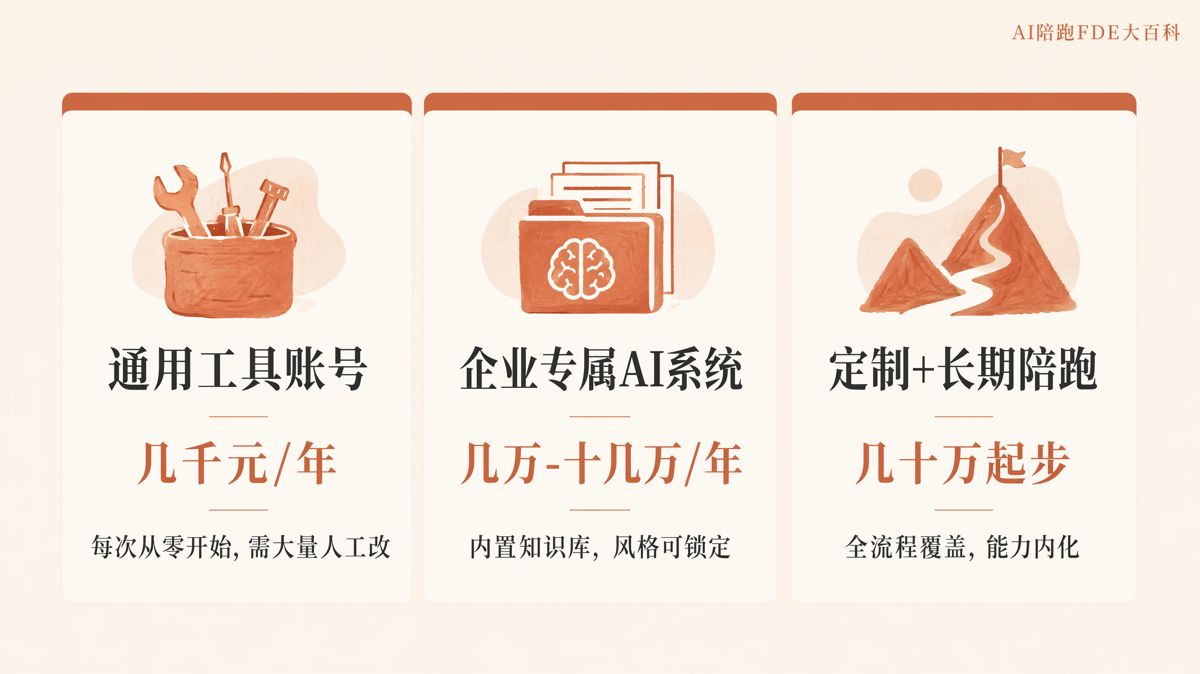
Solutions generally fall into three tiers:
- Tier 1: Generic AI tool accounts. Buying standard licenses for commercial AI platforms costs very little per year. The upside is affordability. The downside is that every task starts from scratch. These tools know nothing about your business context, forcing your staff to rewrite and edit the output manually.
- Tier 2: Dedicated enterprise AI platforms. These include proprietary business knowledge bases, locked brand voice guidelines, and automated batch workflows. They typically run on annual licenses. The deciding factor here is whether the vendor provides hands-on onboarding and workflow enablement.
- Tier 3: Custom development with long-term enablement. This covers the complete lifecycle: building private knowledge bases, configuring AI agents, providing on-site coaching, and training in-house AI operators. These enterprise engagements cost significantly more and suit mid-to-large companies with high content deficits that want to keep capabilities in-house.
When evaluating platforms, do not just read the feature matrix. Ask one critical question: Will this platform verifiably change my team's content production capacity within 30 days?
Layer 3: Talent and Training
This is the most hidden cost layer and where most teams fail.
AI adoption does not end when you purchase software. Someone must operate it daily. This person is not simply a traditional marketer who knows how to write prompts. They are an AI operator: someone who orchestrates AI workflows, maintains the company knowledge base, tracks performance metrics, and continuously optimizes generation pipelines.
A trained AI operator can match the marketing output of 5 to 10 traditional team members. However, that capacity only exists if they are properly trained.
Training costs include ramp-up time, trial-and-error iterations, and initial quality fluctuations. Many leaders calculate software licensing fees but ignore the cost of upskilling their team. When that happens, the company buys an expensive system, nobody uses it, and workflows revert to their old manual habits within three months.
The Three Stages of Results
AI adoption is not an on-off switch. It takes time to set roots, develop, and yield returns.
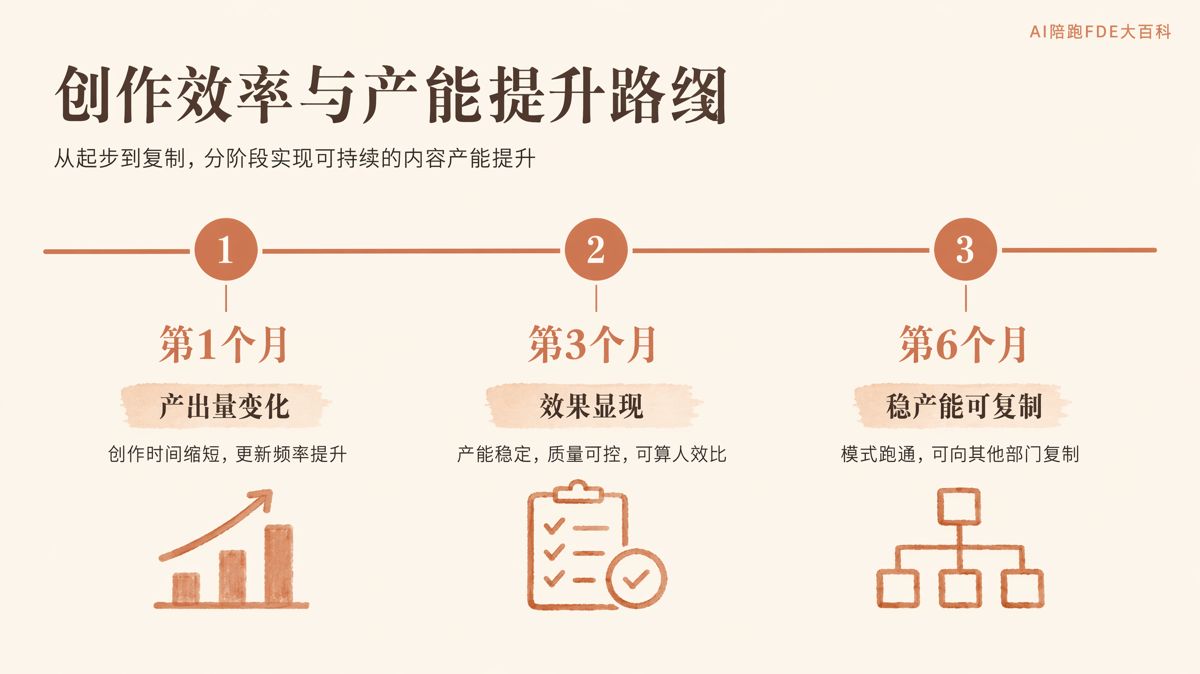
- Month 1: Visible shifts in production volume. Creation time per asset drops, posting frequency rises, and teams stop pulling late nights to hit publishing deadlines. This is an operational efficiency gain. It is easy to measure, but do not obsess over full financial ROI yet.
- Month 3: Tangible performance gains. Output volume stabilizes, quality remains consistent through systematic QA checks, and your internal AI operator runs the platform without external help. Now you can measure workforce efficiency: How much did labor overhead decrease for the exact same output? Did you eliminate your content backlog?
- Month 6: Scalable, reproducible capacity. Once the system runs smoothly in one department, the playbook can expand into customer support, sales enablement, or partner acquisition. This is the stage where you calculate full multi-year ROI.
Industry-wide, enterprise AI projects typically take 2 to 4 years to break even. Content and marketing AI initiatives move much faster because the entry point is narrower and feedback loops are shorter. The golden rule is to keep the initial deployment focused: prove the model in one department and one workflow before expanding.
How to Evaluate Your Investment
Before signing a contract, vet the provider against three criteria:
- Itemized billing transparency. Can the vendor break down costs across man-days, deployment, software licenses, and review sessions? Be cautious of vague, all-in quotes.
- Pilot verification before long-term commitment. Can you run a limited one-month pilot to verify production improvements before signing an annual contract? This is the most reliable way to de-risk adoption.
- Internal capability retention. When the consulting or onboarding engagement ends, can your staff run the operation independently? Are the knowledge bases, standard operating procedures (SOPs), and prompt libraries fully handed over to you? If the operational capability stays with the vendor, the system breaks the moment you cancel the contract.
Key Takeaway
The cost of your first step into AI is not a single invoice. It is the sum of diagnosis, platform tooling, and workforce enablement. Real results arrive in phases: production shifts in month 1, measurable efficiency gains in month 3, and scalable capacity by month 6. The most cost-effective approach is to test on a small, contained scope, verify the data, and scale your spend based on proven results.
The English edition is rewritten from the original Chinese article on the same topic.

Starbox AI is an AI marketing company based in Hangzhou, China. This article draws on Starbox project work. Please credit the source when quoting.
Related reading
 AI Adoption
Can One AI Operator Really Replace 10 People?
Claims of 10x headcount cuts count generation speed, not QA and rework. Real efficiency measures net pipeline hours saved.
Oct 22, 2026 · 6 min read
 AI Adoption
Bought Basic AI and Seeing Zero ROI? A 4-Step Activation Playbook
Activating entry-level AI is not about model parameters. Turn open chat boxes into defined operational stations with clear inputs, templates, and QA checklists.
Oct 22, 2026 · 6 min read
 AI Adoption
Why One-Click AI Fails at Work: How to Pick Enterprise Agents
One-click AI tools seem easy, but their first-draft accuracy is terrible. Real business ROI requires multi-step workflows with your own knowledge base.
Oct 21, 2026 · 6 min read