
Can You Adopt AI Without a Data Foundation?

The short answer
Yes. Clean data is not a prerequisite for AI adoption. Choosing the right entry point matters far more than hoarding years of historical records.
Many business leaders believe they cannot adopt AI until they spend months organizing their historical data. That assumption sounds logical, but it is one of the most common pitfalls in enterprise digital transformation.
A 2025 study by MIT NANDA revealed a counterintuitive finding: 95% of enterprises fail to capture measurable returns from generative AI. The primary bottleneck is almost never model capability or data volume. Instead, failures stem from misalignment across data, workflows, strategic goals, organization, talent, and governance.
Data is only one variable, and it is rarely the decisive one.
In China, enterprise AI tool adoption reached 89.84%, yet only 5% of customized pilot projects advanced into live production (MIT NANDA 2025). Most companies do not fail because they lack data. They fail because they buy software without knowing how to integrate it into real operations.
AI implementation is not a marathon to hoard data. It is a sprint to identify the right use case.
Where Companies Without Data Should Start
A lack of legacy data is often an advantage. Without decades of messy, incompatible records holding you back, you can design native AI workflows from a clean slate.
Marketing Content Production: The Fastest Entry Point
For most small and mid-sized enterprises (SMEs), marketing content capacity offers the quickest route to measurable impact:
- Fast turnaround: Output volume and publishing frequency show improvements within 30 days.
- Zero reliance on legacy databases: You do not need three years of sales spreadsheets. You only need to define who you are, what you sell, and your target audience.
- Quantifiable metrics: Content units per day and creation time per piece are immediately trackable.
- Replicable workflows: Once content generation runs smoothly, the same operational models apply to customer support, partner acquisition, and internal training.
The MIT research supports this path: purchasing solutions and partnering with specialized external teams yields a ~67% success rate, compared to roughly 33% for purely in-house development. For companies starting from scratch, working with an experienced implementation partner to tackle marketing production delivers far higher success rates than experimenting alone.
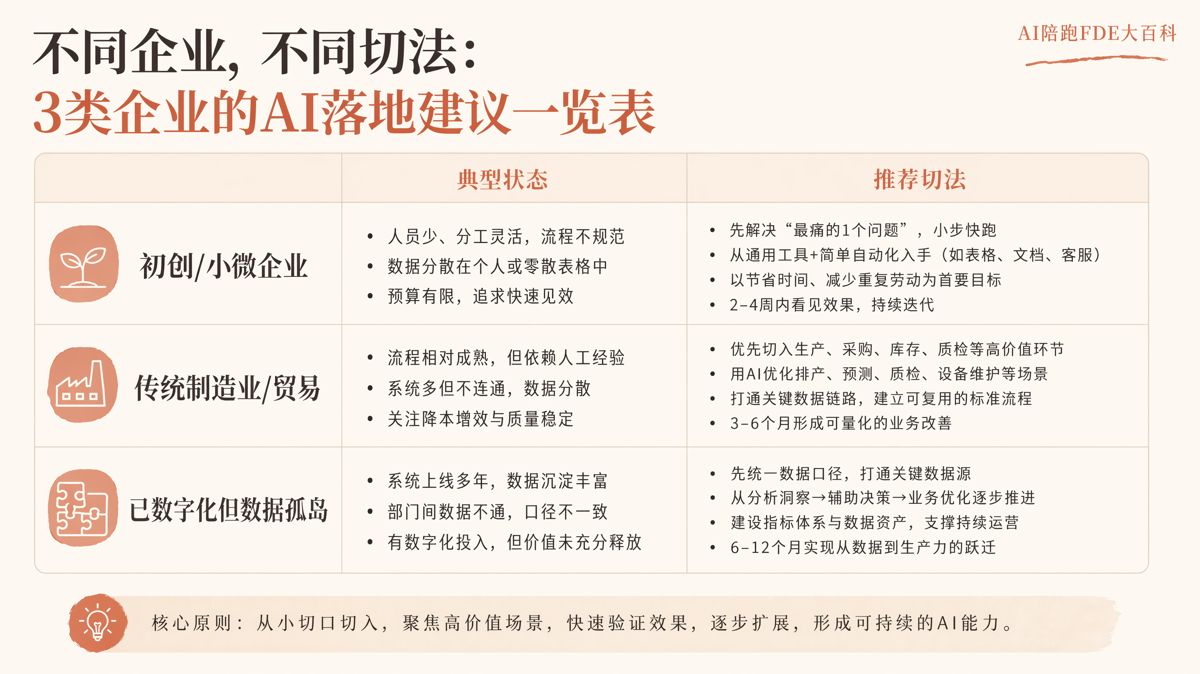
Three Types of Data-Poor Companies
| Enterprise Profile | Current State | Recommended Approach |
|---|---|---|
| Startups and Micro-Businesses | Early stage; workflows are still developing | Build an AI content factory to stabilize output; accumulate operational data in real time |
| Traditional Manufacturing and Trading | Established revenue; low digital maturity | Begin with marketing content to build automated customer acquisition pipelines |
| Digitized but Siloed Organizations | High data volume scattered across disconnected systems | Avoid full data unification initially; select a single operational scenario for a targeted knowledge base |
Core principle: Start with a small scope, validate quickly, then expand.

The Real Risks of Starting Without Data
Data matters, but you must distinguish between startup data and continuous data.
Startup Data Requires Far Less Than You Think
To launch an AI workflow, you do not need ten years of cleaned Excel files. For marketing content, your startup data only requires:
- Your product or service deck (even a short presentation is sufficient)
- A few past content pieces that performed well (articles, brochures, or social updates)
- A working profile of your target customer (even a verbal description)
Most businesses already have these materials. They simply do not view them as data assets.
Continuous Data Accumulates Naturally
The data that actually drives commercial value appears after the AI workflow starts running:
- Which topics earn higher impressions
- Which narrative styles drive conversions
- The top 20 questions prospective buyers ask
Before deploying AI, you cannot know which metrics to track. Launching the workflow reveals what data is worth capturing.
The Real Failure Modes
| Risk | Symptom | Countermeasure |
|---|---|---|
| Overly Broad Scope | Attempting company-wide AI deployment on day one | Target a single point; master one use case before scaling |
| No Accountability | Purchasing software that sits unused within three months | Assign an internal AI operator or retain an implementation partner committed to outcomes |
| Vague Metrics | General feeling that AI helps, without hard numbers | Define concrete, quantifiable KPIs before launching |
How to Determine If You Are Ready to Begin
Not every business should start immediately. Use this framework to evaluate your readiness:
Signals you are ready: - You have an urgent business bottleneck (insufficient content volume, slow customer service response times, outdated sales collateral). - You can designate an individual or team accountable for the final outcome. - You accept a staged approach: validate on a small scale, then expand once targets are met.
Signals to hold off: - You cannot articulate the specific business problem AI should resolve. - Internal leadership expects software to solve organizational inefficiencies automatically. - There is no budget allocated even for a small validation pilot.
AI deployment is an operational business initiative, not an IT experiment. If you have an operational challenge to solve, data can be collected as you build. If you are simply chasing industry trends, no amount of data will make the rollout successful.
How Companies Without Data Should Select Vendors
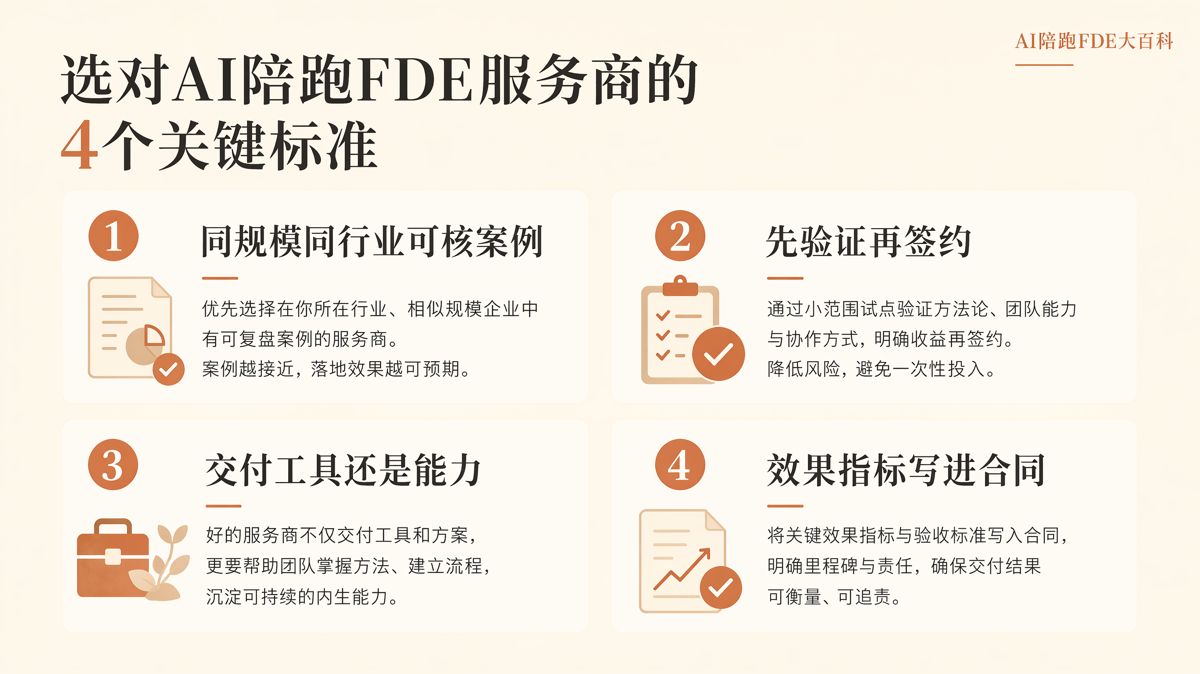
When choosing an AI vendor without an internal data foundation, evaluate four criteria:
- Verifiable case studies in your industry and tier: Avoid generic agency claims. Ask to see case studies from companies of similar size and industry that also started from zero, and request to speak with past clients.
- Willingness to validate before full commitment: Legitimate partners should offer low-risk validation phases before signing long-term agreements. Be cautious of vendors demanding multi-year, upfront payments without proof of concept.
- Delivery of internal capability, not just software licenses: Handing over a software dashboard leads to shelfware. Real value lies in capability transfer—ensuring your internal team can operate the systems independently after vendor engagement ends.
- Contractual performance metrics: Verbal promises of 30-day improvements carry no weight. Focus on concrete metrics written into service agreements, such as percentage increases in content output or reductions in production hours.
A Proven Roadmap: Land, Solve, and Expand
The Forward Deployed Engineer (FDE) model pioneered by Palantir and utilized across frontier AI firms focuses on an essential strategy: do not attempt an enterprise-wide overhaul. Embed technical experts directly into operational workflows, solve one specific problem end-to-end, and then replicate the model across other functions.
This approach is particularly effective for teams starting without data:
- Operational Diagnosis: Identify the single business workflow most receptive to an AI entry point.
- Lock In the Target: Select an area that delivers rapid results, such as marketing content velocity.
- Set Quantifiable Goals: For instance, scale production from one daily asset to five within 30 days.
- Deploy Dedicated Operators: Appoint an internal AI lead or engage an on-site implementation partner to direct execution.
- Review and Iterate: Track performance weekly, adjust prompt workflows monthly, and establish audited business outcomes within 90 days.
MIT's 2025 benchmark showing a ~67% success rate for vendor partnerships reflects this reality: success is not determined by data volume, but by targeted scoping, direct operational ownership, and disciplined execution.
Summary
Data is useful, but it is not an entry ticket. MIT's 2025 findings confirmed that the 95% of companies failing to see AI returns are held back by flawed operational methods, not clean data shortages.
For companies without a data foundation, the path forward requires picking the right entry point, assigning accountability, validating performance, and scaling incrementally. Marketing content capacity remains the most practical starting point. Once that workflow runs, operational data and internal capability will follow.
The real danger is not a lack of data. It is waiting on the sidelines until your data feels ready, while competitors complete their operational pilots.
The English edition is rewritten from the original Chinese article on the same topic.

Starbox AI is an AI marketing company based in Hangzhou, China. This article draws on Starbox project work. Please credit the source when quoting.
Related reading
 AI Adoption
Can One AI Operator Really Replace 10 People?
Claims of 10x headcount cuts count generation speed, not QA and rework. Real efficiency measures net pipeline hours saved.
Oct 22, 2026 · 6 min read
 AI Adoption
Bought Basic AI and Seeing Zero ROI? A 4-Step Activation Playbook
Activating entry-level AI is not about model parameters. Turn open chat boxes into defined operational stations with clear inputs, templates, and QA checklists.
Oct 22, 2026 · 6 min read
 AI Adoption
Why One-Click AI Fails at Work: How to Pick Enterprise Agents
One-click AI tools seem easy, but their first-draft accuracy is terrible. Real business ROI requires multi-step workflows with your own knowledge base.
Oct 21, 2026 · 6 min read