
Starting AI Adoption: Hire First or Train First?

The short answer
Before deciding whether to hire an AI specialist or upskill your current team, run a focused pilot to clarify what the job actually requires.
When companies prepare to integrate AI into daily operations, executive discussions usually jump straight to staffing: should you hire an AI specialist from outside, or train your existing team?
It is the wrong question to start with.
AI adoption means applying artificial intelligence to a specific, defined task to achieve measurable gains in speed, quality, or output. At the very beginning, most organizations do not know which workflows are suitable for AI, what real-world results look like, or how much ongoing workload will exist. Without that validation, you cannot define job responsibilities or performance metrics.
Rushing to recruit at this stage adds a fixed overhead cost before you have even identified the specific operational problem that person needs to solve.
A more practical approach is straightforward: have your current team complete a tightly scoped pilot, track the concrete results, and then decide whether to train from within, bring in external enablement, or recruit a dedicated hire.
Knowing How to Use AI Tools Does Not Mean Leading AI Adoption
Once leadership decides to adopt AI, companies often publish job postings asking for familiarity with large language models (LLMs), prompt engineering, or AI project experience.
LLMs are AI models trained on massive datasets that can understand and generate text and other formats. Prompt engineering is the practice of structuring inputs and instructions to get targeted outputs from an AI model.
Proficiency with these tools is valuable, but companies do not just need tool operators. The person responsible for operational AI adoption must also understand your specific business, assess which tasks should be handed to AI, prepare the required source materials, design workflows, integrate tools into existing routines, and review final outputs.
This work requires business judgment, process design, tooling fluency, and quality control. A new hire unfamiliar with your day-to-day operations cannot handle all of that independently on day one.
If goals are vague, source materials are disorganized, workflows are undefined, and business units do not collaborate, even an experienced AI hire will remain stuck in endless experimentation.
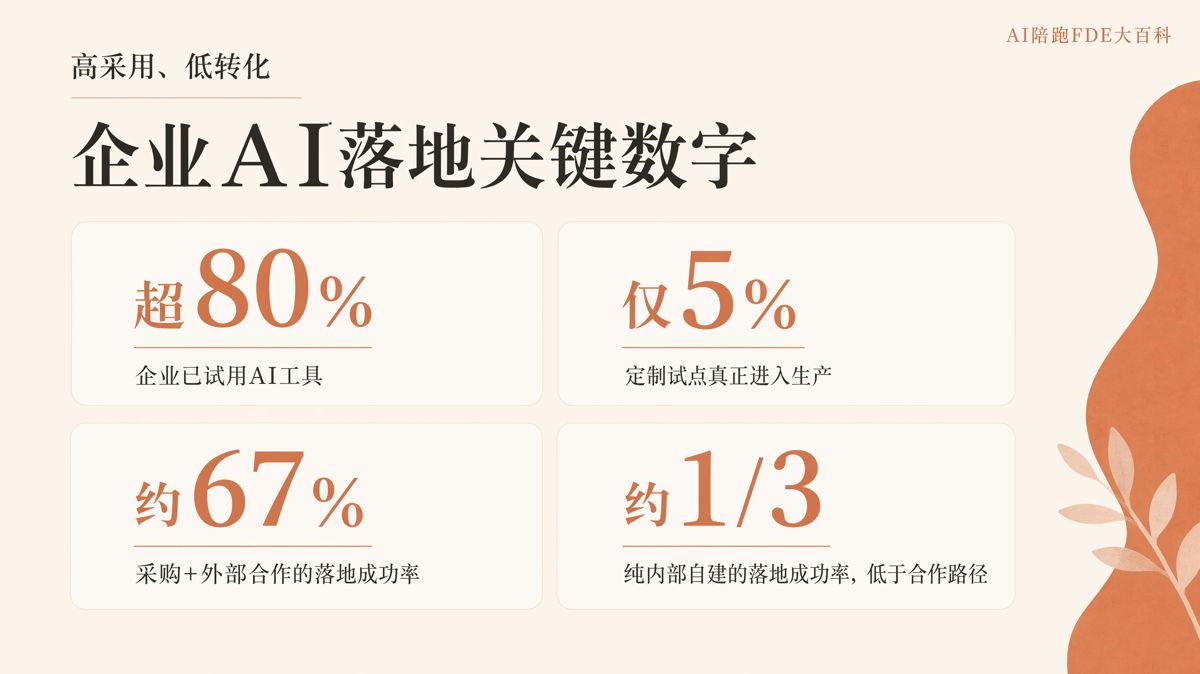
In 2025, MIT's Project NANDA research team published The GenAI Divide. The study found that while over 80% of surveyed organizations had experimented with at least one generative AI tool, only about 5% of custom pilots progressed into production and generated measurable business value. "In production" means the system is integrated into formal business workflows, rather than remaining a one-off demo or short-term trial.
This data highlights a critical gap: running an AI experiment is entirely different from building an operational AI capability. Creating a new job title cannot substitute for clear goals, structured processes, and prepared reference data.
The MIT study also observed that within its interview sample, organizations purchasing mature solutions alongside external partners achieved deployment in roughly 67% of projects. Teams trying to build everything in-house from scratch reached deployment in approximately 33% of projects. These numbers reflect deployment outcomes within that specific research sample rather than universal benchmarks, but the strategic takeaway holds: validating direction and controlling early experimentation costs is far safer than creating a role and figuring out its purpose later.
Use a Pilot to Define Your Actual Talent Requirements
A "scenario" is a specific workflow you want AI to perform. A "pilot" is a small-scale execution designed to generate real data before committing long-term resources.
Workflows suitable for an initial pilot usually meet four criteria: existing source data can be used directly, the operational process is relatively stable, results appear quickly, and outcomes can be measured objectively.
Marketing content production is often an ideal starting point. Production volume, turnaround time, and revision rounds are straightforward to track. A marketing pilot rarely requires modifying core infrastructure, and once proven, the methodology is easy to transfer to other departments.
You can structure your initial pilot in four steps:
- Audit your current team: Identify who understands the business best, who already experiments with AI tools, and which tasks contain high-frequency repetitive work.
- Select one defined workflow: Avoid starting multiple initiatives simultaneously.
- Establish baseline metrics: Track output volume per unit of time, production time per asset, and revision frequency.
- Run a structured debrief: Compare actual operational data against original targets to identify what worked and where bottlenecks emerged.
Once you have these findings, you can clearly answer three key hiring questions:
- Does this workflow justify ongoing investment?
- Is the ongoing workload substantial enough to support a full-time role?
- Does the company need technical developers, process operators, or business practitioners who can apply AI tools?
Without those answers, writing an accurate job description is nearly impossible.
Three Staffing Paths for Different Growth Stages
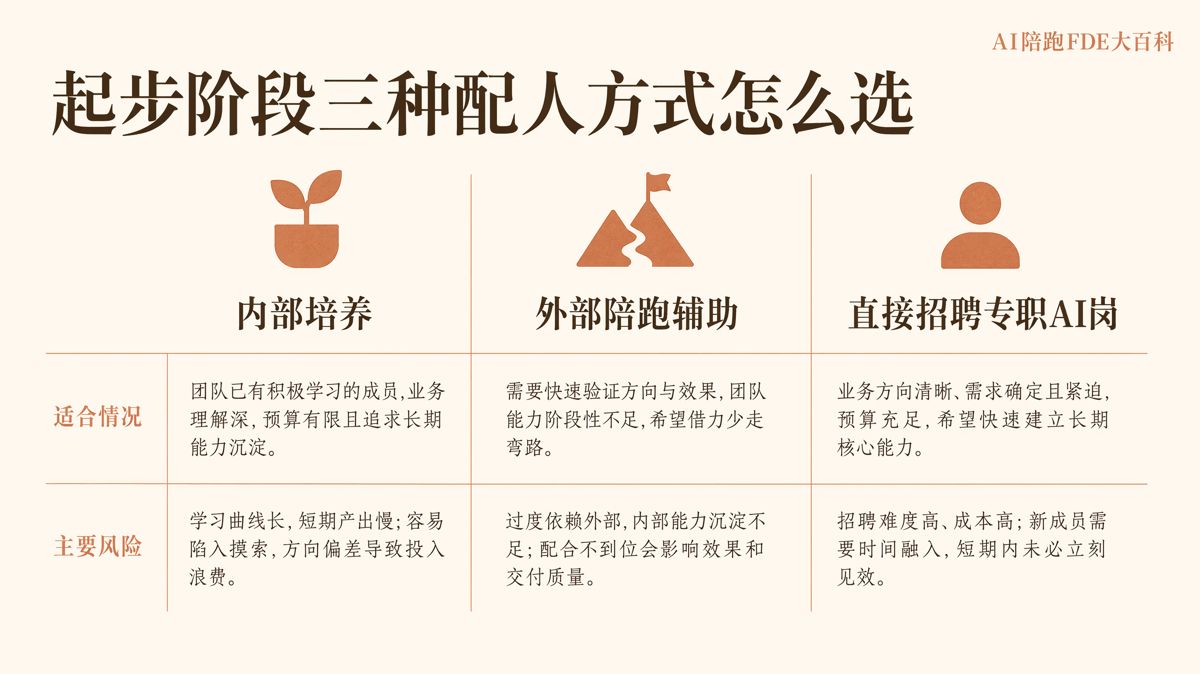
Once pilot results are documented, companies generally have three paths: train existing staff, bring in external enablement partners, or recruit dedicated specialists.
External enablement involves an experienced outside team working alongside your team to select workflows, design standard operating procedures (SOPs), configure tooling, and audit outputs. Internal personnel participate throughout so they can maintain the workflow independently later.
| Staffing Path | Best Suited For | Key Considerations |
|---|---|---|
| Internal Upskilling | Teams with strong business knowledge and active learners, where the initial pilot is already validated. | Training takes time. Without continuous practice, output reviews, and proper tool support, skills fade quickly. |
| External Enablement | Teams with capable operators that lack proven frameworks, process design, or operational experience, needing rapid validation. | Both sides must agree upfront on pilot objectives, deliverables, and exact internal participation requirements. |
| Dedicated Hire | Workflows with completed pilots, verified scale to justify a full-time position, and established KPIs. | Talent combining AI fluency and deep industry context is rare; hires isolated from the core business struggle to deliver results. |
Companies often combine these paths across stages. For example, your internal team can run an initial pilot alongside an external partner to document workflows and build reference assets. Once production expands and workload stabilizes, you can hire a full-time operator.
This role often functions as an internal AI Operations Lead. Their job is not basic tool exploration, but continuously identifying suitable business workflows, organizing operational processes, maintaining company reference data, coordinating teams, and taking accountability for AI production quality and efficiency.
The Value of Training Depends on What Stays Behind
Many organizations run AI workshops, only to see employees revert to their original work habits within a few months. The issue usually lies not in the curriculum, but in what happens afterward: no persistent tools are provided, no ongoing workflows are assigned, no output checks exist, and no internal lead is designated.
A training session can introduce tools, but it will not automatically rewire operational routines. To determine whether your organization has built genuine AI capabilities, look for three tangible assets once an initiative ends:
- An executable SOP: Clear documentation detailing who runs each step, what source materials are required, how to execute, and how outputs are verified.
- Reusable knowledge bases and brand voice libraries: Structured repositories of business context for teams and AI models to reference, alongside standardized style guides and criteria.
- An accountable internal lead: A team member capable of operating the tools independently, auditing outputs, and refining the workflow over time.
If a project ends with nothing more than slide decks, you have not retained the capability internally.
When hiring external service providers, distinguish between vendors who execute a task for you and those who enable your team while delivering the outcome. The former solves short-term output; the latter transfers long-term capability. The three assets listed above serve as direct acceptance criteria for external engagements.
Three Common Staffing Misconceptions
Misconception 1: A stalled AI initiative means you hired the wrong person
Staffing can be a factor, but a new hire cannot unilaterally define your business goals, organize proprietary knowledge, or force business units to cooperate. If basic operational readiness is absent, hiring more people will not solve the problem.
Misconception 2: Company-wide training means the organization is AI-enabled
Attendance numbers and workshop hours do not reflect daily operational reality. Training is effective only when it produces documented workflows, reusable assets, and independent internal owners.
Misconception 3: Hiring AI talent is about cutting headcount
A more sustainable model assigns repetitive execution to AI while humans define objectives, audit quality, handle edge cases, and make complex business decisions. A skilled team member using AI can manage higher output volumes than before, but the exact multiplier depends on task complexity, existing assets, and operational discipline—not an arbitrary formula.
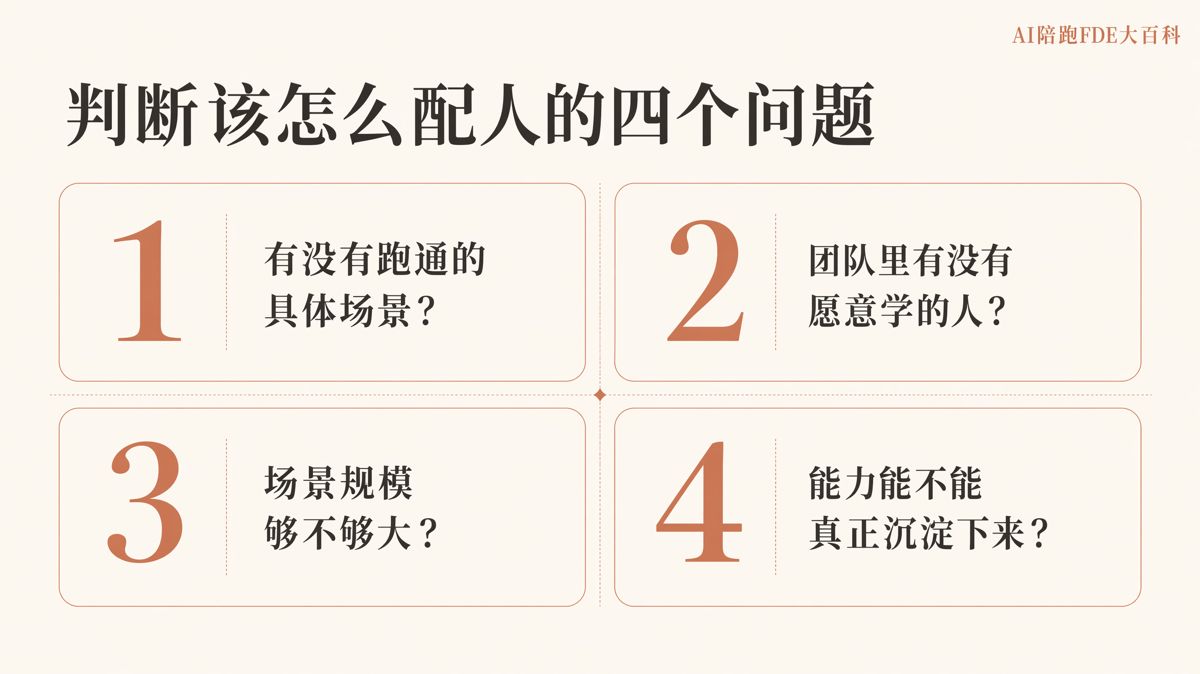
Four Questions to Answer Before Deciding
- Has your organization completed at least one AI pilot with measurable business results?
- Does your existing team have members who understand the business and are willing to take ownership of learning and execution?
- Is the verified ongoing workload large enough to justify a dedicated, full-time position?
- Will your chosen path leave behind operational SOPs, organized knowledge assets, and capable internal operators?
If you cannot answer the first question, validate a single workflow first. If the pilot succeeds and your team has the right operational context, focus on internal upskilling. If your team has the bandwidth but lacks methodology, bring in external enablement. Once operational volume stabilizes and KPIs are proven, begin hiring dedicated specialists.
Validate the workflow and calculate the return first. Only then will you know whether to train, partner, or hire. Staffing decisions should always follow proven business demand.
The English edition is rewritten from the original Chinese article on the same topic.

Starbox AI is an AI marketing company based in Hangzhou, China. This article draws on Starbox project work. Please credit the source when quoting.
Related reading
 AI Adoption
Can One AI Operator Really Replace 10 People?
Claims of 10x headcount cuts count generation speed, not QA and rework. Real efficiency measures net pipeline hours saved.
Oct 22, 2026 · 6 min read
 AI Adoption
Bought Basic AI and Seeing Zero ROI? A 4-Step Activation Playbook
Activating entry-level AI is not about model parameters. Turn open chat boxes into defined operational stations with clear inputs, templates, and QA checklists.
Oct 22, 2026 · 6 min read
 AI Adoption
Why One-Click AI Fails at Work: How to Pick Enterprise Agents
One-click AI tools seem easy, but their first-draft accuracy is terrible. Real business ROI requires multi-step workflows with your own knowledge base.
Oct 21, 2026 · 6 min read