
How to Choose Your Company's First AI Use Case: 4 Criteria

The short answer
Picking the wrong first AI use case kills internal momentum. Here are four practical criteria to choose a pilot that succeeds and scales.
When a company adopts AI for the first time, picking the wrong use case is far more dangerous than picking the wrong tool. If you pick the wrong tool, you can switch it. If you pick the wrong use case, your project may never get a second chance internally.
A 2025 study from MIT Project NANDA showed that when companies partner with external solution providers, their AI project success rate is around 67%. When companies attempt to build everything from scratch in-house, the success rate drops to just one-third of that figure. That gap rarely comes down to pure technical capability. In most cases, teams simply point their efforts in the wrong direction from day one.
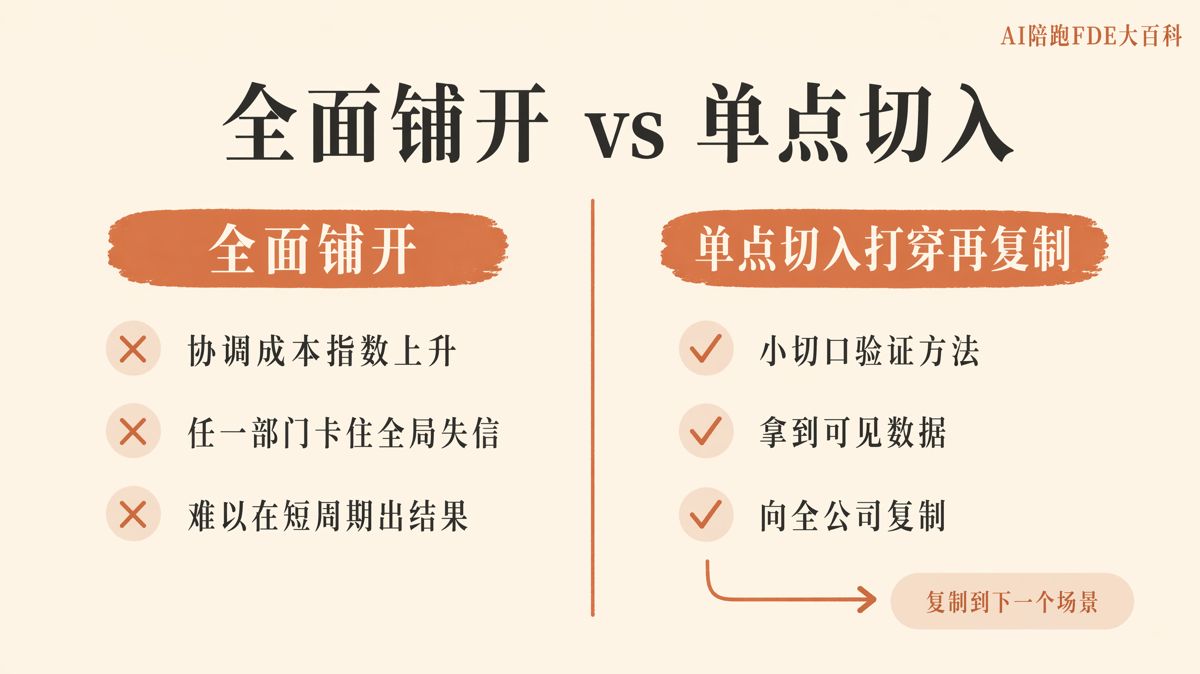
The natural instinct for many executives is to go broad: launch AI across marketing, customer service, and operations all at once. This instinct has the highest failure rate. Successful implementations almost always follow the opposite pattern: find one narrow entry point, break through, deliver verifiable data, and then replicate the model.
Here is how to select that first entry point.
Why a Company-Wide Rollout Fails at the Start
The larger your initial scope, the more departments, workflows, and stakeholders you involve. Every additional department adds a layer of coordination overhead and another stakeholder who can shut the project down.
Enterprise AI is currently stuck in a pattern of high adoption but low business conversion. According to the 2025 China Entrepreneur AI Application Survey Report, 89.84% of surveyed companies have started using AI. Yet MIT NANDA data from the same year shows that only about 5% of companies have successfully integrated custom AI pilots into actual production workflows. That 95% drop-off does not happen because AI tools lack power. It happens because most organizations lack a clear, repeatable methodology to move from a generic tool to daily business operations.
When you spread your initial rollout too wide, the difficulty grows exponentially rather than linearly. Piloting across three departments simultaneously does not mean three times the work; it means managing three distinct data structures, three separate decision-making chains, and three times the communication friction. If one department stalls, internal confidence in the entire AI initiative collapses.
A single-point pilot flips this dynamic. Your only objective is to prove that AI delivers measurable results in one specific setting. Once you have that proof, you use it to unlock the next scenario. Your first step should never be buying software; it should be diagnosing whether your business has a small, viable scenario that can generate fast wins.
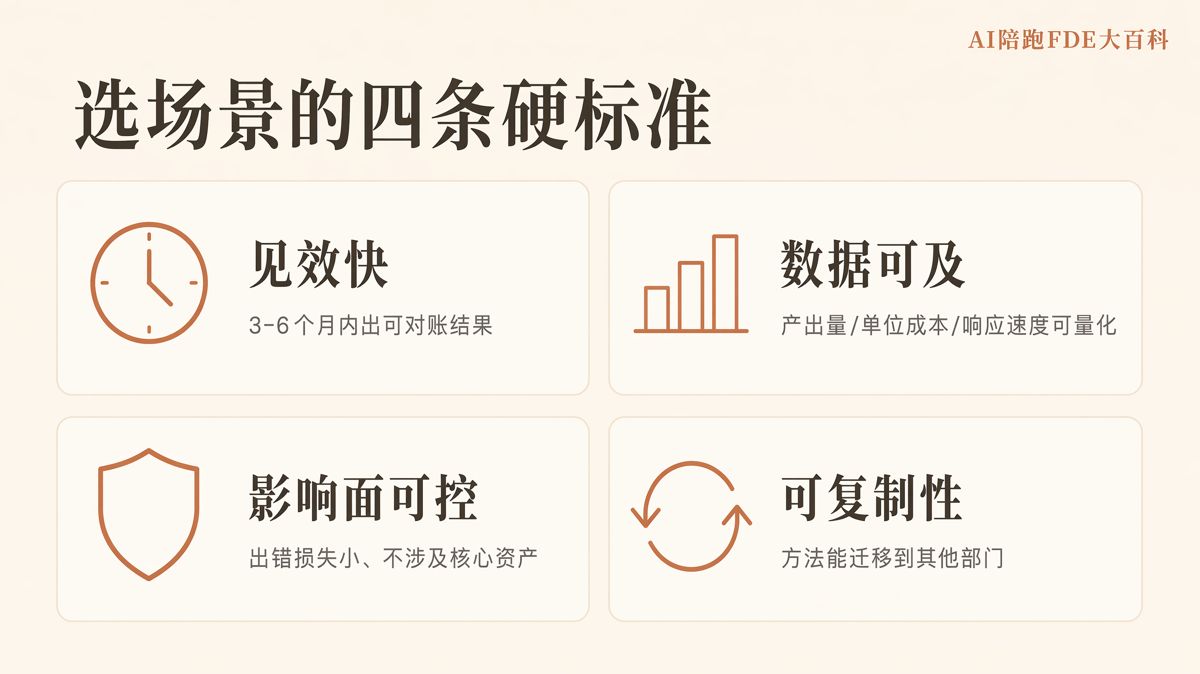
Criterion 1: Fast Results—How Fast Is Fast Enough?
Speed cannot be a vague goal. You need a concrete timeline.
In enterprise pilots, a reliable benchmark is 3 to 6 months. If a project cannot deliver auditable results within that window, leadership will likely pause or cancel it. Decision-makers care about performance data, not long-term promises. Organizational patience is limited, especially during a company's first AI attempt. If six months pass without measurable progress, securing future budget and team buy-in becomes twice as difficult.
To evaluate whether a use case can move fast enough, look at its baseline turnaround time: - If the existing process already takes months or quarters (such as annual strategic planning or cross-departmental restructuring), AI will not suddenly compress it into weeks. The physical reality of the workflow does not support short feedback loops. - If the workflow is naturally high-frequency and short-cycle—such as content production, customer support triage, or data categorization—AI efficiency gains show up within weeks to months.
Criterion 2: Accessible Data—Can You Keep Score?
The second criterion is frequently overlooked: can you cleanly quantify the difference between using AI and not using AI?
Many companies select their first pilot based on intuition—picking a department because the manager is enthusiastic, or because the business unit seems prominent. Intuition does not hold up in an executive review. Numbers do.
Before committing to a pilot, verify whether you can track at least one or two of these core metrics: - Output volume: Units produced per period (e.g., number of marketing assets generated). - Unit cost: Average hours or spend required per deliverable or ticket resolved. - Turnaround speed: Time elapsed from request to delivery. - Error rate: Percentage of outputs requiring rework or correction.
If a scenario cannot naturally measure these numbers, it fails the data test.
A classic counterexample is "improving employee AI literacy." While valuable as a long-term organizational objective, it is an ineffective first use case because you cannot cleanly prove its business return within a quarterly review.
Your ROI calculation depends entirely on data accessibility:
$$\text{ROI} = \frac{\text{Quantified Financial Return} - \text{Total Investment}}{\text{Total Investment}}$$
You must calculate this formula separately for each use case, rather than blending it into general overhead. If a scenario lacks accessible data, you cannot even run this basic calculation.
Criterion 3: Controlled Blast Radius—Can You Absorb a Mistake?
The third criterion defines your risk boundary: if the pilot underperforms or fails initially, will the damage stay contained?
A common misconception is that high impact equals high value, leading teams to test AI directly on core, high-stakes business lines. This is backwards. The purpose of your first pilot is not to prove that AI can run your most critical operation; it is to validate that your team can run an AI workflow successfully. Testing in a mission-critical environment creates unnecessary risk. If something breaks, the business suffers directly, and internal trust in AI evaporates.
A safe pilot scenario should meet three conditions: - Errors are confined to a narrow scope. - Flaws can be spotted and corrected quickly before reaching the client. - The workflow does not touch core customer databases, financial transactions, or operational safety.
Marketing content production is an example of an entry point with a controlled blast radius. If a piece of draft copy misses the mark, you review it, edit it, or discard it. It does not corrupt client data, halt order fulfillment, or disrupt core infrastructure. By contrast, deploying AI directly into pricing engines, credit decisions, or automated financial transactions carries a blast radius that is far too dangerous for an initial experiment.
Criterion 4: Replicability—Can You Transfer What You Learn?
The final criterion determines whether your project is a one-off task or an engine for long-term capability.
A single-point pilot is not an end in itself. Its real purpose is to establish a operational framework that you can later roll out to other business units. When evaluating candidates, ask: if this use case succeeds, can its underlying methodology, prompt structures, and review workflows be transferred to other teams? If a use case is so hyper-specialized that nothing can be reused, its organizational value remains limited even if it hits its target.
Highly replicable use cases validate a repeatable mechanism rather than an isolated tool. A marketing workflow that covers topic selection, content drafting, quality assurance, and performance tracking establishes a framework that customer support, sales enablement, or internal training teams can adapt later. The operational logic stays the same; only the subject matter changes.
How to Apply the Four Criteria
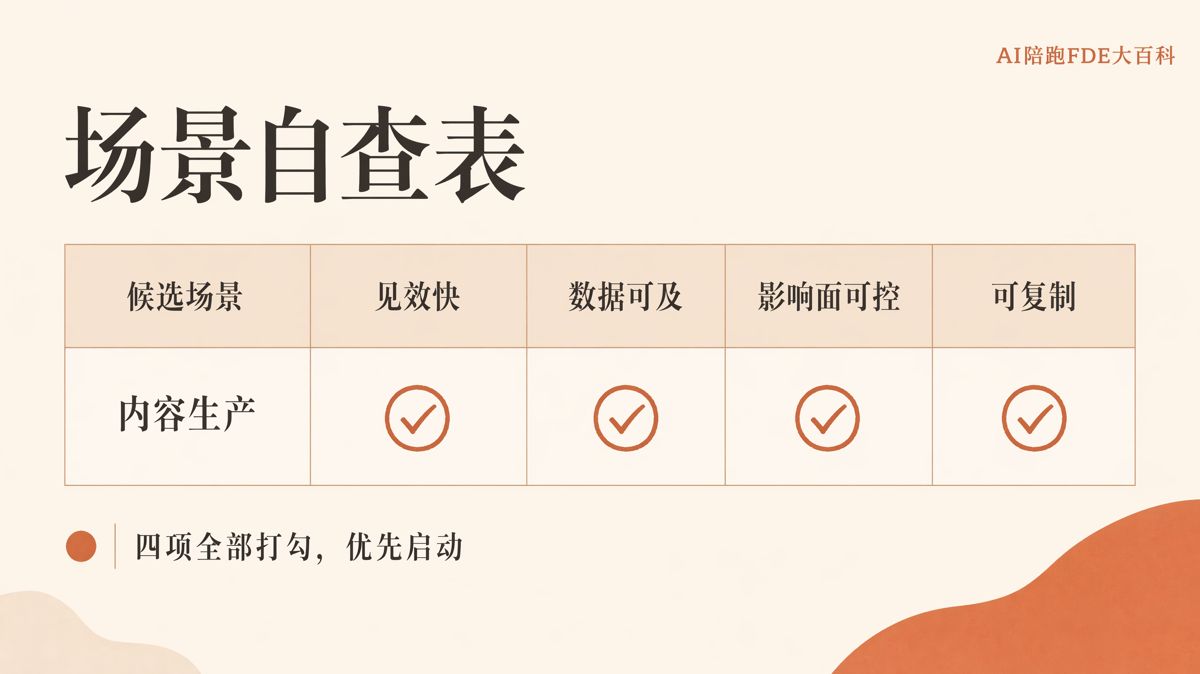
Meeting one criterion is easy. A viable pilot must meet all four. You can use this checklist to screen potential use cases:
| Candidate Use Case | Fast Results (3–6 Months) | Accessible Data (Clear Metrics) | Controlled Blast Radius (Low Risk) | Replicable (Transferable Process) |
|---|---|---|---|---|
| Scenario A | ||||
| Scenario B | ||||
| Scenario C |
- All 4 checked: Prioritize for immediate launch.
- 3 checked, 1 uncertain: Proceed cautiously with a clear risk mitigation plan.
- 2 or fewer checked: Disqualify as a first use case. Revisit after your team builds operational maturity.
Across industries, B2B marketing content production frequently emerges as an optimal first pilot because it fits all four criteria: 1. Fast results: Output changes are visible within weeks. 2. Accessible data: Production volume, unit cost, and publishing frequency are straightforward metrics. 3. Controlled blast radius: Content is reviewed before distribution; core business assets remain untouched. 4. Replicability: The core workflow (ideate $\to$ generate $\to$ QA $\to$ distribute) transfers cleanly to customer service knowledge bases, partner enablement, and internal documentation.
Marketing is not inherently superior to other departments; it simply checks these four boxes more consistently. If another workflow in your company satisfies all four criteria better, start there. The criteria matter more than the department label.
Two Steps to Take After Selecting Your Use Case
Once you identify the right use case, complete two final steps before deploying tools:
- Conduct an AI readiness assessment: Confirm whether your existing data assets, operating procedures, and team bandwidth can support the workflow.
- Set a clear performance metric and designate a single owner: A well-chosen use case will still fail if no individual is directly accountable for its business outcome.
The success of your company's first AI initiative is largely decided during the selection phase. Fast results give the project time to breathe inside your organization. Accessible data keeps reporting grounded in reality. A controlled blast radius ensures early missteps are manageable. Replicability turns a single pilot into a scalable foundation for company-wide transformation.
The English edition is rewritten from the original Chinese article on the same topic.

Starbox AI is an AI marketing company based in Hangzhou, China. This article draws on Starbox project work. Please credit the source when quoting.
Related reading
 AI Adoption
Can One AI Operator Really Replace 10 People?
Claims of 10x headcount cuts count generation speed, not QA and rework. Real efficiency measures net pipeline hours saved.
Oct 22, 2026 · 6 min read
 AI Adoption
Bought Basic AI and Seeing Zero ROI? A 4-Step Activation Playbook
Activating entry-level AI is not about model parameters. Turn open chat boxes into defined operational stations with clear inputs, templates, and QA checklists.
Oct 22, 2026 · 6 min read
 AI Adoption
Why One-Click AI Fails at Work: How to Pick Enterprise Agents
One-click AI tools seem easy, but their first-draft accuracy is terrible. Real business ROI requires multi-step workflows with your own knowledge base.
Oct 21, 2026 · 6 min read