
How to Protect Data Ownership in AI Consulting Contracts
The short answer
Data ownership is really about whether you can take your assets when you leave. Lock in training exclusion, physical isolation, and portable export rights.
Key Facts: - In vendor selection, 51.56% of small and mid-sized enterprises explicitly cite "data compliance" as a core concern (China Academy of Information and Communications Technology SME Study, 2025). - Across industry implementations, failure to internalize capabilities and the inability to migrate raw data are the most common blockers when switching vendors. - Standard enterprise AI data security relies on a three-part framework: physical isolation, exclusion from model training, and role-based access control—not a single technical feature. - A 2025 study by MIT Project NANDA showed that companies partnering with professional service providers achieved an AI project success rate of roughly 67%—nearly three times higher than purely internal builds. However, this advantage holds only when the partnership is controllable and allows a clean exit. - Validating on a small scale before signing a full contract is the standard low-risk approach, yet data ownership terms during the pilot phase are routinely overlooked.
Why Data Ownership Becomes an Issue
When signing an AI consulting or hands-on enablement contract, most buyers focus on pricing and performance guarantees. Few read the data clauses line by line. That is understandable. Pricing is an explicit number, easy to compare. Data ownership clauses often read like generic legal boilerplate and get skimmed.
The problem is that an ongoing AI enablement partnership looks nothing like standard vendor contracts. It is not an off-the-shelf software license, nor is it a one-and-done outsourcing project where the vendor leaves after delivery. It is an embedded, continuous engagement that touches your internal operations: customer records, marketing assets, operational metrics, and employee workflows all flow into the vendor's systems over time.
Once your data sits in a vendor's infrastructure, three practical questions emerge: 1. Will your data be used to train their base models, effectively transferring your domain expertise to competitors? 2. Where does your data live physically, and who has access to it? 3. If you decide to switch vendors or walk away, can you export that data intact, and in what format?
If your contract leaves these questions vague, resolving them later is almost impossible. By the time an issue arises, the vendor has processed your data for six to twelve months, and you may not even know what your accumulated knowledge base looks like behind their interface.
The Three Essential Data Clauses
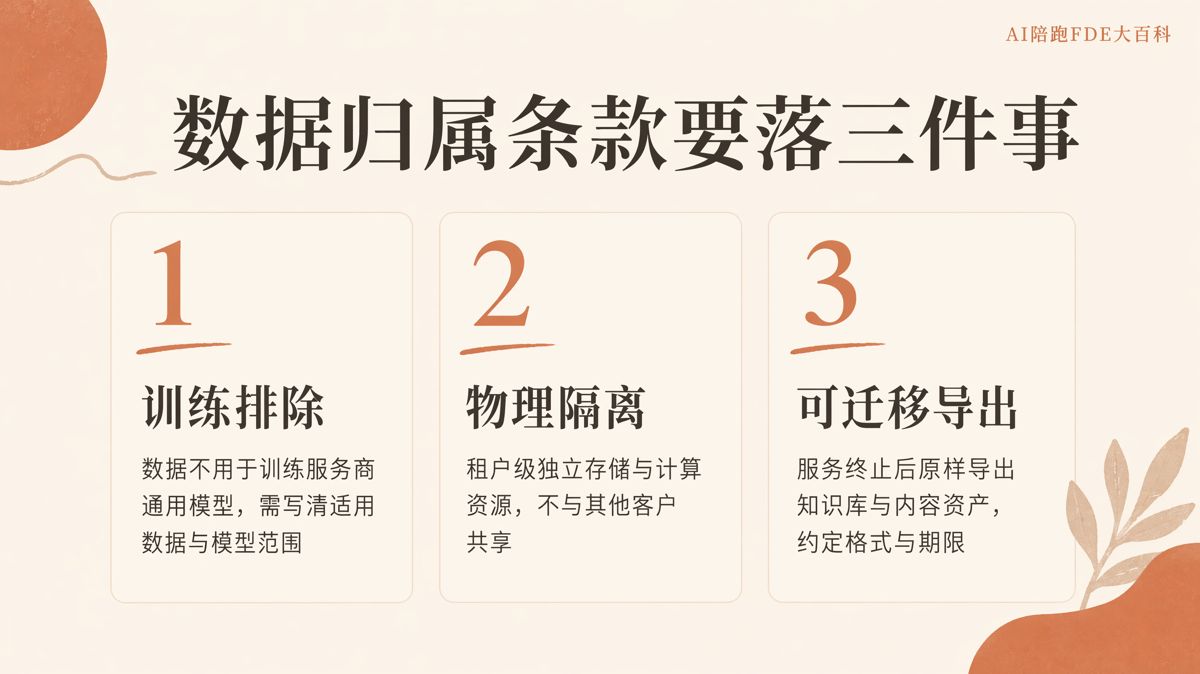
Reliable enterprise AI data governance rests on three parallel safeguards. A vague promise that "your data is secure" is meaningless—data security is never absolute, and real compliance requires explicit boundaries:
1. Training Exclusion
Your data must not be used to train the vendor's foundation or shared models. This sounds straightforward, but the contract must explicitly define which data sets, which models, and what level of processing are excluded. A verbal commitment or a blanket "we respect your privacy" statement does not protect you.
2. Physical Isolation
Where your data is stored and whether it shares compute or storage resources with other clients determines your exposure during system incidents. The standard baseline is tenant-level physical isolation with zero cross-client data sharing. This technical requirement belongs in the legal terms, not just on a marketing slide.
3. Portable Export Rights
This is the most critical and frequently missed clause. When the contract ends, can you export your accumulated knowledge base, content assets, and operational logs? In what format will they be delivered? How quickly must the vendor complete the handover?
Without portable export rights, the first two safeguards only keep you safe while you stay. Exportability determines whether you can ever leave.
The Trap Companies Fall Into When Switching Vendors
When companies replace an underperforming AI vendor, a recurring roadblock emerges: the original raw data and the knowledge assets accumulated during the engagement cannot be extracted, or they come out in unusable proprietary formats. The company is forced to start from scratch.
This is a structural lock-in. If the contract does not grant explicit data migration rights, the vendor has no legal obligation to provide your assets in a usable format, nor any binding deadline to do so. You may want to walk away, but your data is trapped.
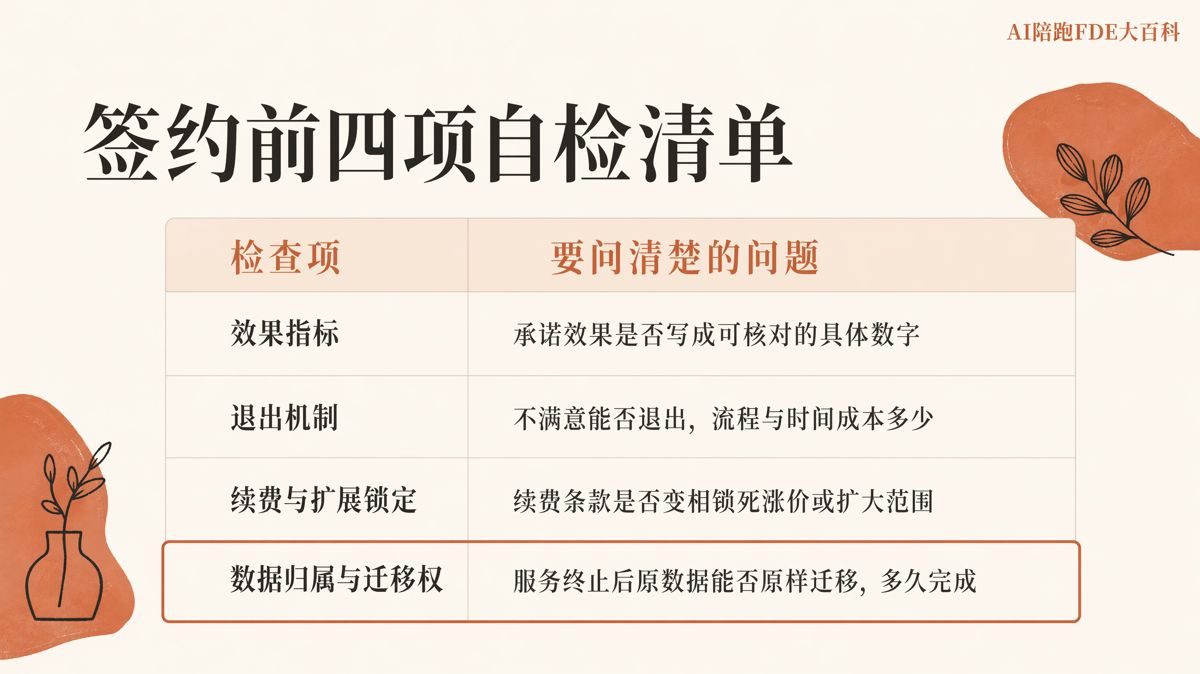
To evaluate whether an AI partnership agreement preserves your operational independence, review these four checkpoints:
| Checkpoint | Key Questions to Clarify |
|---|---|
| Performance Metrics | Are promised outcomes tied to verifiable, concrete numbers, or left vague? |
| Exit Mechanism | Can you terminate if dissatisfied? What is the notice period, process, and cost? |
| Renewal Lock-in | Do renewal clauses automatically trap you in price hikes or mandatory scope expansions? |
| Data Ownership & Portability | Can raw data and knowledge bases be migrated intact upon termination, and within what timeframe? |
Data ownership and export rights are usually audited the least carefully because they cause no friction on day one. They only hurt on the day you decide to walk away.

How to Address Data Terms Before Signing
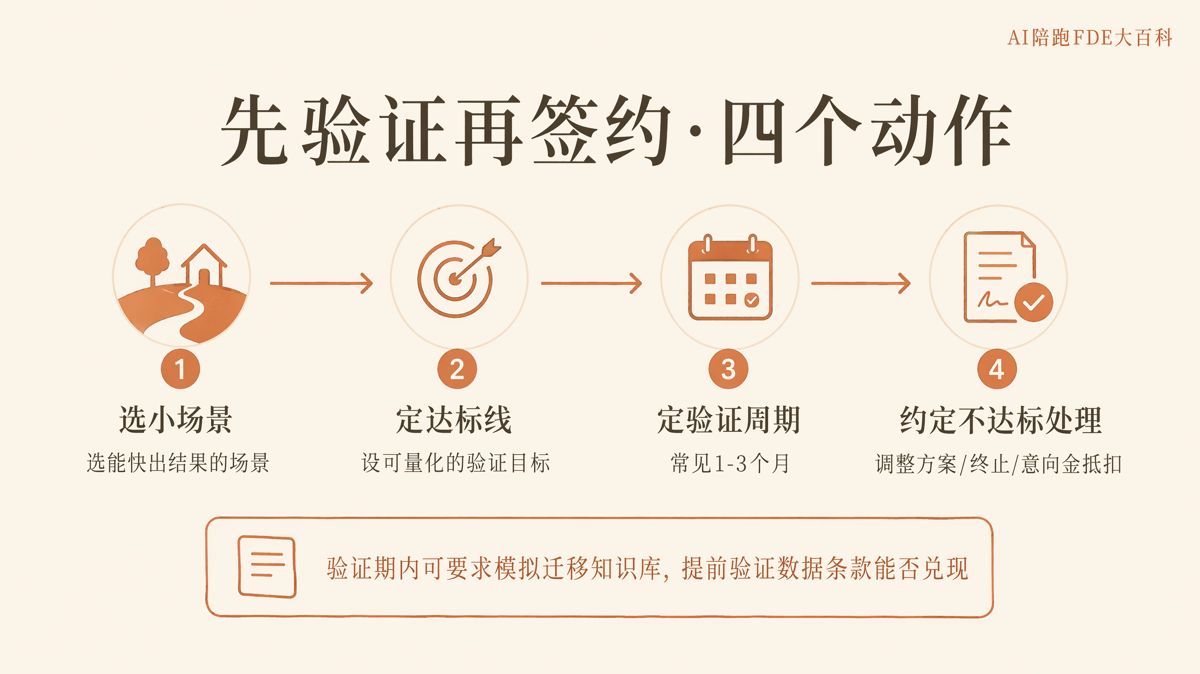
The most practical approach is to require a small-scale pilot phase before signing an annual or multi-year agreement. A common industry standard is a one-to-three-month validation window. During this phase, you verify both the performance results and whether the vendor's data promises hold up in practice.
For example, ask the vendor to execute a mock data export during the pilot. Check whether the knowledge base can be extracted cleanly and whether your team can use the exported files independently. Running this test during a pilot costs very little; finding out after signing a long-term contract is expensive.
A structured pilot includes four elements: - A specific, high-velocity business scenario. - A quantifiable performance target. - A firm timeline (usually 30 to 90 days). - Explicit rules for missed targets (adjusting scope, terminating without penalty, or crediting initial fees).
Your data ownership terms should be written directly into this pilot agreement, not saved for the formal contract later.
When drafting the final contract, ensure it covers: - The precise scope of data excluded from model training. - Technical specifications for data isolation. - Handover triggers (contract expiration, mutual termination, or termination for breach). - Export formats, delivery timelines, and technical support obligations during handover.
Frequently Asked Questions
Does on-premises deployment automatically guarantee data security?
No. Deploying models and software on your own servers is just an infrastructure choice, not an automatic guarantee of clear data ownership. If the contract does not specify who has remote access or whether the vendor can pull diagnostics and operational logs, vulnerabilities remain. Choosing between on-premises and cloud setups should be based on four factors: data sensitivity, regulatory compliance, budget, and internal IT maintenance capabilities.
Who should draft data ownership clauses?
Vendors typically provide their own contract templates, but you should not rely entirely on their language. You need your own checklist covering training exclusions, isolation standards, and export requirements. Compare the vendor's draft against your checklist and insist on written amendments for any gaps.
Who owns the data generated during a pilot phase?
This must be stated clearly in the pilot agreement. Never assume that unfinalized contracts mean you retain full rights by default. Raw assets provided by your team and intermediate data generated during the pilot should follow the same ownership and export rules as the final contract.
Can you take 100% of your knowledge base when changing vendors?
That depends entirely on what your contract states. Raw inputs—such as product documentation, sales collateral, and historical brand content—must remain fully yours to export. However, secondary processing, prompt libraries, or proprietary vendor frameworks built on top of those assets can create gray areas unless explicitly addressed beforehand.
Can smaller companies with limited leverage negotiate these terms?
Data ownership clauses are risk management controls, not pricing concessions. Even if your pricing negotiation room is small, treat training exclusions and data export rights as non-negotiable baselines. You should never trade data rights away for a discount.
Summary
Data ownership feels theoretical when you sign a contract. It becomes critical the day you decide to leave. Whether you can walk away with your accumulated operational assets or have to rebuild from zero depends entirely on these clauses.
When evaluating an AI enablement partner, look past the pitch deck and pricing sheet. Audit three terms with your legal team: exclusion from training, physical isolation, and portable export rights. Exportability is your exit route—and without an exit route, you have no leverage.
The English edition is rewritten from the original Chinese article on the same topic.

Starbox AI is an AI marketing company based in Hangzhou, China. This article draws on Starbox project work. Please credit the source when quoting.
Related reading
 AI Adoption
Can One AI Operator Really Replace 10 People?
Claims of 10x headcount cuts count generation speed, not QA and rework. Real efficiency measures net pipeline hours saved.
Oct 22, 2026 · 6 min read
 AI Adoption
Bought Basic AI and Seeing Zero ROI? A 4-Step Activation Playbook
Activating entry-level AI is not about model parameters. Turn open chat boxes into defined operational stations with clear inputs, templates, and QA checklists.
Oct 22, 2026 · 6 min read
 AI Adoption
Why One-Click AI Fails at Work: How to Pick Enterprise Agents
One-click AI tools seem easy, but their first-draft accuracy is terrible. Real business ROI requires multi-step workflows with your own knowledge base.
Oct 21, 2026 · 6 min read