
Test Before You Sign: The 4-Step Pilot Deposit Model for AI
The short answer
Before signing a full enterprise AI contract, use a credited pilot deposit to validate your vendor's delivery, business fit, and team chemistry.
Choosing an AI implementation partner means selecting an outside team to embed AI into your core business workflows. The hardest part of this decision is rarely whether their pitch sounds impressive. It comes down to three operational realities: does the vendor have real delivery capability, does their solution fit your existing business, and can your teams work effectively together?
A standard sales meeting cannot answer those questions. That is why some enterprises take a phased approach: pay a relatively small pilot deposit to enter a structured alignment phase. During this trial period, both sides complete an initial operational diagnosis, design a tailored implementation blueprint, and run a small-scale pilot within an agreed scope. If the vendor meets predefined acceptance criteria, you execute the full contract, crediting the deposit toward the total price. If the benchmarks are not met, the deposit is handled according to the agreement, and both parties part ways.
In this context, a "pilot deposit" is a written commitment fee paid prior to a full contract. It can fund upfront discovery and solution design, or compensate the vendor for dedicating specialized personnel and schedule capacity. How the money is accounted for, whether it can be refunded, and how it is credited toward a final contract must be explicitly detailed in writing, rather than inferred from the word "deposit."
MIT's Project NANDA highlighted this delivery challenge in its 2025 research report, The GenAI Divide: State of AI in Business 2025. The report found that among surveyed enterprises, roughly 67% of custom AI tools built with external partners successfully advanced from pilot trials to full production deployment, compared to approximately 33% for internally built tools. The report notes that these figures reflect self-reported survey data and should not be generalized across every organization, nor do they guarantee that any specific external vendor will succeed.
Still, the data offers clear directional guidance: do not commit to an AI vendor based solely on a pitch. You need to verify their hands-on delivery and collaborative fit first. Testing before signing builds this verification directly into your procurement timeline.
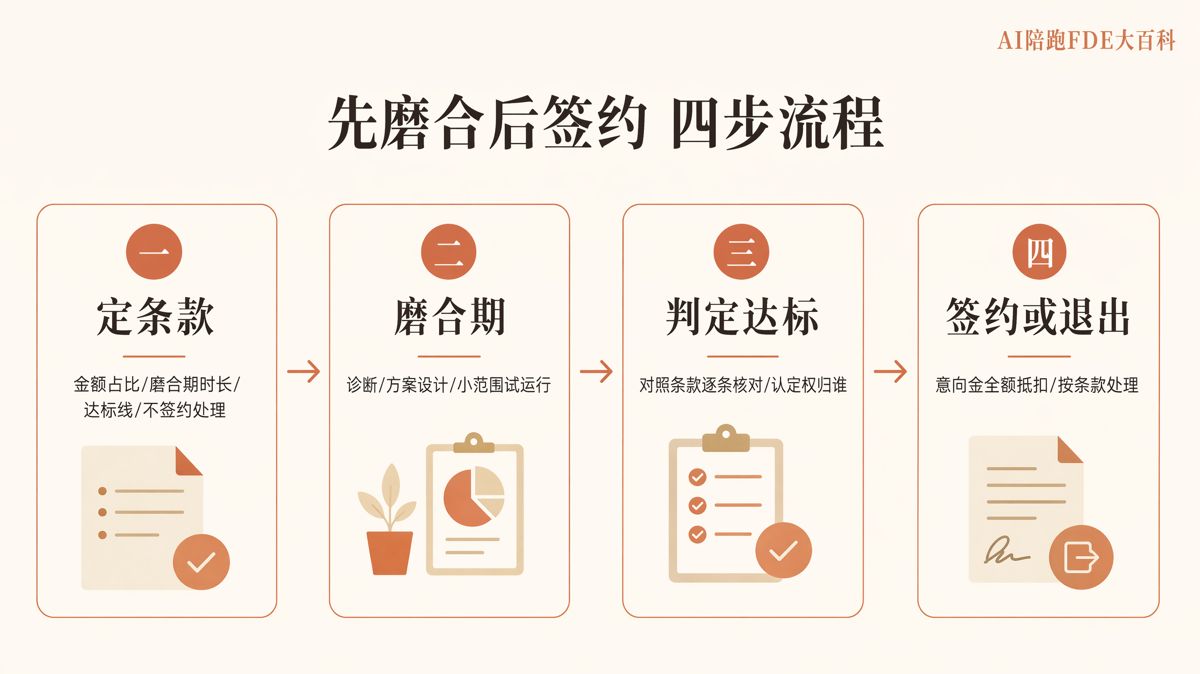
The process breaks down into four clear steps.
Step 1: Put Four Key Terms in Writing Before Paying Any Deposit
A trial period is not an informal trial run. Before transferring any funds, both sides must sign a pilot deposit agreement or trial-phase contract covering the fee, duration, deliverables, acceptance criteria, and exit mechanisms.
1. The Deposit Amount and What It Actually Covers
A pilot deposit typically represents a small fraction of the total contract value, meant to cover upfront labor during the alignment phase. The agreement must state exactly what work this fee funds: a current-state diagnosis, solution blueprinting, reserved staffing, or other defined services.
If the requested deposit approaches 50% or more of the estimated total contract value, you are no longer managing small-scale trial risk. You are taking on the risk of a major upfront prepayment. If that happens, reassess the payment structure, deliverables, credit terms, and exit options. Do not lower your contract standards simply because the word "deposit" appears on the invoice.
2. Phase Duration and Concrete Scope of Work
Trial periods typically run between 1 and 3 months, but that window is not universal. Specific start dates, end dates, and extension clauses must be documented in writing.
Deliverables must be unambiguous: does the phase include only diagnostic analysis and solution architecture, or does it also require a small-scale pilot run in a live workflow? If an agreement merely states "both sides will review full engagement after the trial period" without a task checklist and deadlines, you will have no objective way to measure whether the vendor fulfilled their obligations.
3. Clear Acceptance Criteria
Vague terms like "satisfactory performance" or "substantially meeting requirements" cannot serve as acceptance criteria because each party interprets them differently.
Instead, define verifiable performance targets: - Output efficiency for a specific content type must hit a designated range. - Processing time for a designated workflow step must drop from X to Y.
Beyond numeric targets, document what data sources will be referenced, how metrics will be calculated, what supporting files must be provided, and who holds final approval authority. Without agreed-upon benchmarks, you risk reaching the end of the trial period with you feeling unsatisfied and the vendor insisting their job is done.
4. What Happens to the Deposit if You Walk Away
There are three common ways to handle the deposit if you decide not to sign a full contract: - Convert the entire deposit into a non-refundable service fee for discovery and preliminary work. - Deduct documented labor costs incurred to date and refund the remaining balance. - Retain the entire deposit as compensation for the vendor's reserved staff and blocked calendar time.
No single method fits every scenario. Choose the mechanism that matches your company's risk tolerance, and document the calculation method, refund triggers, and processing timelines in the contract. Any promise that impacts payments, deductions, or exit terms must be in the written agreement.

Step 2: Test Real Execution Capabilities During the Trial
Signing a trial agreement is not an excuse to wait passively for the final date. Both teams must complete active work during this period to verify that the proposed solution can actually be deployed.
Start with a Baseline Diagnosis
The vendor needs to examine your existing data foundation, current business workflows, and operational team structure before confirming whether an AI solution is technically and operationally feasible.
Your team must provide representative, accurate workflow data within the agreed scope. If you supply test samples that diverge sharply from real operations, the vendor's diagnostic findings will be skewed. A pilot phase tests the vendor's delivery, but it also tests whether your internal team can provide the operational cooperation required for enterprise AI adoption.
This step should produce a written diagnostic report detailing identified bottlenecks, factual findings, and recommended architectural changes, rather than just an informal verbal briefing.
Review and Refine the Solution Architecture
Using the diagnostic findings, the vendor drafts an implementation blueprint. Your functional leaders, along with IT and finance reviewers, should evaluate the blueprint and submit formal feedback.
Pay close attention to two questions: Does the vendor genuinely understand your day-to-day operations? And is their solution tailored to your operational realities rather than an off-the-shelf template? Document every revision in writing and confirm the final blueprint jointly to ensure both teams build from the same baseline.
Run a Small-Scale Pilot (If Agreed in the Scope)
If your pilot agreement includes a live test, select one specific operational node, run real business data through the new workflow, and evaluate the output against your agreed metrics.
A live, small-scale test exposes execution flaws far faster than inspecting blueprint slides, but it requires internal staff time. If internal stakeholders fail to provide timely data or miss review sessions, project results will suffer, and that failure cannot be attributed entirely to the vendor's solution.
Before the alignment phase ends, you should hold at least three tangible deliverables: 1. A written diagnostic report 2. Documented solution architecture revisions 3. Pilot workflow data and measured performance results
If your contract excluded a live test, acceptance relies on the first two deliverables.
Step 3: Conduct Acceptance Reviews Against Original Benchmarks
Deciding whether to sign a full contract should never depend on whether the vendor gave you a "good general impression." It must depend strictly on the acceptance benchmarks defined before any money changed hands.
Audit each criterion side by side against actual outputs and supporting materials: Was the work completed? Did the metrics reach required targets? Were numbers calculated using the agreed methodology? Can your internal team independently reproduce the figures?
Verify who has the contractual right to sign off on acceptance. If that authority sits entirely with the vendor, and your team has no access to underlying data or review mechanisms, the trial period provides no real validation. The review process must include internal stakeholders capable of validating results, or rely on mutually auditable data.
Before paying a pilot deposit, ask this foundational question:
If the trial period ends and our team concludes the benchmark was missed, while the vendor claims it was met, who arbitrates, what evidence is reviewed, and what process is followed?
If your draft agreement cannot answer that question, your acceptance clause is incomplete.

Step 4: Execute the Contract or Exit, and Reconcile the Deposit
Once acceptance reviews conclude, the partnership moves in one of two directions.
Proceeding to a Full Contract
If performance meets agreed benchmarks, apply the pilot deposit toward the full contract value as specified in the agreement, paying only the remaining balance.
When drafting the master services agreement, verify that the credited deposit and remaining balance are explicitly stated in the payment schedule. Never rely on verbal assurances that an invoice will be adjusted later.
Check for expiration windows on deposit credits. Some agreements mandate that you sign the full contract within a specific timeframe after the pilot ends, or forfeit the deposit credit. If your internal legal or procurement cycles run long, negotiate that timeline before paying the initial deposit.
Exiting Without a Full Contract
If performance falls short of your benchmarks, or your organization decides not to proceed, follow the exit terms outlined in the pilot agreement: convert the deposit into a service fee, receive a partial refund net of incurred costs, or forfeit the deposit.
If the vendor requests additional fees, cost retentions, or altered refund amounts outside the signed terms, require them to point to specific contractual clauses and show documented accounting records.
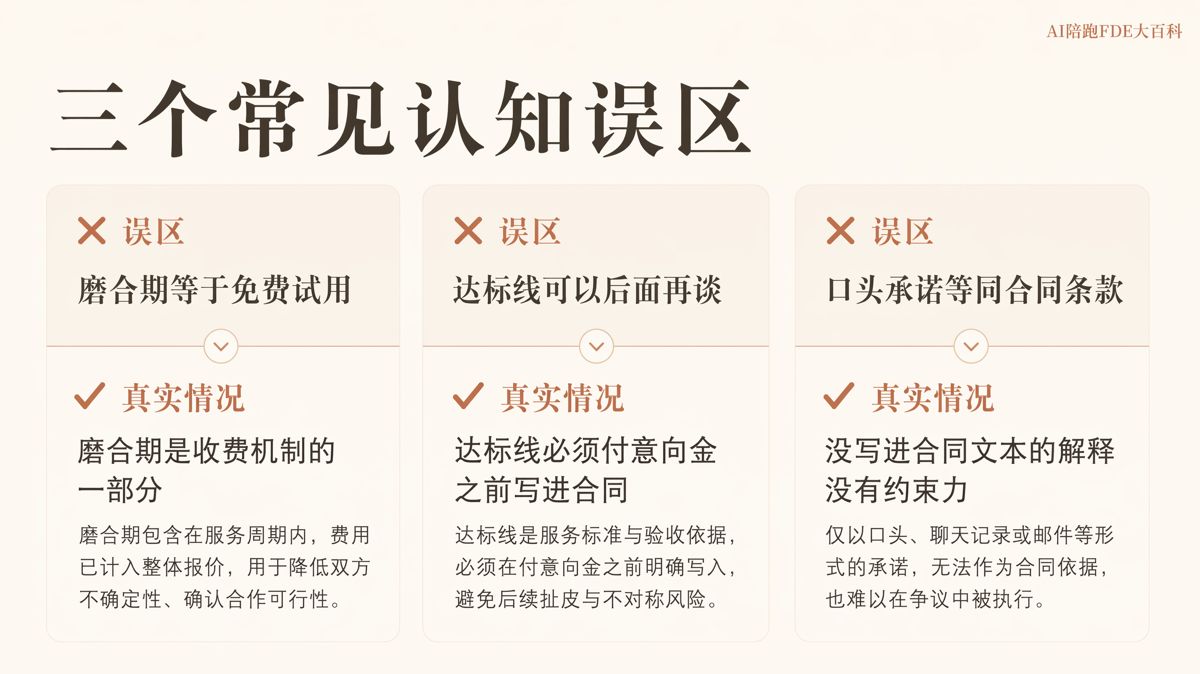
A Pilot Agreement Is Not a Free Trial
Teams entering phased AI agreements often make three common mistakes:
- Treating the trial phase like a free software demo. A pilot deposit is dedicated funding governed by an agreement; it is not automatically refundable. Your internal team must invest time, data, and review resources. If either side neglects their commitments, the validation exercise fails.
- Postponing acceptance criteria until after work begins. Modifying acceptance standards after money has changed hands is difficult. Deliverables, success metrics, verification workflows, and exit rules must be locked down before you wire the deposit.
- Relying on sales conversations instead of contractual language. Any verbal promise regarding scope, sign-off authority, deposit crediting, or refund terms must be written into clear, enforceable contract clauses.
The purpose of testing before signing is not to delay a project. It is to de-risk your investment by validating vendor delivery, solution fit, and operational collaboration before you commit your full implementation budget.
Follow this sequence every time: lock down the deposit amount, duration, deliverables, acceptance criteria, and exit mechanisms in writing first. Pay the deposit, run the validation, and then decide whether to execute the full contract.
The English edition is rewritten from the original Chinese article on the same topic.

Starbox AI is an AI marketing company based in Hangzhou, China. This article draws on Starbox project work. Please credit the source when quoting.
Related reading
 AI Adoption
Can One AI Operator Really Replace 10 People?
Claims of 10x headcount cuts count generation speed, not QA and rework. Real efficiency measures net pipeline hours saved.
Oct 22, 2026 · 6 min read
 AI Adoption
Bought Basic AI and Seeing Zero ROI? A 4-Step Activation Playbook
Activating entry-level AI is not about model parameters. Turn open chat boxes into defined operational stations with clear inputs, templates, and QA checklists.
Oct 22, 2026 · 6 min read
 AI Adoption
Why One-Click AI Fails at Work: How to Pick Enterprise Agents
One-click AI tools seem easy, but their first-draft accuracy is terrible. Real business ROI requires multi-step workflows with your own knowledge base.
Oct 21, 2026 · 6 min read