
Which Use Case Should You Pick to Validate AI First?

The short answer
Pick a fast, quantifiable use case that does not touch core systems. Test candidates against four criteria to find your best pilot.
Key Facts
- According to MIT Project NANDA's report The GenAI Divide (2025), over 80% of companies have experimented with ChatGPT or Copilot-style tools, but only 5% of custom pilots ever make it into production and generate measurable value.
- The same report reveals that companies choosing a "purchasing plus external partnership" approach achieve a success rate of about 67%—roughly triple the success rate of pure internal in-house builds.
- McKinsey's The State of AI in 2025 (Greater China) found that only about 6% of companies qualify as "high-performing winners" that generate real business returns from AI.
- The Chinese Entrepreneurs AI Adoption Survey Report 2025 notes that 89.84% of surveyed businesses use AI, yet only 16.41% have a dedicated AI team—highlighting a steep disconnect between tool adoption and organizational capability.
- Industry benchmarks show that pilot validation cycles typically run between one and three months. Marketing scenarios, with smaller entry points and faster feedback loops, generally deliver visible results earlier than heavier applications like predictive maintenance in manufacturing.
Why Selecting the Right Use Case Is a Decision Filter
Most companies have not failed at AI because they avoided it. They failed because they launched it in the wrong place.
The MIT report quantifies this clearly: more than 80% of companies have tested AI tools, but only 5% of customized pilots ever enter production and deliver tangible business returns. The industry calls this gap the "GenAI Divide."
This divide is not caused by weak models or regulatory roadblocks. The MIT study states plainly that success comes down to the implementation path, not the tool itself. In practical terms: your project does not succeed or fail based on how advanced the model is. It succeeds or fails based on whether your initial business use case can sustain a complete validation cycle.
Pick the wrong use case and several things happen. Either results arrive too slowly, leading leadership to pull funding after months of silence. Or the outcome cannot be measured, leaving no proof that AI made a difference. Or the team targets core enterprise systems on day one, triggering widespread resistance and risk before validation even finishes.
Choosing your starting point is not a matter of luck. It is a filter you can run in advance.
Criterion 1: How Fast Can You See Data?
The validation phase has one core objective: answer whether this path works in the shortest possible time. That makes speed your first filter.
Your pilot scenario must show reconciled, verifiable results within one to three months. In standard market practice, teams set a clear threshold for a small use case and run a complete validation cycle over one to three months (actual timelines vary by use case). Predictive maintenance in manufacturing can reach a three-month payback window in experienced teams, but only if the data pipeline and machine connectivity are already built. By contrast, projects requiring cross-departmental alignment or organizational restructuring take much longer to produce evidence. They do not belong in an early pilot.
Work backwards from the timeline: how long will it take from project kickoff to your first reliable data report? If you cannot see intermediate metrics within three months, set that project aside. Tackle it later once you have validated your approach and built internal confidence.

Criterion 2: Can You Prove It with Numbers?
Validation exists to inform decisions about future budget allocation, replacing intuition with evidence. This requires a use case that produces measurable output by default.
Content output volume, production hours per asset, publishing frequency, customer support response latency, and conversion rates are figures your business already tracks daily. Compare performance before and after deploying AI, and the conclusion is clear. In contrast, goals like "improving brand perception" or "smoothing team collaboration" make it nearly impossible to isolate the exact impact of AI.
This is why marketing is often the preferred starting point for validation. Output capacity and labor efficiency can be tracked weekly or even daily, and the results do not depend on massive IT overhauls. This does not mean other business units cannot run validations; it simply means marketing carries a lower barrier to measurement and a shorter path to proof.
Criterion 3: Does It Touch Core Systems?
Validation should also mean low-risk experimentation. Whether a use case alters core business systems serves as your second dividing line.
Integrating directly with enterprise ERP, live production schedules, or primary financial databases creates immediate enterprise-wide exposure. If a glitch occurs, the core business stalls, and operations will pull the plug before validation finishes. By comparison, internal knowledge retrieval, draft generation, or customer support assistance can fail safely. If an output is sub-par, it affects a single asset without interrupting the main engine of the business.
Ask yourself one question: "If this validation fails completely, will the company suffer material operational damage?" If the answer is no, it belongs on your shortlist. If the answer is yes, hold off until your organization has established AI operating experience and reliable fallback mechanisms.
Criterion 4: What Is the Cost of Failure?
System architecture is only part of the risk equation; external impact also matters. Some use cases do not touch core databases, but their errors carry high external costs. Client-facing communications and compliance-related documentation are clear examples: if an AI generates factual errors or improper phrasing, it directly threatens customer relationships or regulatory standing.
These scenarios can still benefit from AI, but they should not sit at the front of your pilot queue. The validation phase is precisely when workflows and quality-assurance systems are still being refined, meaning you need ample room for error. The safer approach is to prove your review loops and workflows on internal tasks—such as internal documentation or intranet search—before deploying AI to customer-facing channels.
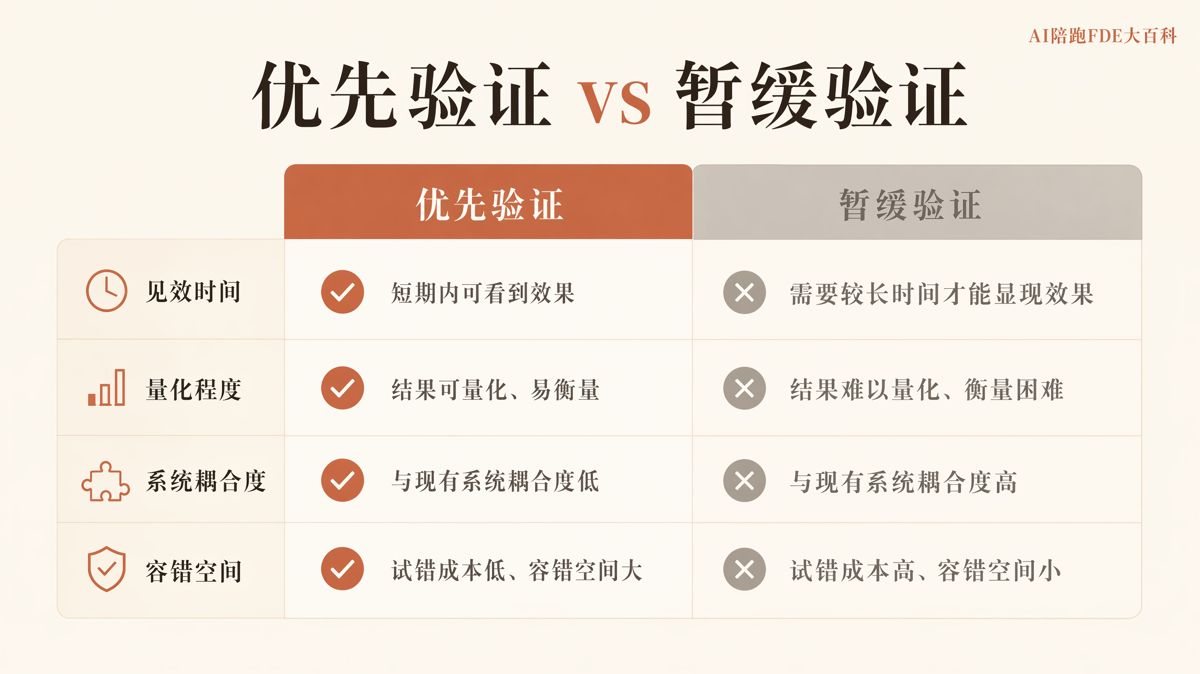
Putting the 4 Criteria Together: A Self-Check Scorecard
Run your candidate use cases through this checklist and prioritize those that meet the most criteria:
| Dimension | Prioritize for Validation (Check) | Postpone Validation |
|---|---|---|
| Time to Value | Intermediate metrics visible within 1–3 months | Requires more than 6 months for initial results |
| Measurability | Existing, trackable metrics (volume, efficiency, conversion, response time) | Relies on subjective perception to judge success |
| System Coupling | Does not touch core production, ERP, or financial systems | Requires modifying core enterprise architecture |
| Tolerance for Error | Controlled impact; does not expose clients or breach compliance | Errors directly damage client trust or create regulatory risk |
Scenarios that check all four boxes are ideal starting points. Scenarios meeting three criteria are viable candidates. If a project checks two or fewer, save it for later stages of adoption.
Why Mastering One Point Before Scaling Works Better
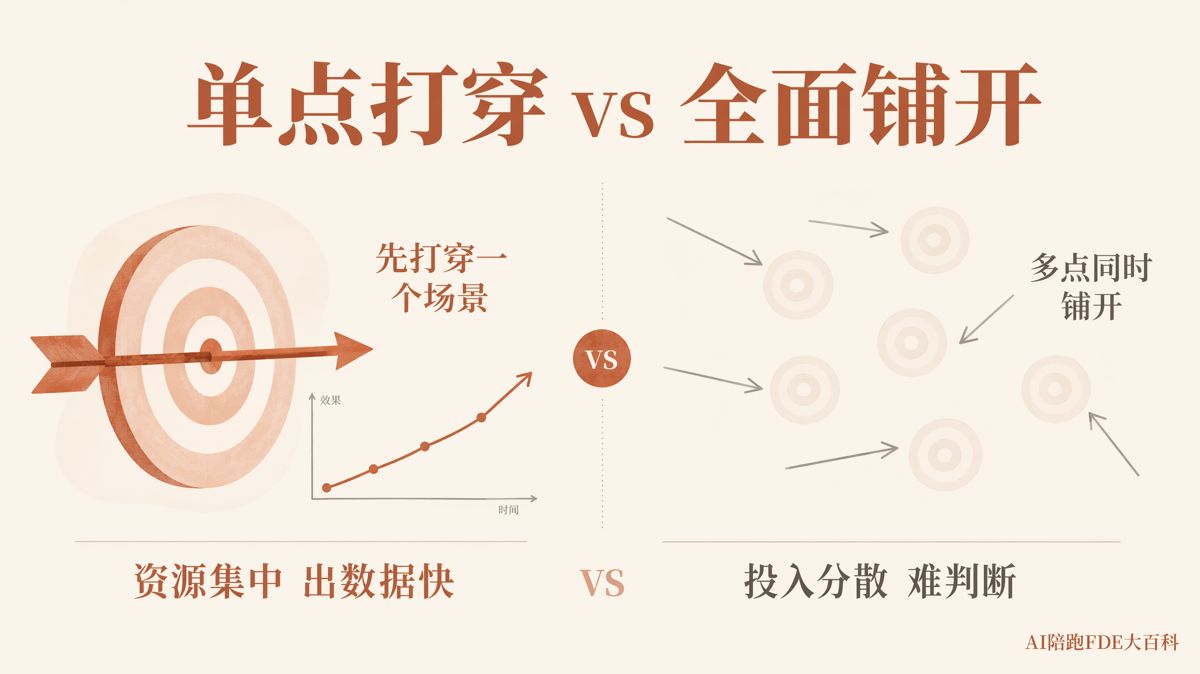
Once a scenario is selected, teams often make another mistake: trying to validate multiple departments simultaneously. Practical industry experience favors the opposite approach: nail one specific scenario, capture hard performance data, and then transfer that methodology to other parts of the company.
Early-stage validation resources, attention, and risk budgets are limited. Spreading them thin dilutes your effort, and a failure in any single stream undermines the entire initiative. Within an organization, one fully proven benchmark is far more persuasive than five half-finished experiments. When presenting to executive leadership, a completed before-and-after comparison moves decisions forward faster than five "in-progress" status updates.
The MIT data supports this logic: companies taking an external partnership and procurement path hit a 67% success rate—roughly three times that of internal-only builds. The gap is not budget size. It comes down to picking the right starting point, executing it thoroughly, and resisting the urge to run across multiple fronts before proving the first one.
Frequently Asked Questions
Does the validation pilot have to be in marketing? No, but marketing often scores highest across these four criteria for most businesses. It has clear numerical baselines, stays away from core enterprise architecture, and yields results fast. If your organization has more mature data tracking in customer service or internal knowledge management, those can work just as well. Prioritize based on the four criteria, not the department label.
How long should an AI validation phase last? Between one and three months is the common industry standard, depending on the operational cycle of the chosen workflow. Content-driven scenarios offer fast data turnaround and can run on shorter timelines. Projects involving IoT data or cross-team handoffs take longer, but validations should rarely exceed six months. Beyond that window, the pilot loses its purpose as a rapid decision-making filter.
What if our pilot misses its targets? Does that mean AI will not work for us? Not necessarily. Start with a clear post-mortem: did you pick the wrong scenario, was the underlying data insufficient, or did execution fail due to lack of team buy-in? Most failed first attempts stem from defining too broad a scope without clear ownership, rather than technical model limitations. Once you diagnose the issue, re-testing with a tighter, more specific entry point often yields very different results.
How much budget should be allocated to validation? There is no fixed dollar figure; it depends on company size and workflow complexity. The governing principle is that validation spend must remain significantly lower than the cost of a full-scale rollout. If testing a concept requires an investment close to enterprise deployment, your scope is too broad and needs to be broken down into smaller milestones.
Once a pilot succeeds, how do you scale it to other departments? Do not simply duplicate the exact software settings. Transfer the underlying playbook: how to evaluate candidate use cases, establish baseline metrics, and run root-cause analysis. Because operational logic differs across departments, copy-pasting the specific execution of your first pilot into an unrelated workflow usually causes performance to drop.
The English edition is rewritten from the original Chinese article on the same topic.

Starbox AI is an AI marketing company based in Hangzhou, China. This article draws on Starbox project work. Please credit the source when quoting.
Related reading
 AI Adoption
Can One AI Operator Really Replace 10 People?
Claims of 10x headcount cuts count generation speed, not QA and rework. Real efficiency measures net pipeline hours saved.
Oct 22, 2026 · 6 min read
 AI Adoption
Bought Basic AI and Seeing Zero ROI? A 4-Step Activation Playbook
Activating entry-level AI is not about model parameters. Turn open chat boxes into defined operational stations with clear inputs, templates, and QA checklists.
Oct 22, 2026 · 6 min read
 AI Adoption
Why One-Click AI Fails at Work: How to Pick Enterprise Agents
One-click AI tools seem easy, but their first-draft accuracy is terrible. Real business ROI requires multi-step workflows with your own knowledge base.
Oct 21, 2026 · 6 min read