
How to Structure an AI Vendor Contract You Can Pivot Away From

The short answer
Case studies do not guarantee results. Here is how to structure AI vendor contracts with validation periods, clear metrics, and exit clauses before you commit.
When enterprise leaders procure artificial intelligence (AI) services, the process usually follows a familiar script: review a pitch, examine case studies, sign a long-term contract, pay upfront, and wait several months to see the results.
The problem is that a vendor's past case studies only prove what worked in other environments. They cannot tell you whether that system will deliver when connected to your own workflows, your team, and your proprietary data.
By the time you discover that the results fall short, the budget has been spent and internal teams have burned months of operational bandwidth. At that stage, pivoting or walking away is expensive.
A contract cannot guarantee that every AI initiative will succeed. It can, however, formalize three critical operational terms: how long the validation phase will run, what specific metrics qualify as a success, and what happens if those targets are missed.
These provisions give your leadership the data needed to decide whether to scale spending, while giving vendors a clear benchmark to work toward.
Deploying AI Is Not the Same as Getting Business Results
According to the 2025 report The GenAI Divide by MIT Project NANDA, 95% of enterprise organizations have seen no measurable business return from their generative AI investments. (Generative AI refers to systems that generate content from natural-language instructions.) The report analyzed 150 executive interviews, 350 employee surveys, and 300 public deployment case studies.
The same report found that companies choosing an "external procurement and partnership" model achieved an implementation success rate of roughly 67%—three times higher than organizations trying to build everything internally.
A 2025 survey by S&P Global showed that by mid-2025, 42% of US companies had abandoned the majority of their AI projects, up from 17% the previous year.
Data from Chinese enterprises reflects a similar disparity. The China Entrepreneur AI Application Survey Report 2025 showed that 89.84% of surveyed companies were already using AI tools. Yet in McKinsey's The State of AI in 2025 survey covering Greater China, only 6% of surveyed organizations qualified as "high-performing winners."
These findings highlight a consistent reality across markets: adopting AI tools and generating auditable business results are two entirely different milestones.
Whether an AI system produces value depends on far more than the underlying model or software. How employees integrate it, whether existing workflows are redesigned, and whether internal teams provide continuous operational support all dictate outcomes.
When negotiating an agreement, you must evaluate both the technical fit and whether the contract structure can produce measurable outcomes inside your operational environment.
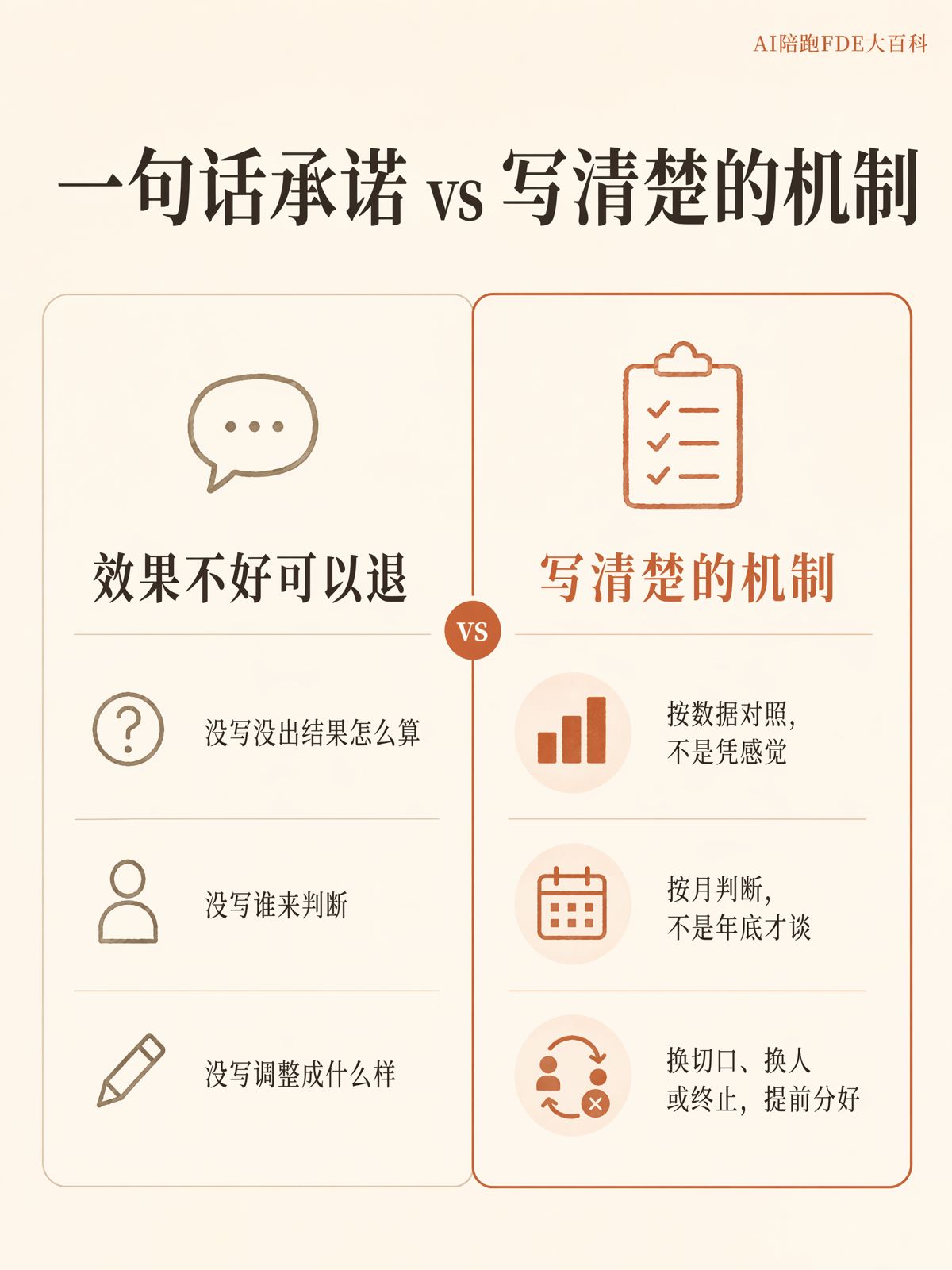
Set Validation Terms Before Signing a Long-Term Deal
Validation does not mean a casual product test. It means running the vendor's solution against your operational workflows, your team, and your live data. Your contract should define the validation scenario, the timeline, and the evaluation criteria upfront.
Start with a scenario that is easy to measure
A standard validation phase runs for 1 to 3 months. For complex operations where outcomes take longer to mature, it may require 3 to 6 months. Your business cycle should dictate the duration: too short, and results might reflect random variation; too long, and your organization shoulders financial risk before viability is proven.
Keep the initial scope contained. The ideal testing ground is a workflow that generates measurable data within a tight timeframe and carries zero risk to your core operational systems if the pilot fails.
Marketing content is frequently used as a first validation scenario. Content output, production turnaround times, and publishing frequency are easily tracked, allowing companies to compare baseline metrics against post-deployment performance quickly.
You do not have to start with marketing. The point is to select a discrete use case, capture empirical performance data with limited capital exposure, and use those findings to decide whether to expand the engagement.
Define "success" in auditable numbers
Vague contract terms like "improve operational efficiency" or "enhance output quality" cannot be used for project sign-off. When the pilot ends, both sides will inevitably disagree on whether the efficiency gain was sufficient.
Before kickoff, establish a baseline and a performance threshold. The baseline represents your actual operational performance before deploying AI. The target line is the minimum result the vendor must deliver by the end of the validation phase. Without a baseline, you cannot quantify improvement; without a target line, you cannot reach an objective acceptance decision.
Useful metrics include:
| Metric | What to Measure |
|---|---|
| Throughput | Number of tasks completed per unit of time |
| Team efficiency | Workload handled by the same headcount |
| Unit cost | Change in cost per completed task or deliverable |
| Conversion | Change in the rate at which prospects complete a defined next step |
Ensure your metrics tie directly to the pilot workflow, can be quantified, and can be tracked continuously. Agree on specific deliverables: units produced per week, hours required per task, or update cadences over a fixed schedule.
The target line should not be set so low that it proves nothing, nor should it ignore current operational constraints. Confirm the baseline, the target threshold, the data source, and the evaluation methodology before the pilot begins—never alter benchmarks after seeing the preliminary numbers.
Spell out remedies if targets are missed
Many vendor agreements explain how to extend a contract after a successful pilot, but stay silent on what happens if the pilot falls short.
If you wait until results stall to start negotiating, you have already spent the budget, deployed resources, and lost your leverage.
Standard agreements should specify one of three remediation paths if targets are not met:
- Refine the approach and run an additional validation round;
- Terminate the agreement with no further financial commitment;
- If an initial upfront fee was designated as a refundable commitment deposit, offset or refund it according to predetermined terms.
Whichever option you choose, put it in writing before signing so both sides have a clear operational path if expectations are missed.

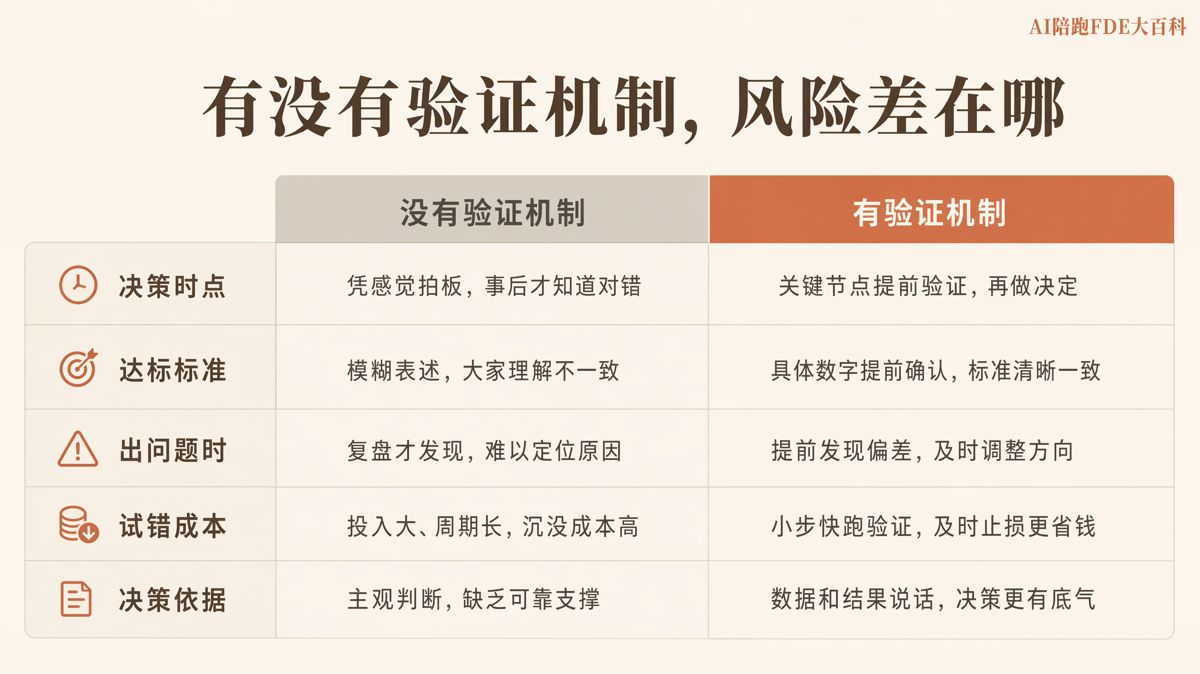
What Changes When You Build in a Validation Mechanism?
| Dimension | Without a Validation Mechanism | With a Validation Mechanism |
|---|---|---|
| Basis for signing | Vendor pitch decks and historical case studies | Empirical data from your own business workflows |
| Acceptance criteria | Subjective terms like "efficiency gains" | Auditable target numbers agreed upon upfront |
| Remediation for failure | Ad-hoc renegotiation after money is spent | Pre-agreed adjustments, contract termination, or deposit handling |
| Upfront commitment | Often full contract value or large advance payments | Capped, controlled budget for the pilot phase |
| Next steps | Guided by subjective impressions or sunk costs | Decided strictly on real operational data |
The difference comes down to control: with a validation mechanism, you verify performance before scaling your investment, and you retain an orderly exit path if things do not work out.
A Validation Phase Is Not the Full Payback Period
Payback means the project has generated enough cumulative returns to fully cover the initial investment. In enterprise software, typical AI payback cycles span 2 to 4 years, though a small percentage of deployments show a return within 12 months. This is a general industry benchmark, not a performance guarantee for any specific implementation.
Your validation phase does not need to achieve complete financial payback. However, it must produce verified, measurable operational shifts. Without those intermediate signals, leadership has no objective basis to justify continued spending.

"Pay for Performance" Is Not a Substitute for Validation
Performance-based pricing ties billing to specific business outcomes. A validation mechanism, by contrast, establishes the timeframe, benchmarks, and data sources used to judge whether the system works at all.
If your contract lacks a defined baseline, clear targets, and an auditable acceptance protocol, "performance" remains open to interpretation. Adding a pay-for-performance clause without objective definitions will only lead to billing disputes.
You can only enforce performance-based billing after establishing clear, measurable metrics.

Before Your Next AI Project, Review Your Previous One
If your company has already experienced an AI initiative that fell flat, do not simply switch vendors or software tools. Review how the partnership was structured.
Check whether the original scope was too broad, whether ongoing cross-functional collaboration was lacking, and whether anyone had clear accountability for business results.
Before entering a new agreement, clarify five questions with the vendor:
- Are they willing to validate on a small-scale pilot first?
- Can measurable performance metrics be written directly into the contract?
- If targets are missed, can you adjust terms or exit according to a pre-agreed clause?
- Can existing data assets and structured knowledge bases (materials previously organized for AI ingestion) be reused?
- How will this implementation address the operational bottlenecks that derailed previous attempts?
Addressing these points early ensures your next partnership fixes structural workflow issues rather than repeating them.
The Seven-Point Pre-Signing Checklist
An AI vendor contract that allows for validation and timely adjustments should define these seven items in writing:
- The specific business workflow being tested;
- The exact start and end dates of the validation phase;
- The pre-deployment baseline numbers;
- The exact target metrics and numeric thresholds required for acceptance;
- The specific data sources and review process used to assess performance;
- The remediation process if targets are missed (workflow adjustment, contract termination, or deposit handling);
- The contractual terms for expanding the scope once the pilot passes.
Falling short during a validation phase does not have to mean losing your investment or triggering an abrupt dispute. When timelines, targets, and exit options are codified from day one, your company retains control over its budget, and your vendor has an unambiguous roadmap for delivery.
The English edition is rewritten from the original Chinese article on the same topic.

Starbox AI is an AI marketing company based in Hangzhou, China. This article draws on Starbox project work. Please credit the source when quoting.
Related reading
 AI Adoption
Can One AI Operator Really Replace 10 People?
Claims of 10x headcount cuts count generation speed, not QA and rework. Real efficiency measures net pipeline hours saved.
Oct 22, 2026 · 6 min read
 AI Adoption
Bought Basic AI and Seeing Zero ROI? A 4-Step Activation Playbook
Activating entry-level AI is not about model parameters. Turn open chat boxes into defined operational stations with clear inputs, templates, and QA checklists.
Oct 22, 2026 · 6 min read
 AI Adoption
Why One-Click AI Fails at Work: How to Pick Enterprise Agents
One-click AI tools seem easy, but their first-draft accuracy is terrible. Real business ROI requires multi-step workflows with your own knowledge base.
Oct 21, 2026 · 6 min read