
5 Clauses to Lock Down Before Signing an AI Partnership Contract

The short answer
A slick demo shows features, but your contract determines acceptance, payment, and asset ownership. Here are 5 terms to define before you sign.
A slick software demo can showcase impressive features, and sales reps can pitch endless growth opportunities. But when a project ends, what actually decides acceptance, settlement, and asset handoffs is the contract text.
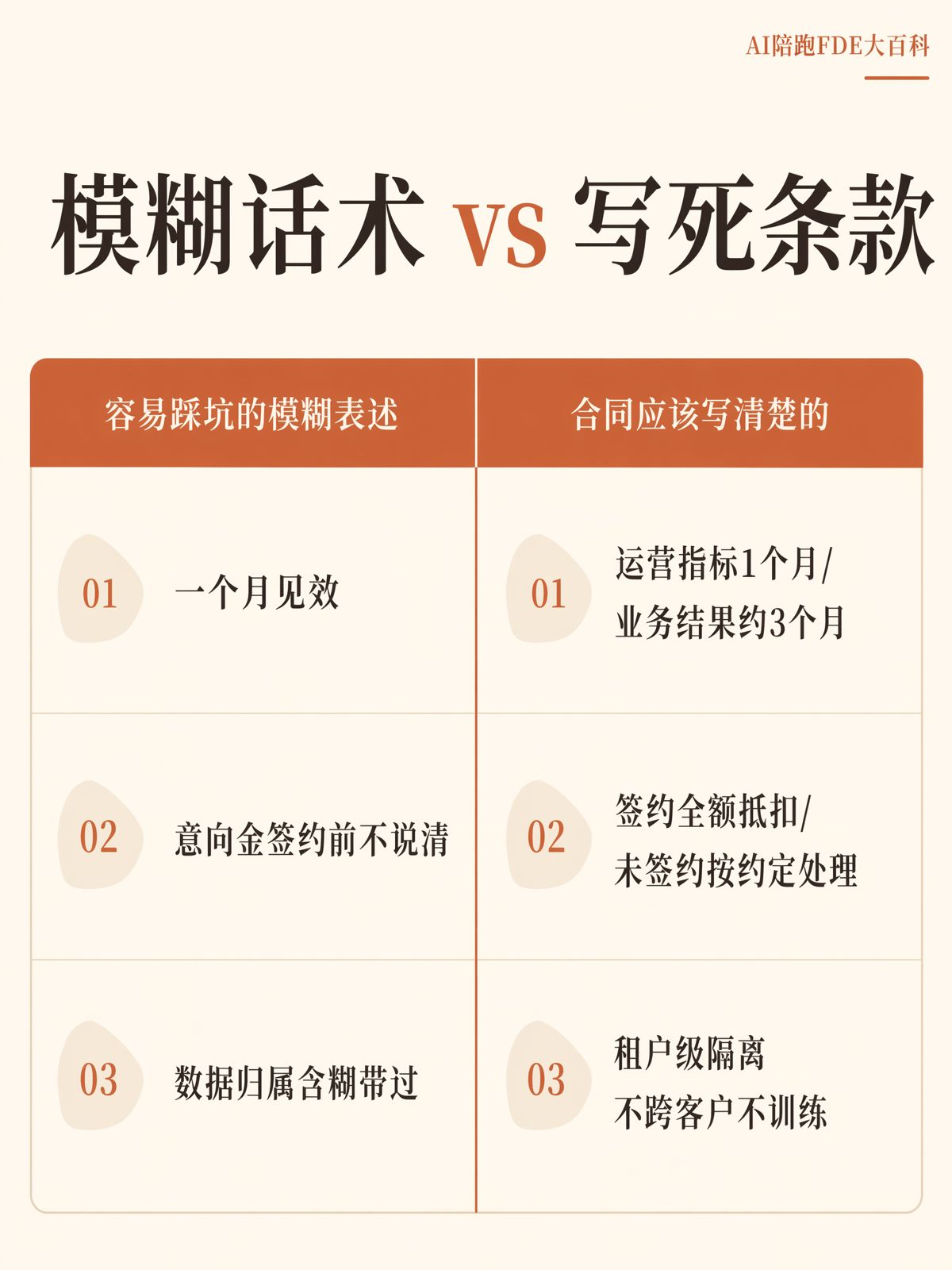
Vague promises like "boost team efficiency," "accelerate business growth," or "money-back guarantee if it doesn't work" are practically unenforceable without clear metrics, timelines, verification methods, and remedies.
In enterprise consulting, an AI enablement partnership involves a vendor embedding AI into your business workflows over a set period. Beyond software licenses, they handle tool onboarding, staff training, data structuring, workflow design, and continuous optimization. This work touches proprietary business data, institutional knowledge, operational playbooks, and ongoing maintenance.
Recent research makes it clear: adopting AI does not automatically generate business results.
According to The GenAI Divide, a 2025 report published by MIT Project NANDA, roughly 95% of organizations surveyed saw no measurable profit-and-loss (P&L) impact from their generative AI investments. Generative AI refers to models that produce text, imagery, and other content from prompts; measurable P&L impact means observable shifts in revenue or cost structures.
The same report also compared deployment rates across two project types: external partnerships using adaptable, customizable tools saw about 67% advance to deployment, compared to roughly 33% for purely in-house builds. Here, customizable tools mean systems that adjust to an organization's actual usage patterns and evolving requirements. "Reaching deployment" means the tool was put into active use, not that it turned a profit or guaranteed success.
Meanwhile, a 2025 survey by S&P Global found that among surveyed enterprises in North America and Europe, the share of companies abandoning the majority of their AI initiatives before full production spiked from 17% the previous year to 42%.
These statistics do not measure any single vendor's credibility. They highlight a broader reality: software tools are only one piece of the puzzle. Whether the use case is appropriate, who owns accountability, how both sides execute, and how results are verified will decide whether a project survives.
Because there is no standardized industry definition for AI enablement services, scopes, pricing models, and deliverables vary wildly between providers. Before you sign, lock down these five areas in writing.
1. Performance Metrics Must Be Measurable
Phrases like "boost operational efficiency with AI" or "accelerate business growth" indicate direction, but they cannot serve as contractual acceptance criteria.
How much must efficiency improve to count as successful? Does growth mean top-line revenue, order volume, or content output? When does the clock start? Who provides the underlying data, and who signs off on it? Without clear answers in the contract, both sides will inevitably evaluate the outcome using different yardsticks.
For a marketing content initiative, for instance, break targets down into three trackable metrics:
- Total assets produced per week or per month
- Average production time per asset
- Publishing and update frequency
Every metric requires four components: a baseline, a target value, an agreed data source, and a measurement window.
The baseline represents your historical performance before the engagement begins. To claim content output increased, you must first document your average output over a defined pre-project period. The target is the figure to hit post-implementation. The data source should be an agreed platform dashboard or analytics export, and the measurement window specifies whether evaluation happens weekly, monthly, or at project completion.
Your contract should also distinguish between operational metrics and business outcomes. Output volume, production turnaround, and update frequency are operational metrics that can be tracked directly. Revenue, profit margins, and deal volume are business outcomes influenced by pricing, broader market demand, and sales execution. An increase in content volume does not mean all downstream business fluctuations can be credited to an AI vendor.
You can also stage acceptance windows separately. Operational gains like output and speed often show up within thirty days, whereas strategic content initiatives typically require a full content cycle—often around three months—to reflect in downstream engagement. Whatever timeline makes sense for your project, write it into the contract.
If a vendor promises "immediate results upon signing" or "double your output in 30 days," ask four direct questions:
- Which specific metric will double?
- What historical timeframe establishes the baseline?
- Who tracks and verifies this data?
- What is the remedy if the target is missed?
When proposals feature claims like "see impact in 30 days" or "300% order growth," treat them with the same scrutiny. What matters is not what appears on a pitch deck, but what is documented in the contract and verifiable by both parties.
2. Define Both Success Thresholds and Exit Terms for Pilot Phases
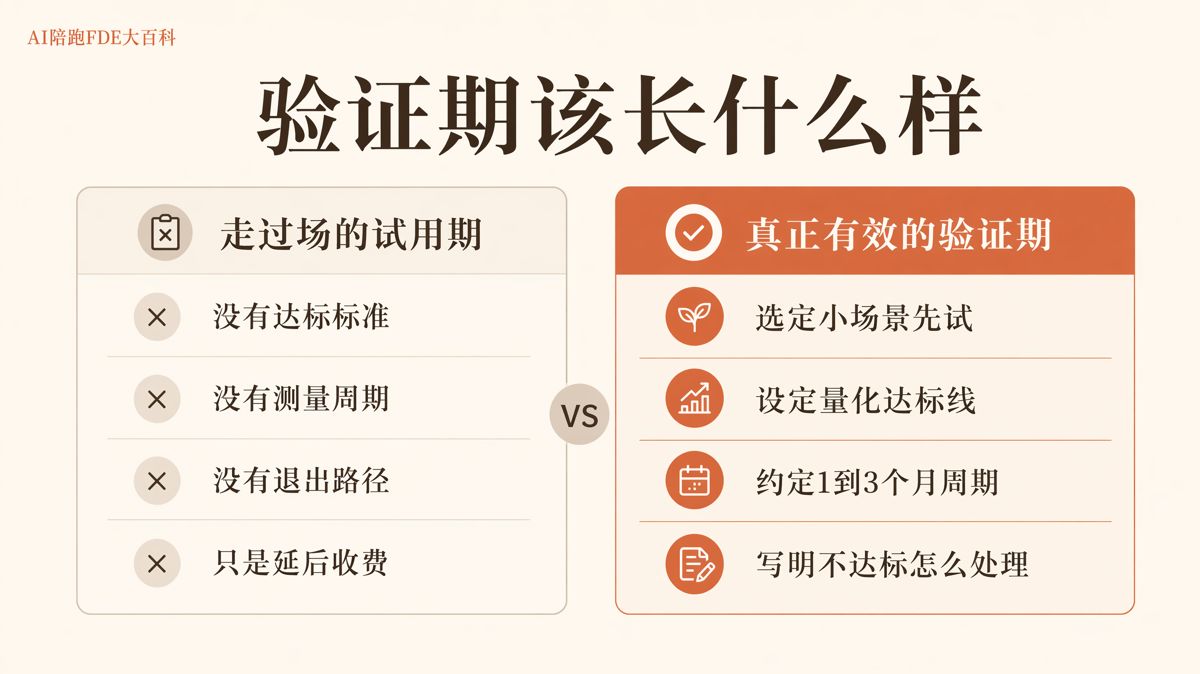
A pilot phase allows an enterprise to test an AI workflow within a narrow, controlled business function before committing to a larger rollout. Its purpose is not merely to trial software, but to confirm whether the workflow can hit agreed milestones under realistic operating conditions.
A complete pilot clause must define four elements:
- The exact use case being tested
- The specific metrics used to evaluate success
- The precise start and end dates
- The procedure if the project fails to meet agreed targets
Keep the pilot scope tightly focused. For example, start by testing marketing copy production rather than attempting to overhaul multiple operational departments at once. An overly broad scope makes it nearly impossible to isolate what worked, evaluate performance, or assign accountability.
Pilots typically run between one and three months, depending on the complexity of the workflow. Simply writing "three-month trial period" without defining pass/fail criteria or exit paths merely delays decision-making without mitigating risk.
Your failure-to-perform terms are critical. The contract must state clearly:
- Whether you have the right to terminate the engagement
- Whether the vendor will refine the workflow or extend the pilot at their own cost
- How previously paid fees will be handled or credited
- How accumulated data, custom knowledge bases, and work products will be handed over
If a contract includes clauses like "eligible for a refund if core value is not realized within three months," push further: How is "core value" defined? Which metric tracks it? What exact conditions trigger a refund, and which fee categories are covered?
A sales rep's verbal reassurance that "you can get a refund if it doesn't work" carries no weight without precise contractual backing.

3. Establish Separate Terms for Data, Knowledge Bases, and SOPs
An AI enablement project will interact with your customer data, operational records, and historical creative assets. Over time, it will also generate proprietary assets: knowledge bases, brand tone guidelines, prompt libraries, and standard operating procedures (SOPs).
A knowledge base organizes your documentation, business logic, and case studies so human team members or AI agents can query them. Brand voice rules govern tone, vocabulary, and messaging constraints. SOPs define step-by-step responsibilities, execution order, and quality standards for a given task.
Do not lump these assets under a generic label like "project collateral." Define ownership, usage rights, and export procedures for each category separately.
First: Your core historical business and customer data. The contract must specify:
- Where the data is stored
- Which vendor personnel have access
- How your data is partitioned from other client data
- Whether cross-client data sharing is prohibited
- Confirmation that your data will not be used to train or fine-tune models for other clients
- How data is returned or permanently purged upon contract termination
Vague commitments to "ensure data security" are inadequate. Even when vendors use phrases like "physical isolation," "air-gapped," "100% isolated," or "zero leakage," ask for technical specifics and verification methods. "Physical isolation" is a technical term; the contract should detail exactly which compute or storage resources are isolated and how, rather than relying on marketing shorthand.
Second: Knowledge bases and methodology developed during the project. Confirm in advance:
- Does your business retain full rights to use these assets after the contract ends?
- Can they be exported in full?
- In what standard file formats will they be provided?
- Will you retain system access post-termination to retrieve them?
- What requirements must be met to migrate them to an alternative platform?
Third: SOPs, prompt libraries, and workflow documentation. Clarify what you actually own: temporary access to a proprietary platform, or perpetual ownership of editable, portable files that your internal team can view, adapt, and run independently.
If you wait until you switch vendors to sort this out, you risk losing your operational playbooks and having to rebuild from scratch. The issue is rarely the transition itself—it is failing to define asset ownership and migration terms in the initial contract.
4. Spell Out Renewal, Expansion, and Termination Terms Upfront
Focusing solely on the initial pilot price and immediate scope makes it easy to underestimate the total cost of ownership.
Check your renewal terms against three questions:
- Will renewal pricing stay locked at initial rates, or what specific conditions govern price increases?
- How are additional features or use cases billed, and do they require separate pilot validation?
- What happens to your software environment, user seats, data, and knowledge bases if you choose not to renew?
When a proposal states pricing "starts at" a baseline figure, ask for a complete cost breakdown: the base service fee, the exact features and use cases included, the incremental cost per additional workflow, and whether ongoing maintenance carries separate fees.
A single flat price without an itemized scope leaves you unable to tell whether future requests fall within the original contract, making total expenditure impossible to forecast.
Termination procedures require equal attention. The agreement should document exactly when system access cuts off, whether a transition window is provided, who retains administrative control of user accounts, whether data and knowledge bases remain accessible, and how files will be transferred.
When you decide not to renew, handoffs should follow a clear contractual playbook rather than an ad-hoc negotiation after your access has already been revoked.

5. Performance-Based Pricing Must Define What Counts as a "Result"
Performance-based billing ties payment schedules, milestone releases, or fee adjustments to agreed business outcomes. This billing model does not automatically eliminate client risk; its enforceability depends entirely on how both parties define a "result."
Every performance clause needs to meet three conditions:
- The outcome must be mathematically quantifiable.
- Both parties must evaluate performance against the exact same data source.
- Target numbers and specific remedies for missed targets must sit inside the core contract body.
Avoid contracts that simply state "improve operational performance." The agreement must clearly identify:
- The exact metric being improved
- The pre-project baseline value
- The deadline for hitting the target
- Who extracts, reconciles, and signs off on the data
- The payment schedule once the target is met
- The explicit remedy if the target is missed (e.g., discounted fees, waived milestones, partial refunds, or extended service without added cost)
Review your contract draft for terms like "performance," "results," or "milestones." Check whether each instance is accompanied by specific numbers, a defined verification method, and clear consequences for non-performance. If any piece is missing, require an amendment.
If an account executive says, "You don't pay if we don't deliver," but the written contract does not reflect that mechanism, you have no legal basis to withhold payment.

Final Pre-Payment Checklist
Run through this checklist before executing any agreement or wiring funds:
- Are performance goals backed by concrete numbers?
- Does every target metric include a verified pre-implementation baseline?
- Are the authoritative data sources and measurement windows specified?
- Is there a contained pilot phase with narrow operational scope?
- Does the contract define exit rights, scope revisions, or fee adjustments if the pilot misses targets?
- Does the contract prohibit using your proprietary data to train models for other clients?
- Can your knowledge bases, SOPs, and prompt libraries be fully exported in standard formats?
- Are renewal rates, expansion costs, and feature add-ons itemized?
- Is there a structured handoff process for data, accounts, and assets if you do not renew?
- Are performance-based verification methods and default remedies written directly into the contract text?
If a service provider demands an annual commitment or full upfront payment without offering a structured, low-risk pilot phase, pause the transaction and reassess.
If an initial AI deployment falls short of expectations, do not assume the underlying technology was the sole failure point. Review whether the initial scope was too ambitious, whether an internal process owner was accountable for adoption, whether staff continued using the workflows after initial training, and whether workflows were adjusted based on early operational data.
When preparing to change vendors, verify that your existing data models and knowledge assets can be exported cleanly to avoid paying twice for the same work.
A solid AI implementation contract is straightforward at its core: what the vendor delivers, the standard they must meet, the data used to measure it, what happens if they fall short, and what intellectual property you keep when the engagement ends.
Performance metrics, pilot exit terms, asset ownership, renewal structures, and result definitions: if any of these five areas remains vague, do not sign.
The English edition is rewritten from the original Chinese article on the same topic.

Starbox AI is an AI marketing company based in Hangzhou, China. This article draws on Starbox project work. Please credit the source when quoting.
Related reading
 AI Adoption
Can One AI Operator Really Replace 10 People?
Claims of 10x headcount cuts count generation speed, not QA and rework. Real efficiency measures net pipeline hours saved.
Oct 22, 2026 · 6 min read
 AI Adoption
Bought Basic AI and Seeing Zero ROI? A 4-Step Activation Playbook
Activating entry-level AI is not about model parameters. Turn open chat boxes into defined operational stations with clear inputs, templates, and QA checklists.
Oct 22, 2026 · 6 min read
 AI Adoption
Why One-Click AI Fails at Work: How to Pick Enterprise Agents
One-click AI tools seem easy, but their first-draft accuracy is terrible. Real business ROI requires multi-step workflows with your own knowledge base.
Oct 21, 2026 · 6 min read