
Validate First, Sign Later: De-Risking Enterprise AI Engagements

The short answer
The most reliable way to de-risk an enterprise AI partnership is to validate performance on a targeted workflow before signing a long-term contract.
If you are evaluating external AI implementation partners, the most effective way to eliminate risk boils down to a single principle: validate whether the provider can generate tangible results on a small, focused workflow before signing a long-term contract.
Reversing this order—signing a long-term contract and paying upfront before seeing measurable results—is where most failed enterprise AI adoptions begin.
The baseline facts:
- According to MIT Project NANDA's 2025 study The GenAI Divide, enterprises that partner with external AI providers achieve a success rate of roughly 67%. Teams attempting to figure out AI and build custom setups entirely in-house succeed only about a third as often (MIT NANDA 2025).
- The same report reveals that while over 80% of organizations have tested off-the-shelf tools like ChatGPT or GitHub Copilot, only 5% of customized AI pilots make it into production and generate measurable business value (MIT NANDA 2025). The report notes that this "adoption-to-production" gap is not driven by model capabilities or regulatory barriers, but by flawed implementation methodologies.
- Across industry practitioner discussions, phased rollouts are becoming the standard recommendation. Common practices include running three-month pilots to validate core value with exit provisions, and some providers now offer refund mechanisms if milestones are not reached within three months (industry market observations, 2026).
These findings highlight an important reality: the way you structure an AI partnership matters more than how convincing the initial pitch sounds. A "validate-first" approach turns this principle into an actionable procurement safeguard.
Why Signing First Leads to Higher Failure Rates
You cannot evaluate whether a vendor will deliver measurable business outcomes simply by reviewing a proposal. Product features and user interfaces are easy to judge through a live demo or technical documentation. But whether that system will actually move your business metrics cannot be verified before deployment.
This dynamic drives the core findings of MIT's NANDA report: the GenAI divide is rarely about tool selection; it is about implementation strategy. When you commit to a long-term contract and pay in full upfront, you take on significant downside risk. If the vendor's methodology, operational team, or industry domain knowledge fails to align with your day-to-day operations, backing out becomes expensive. Budgets are spent, time is lost, and internal team trust evaporates.
This explains why "secondary implementations"—companies parting ways with an initial vendor and starting over—are common across the industry. When post-mortems are conducted, the root cause is rarely the underlying model. Instead, projects stall due to lack of hands-on operational support, attempting to overhaul too many complex processes at once, or working with vendors who refuse to tie their compensation to business outcomes. The failure lies in the partnership structure, not the AI technology itself.
A clear warning sign during vendor evaluation: if a provider refuses to run a scoped proof-of-value phase and insists on a multi-year commitment or upfront payment, proceed with caution. Providers with proven delivery track records are usually comfortable letting you evaluate initial performance at a limited scale.

How to Structure a Validation Phase: An Actionable Checklist
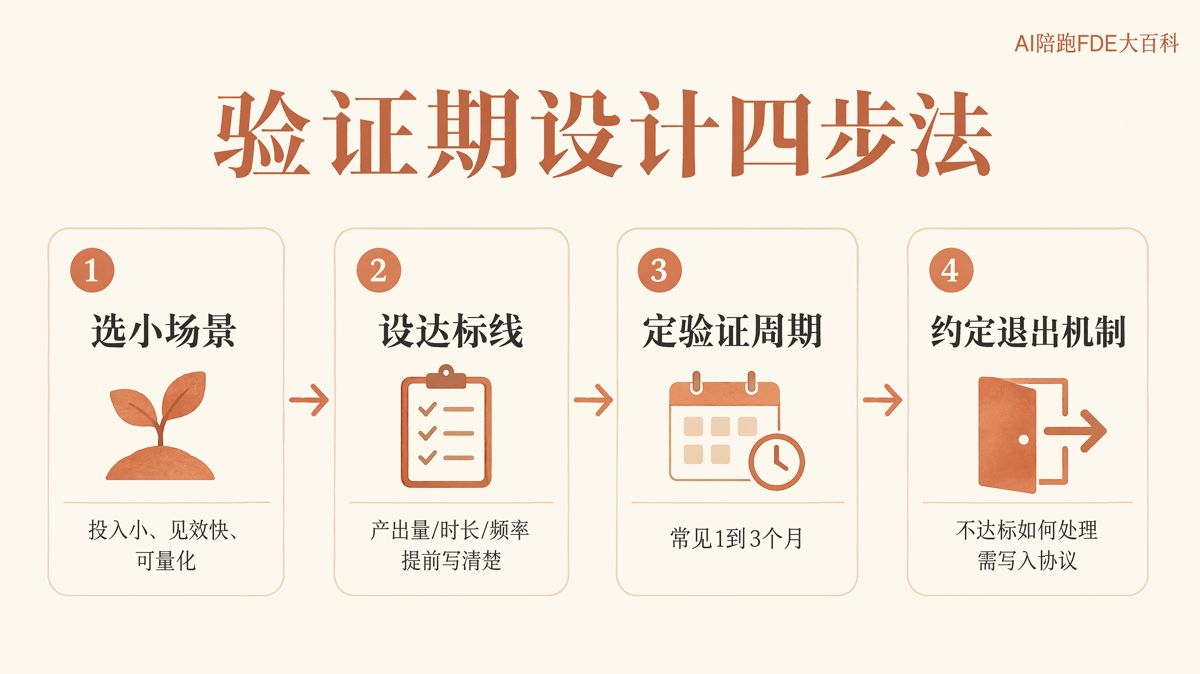
A validation phase should not be a loose trial period. To avoid turning it into a formality, lock down these four components:
1. Pick a targeted workflow with fast feedback cycles. Do not attempt to overhaul an entire department or complex business pipeline during validation. Choose an entry point that requires minimal systems integration, provides rapid feedback, and produces measurable deliverables. Marketing content production is a frequent starting point: output volume and workforce productivity improvements are easily measured without requiring deep infrastructure modifications.
2. Establish quantitative pass/fail benchmarks. Define what counts as success before work begins. Will you evaluate content volume, production turnaround time per asset, or publishing frequency? These metrics must be documented and agreed upon in writing by both parties upfront, rather than defined after the pilot ends.
3. Set a strict validation timeline. Most enterprise pilots run between one and three months. A timeframe shorter than 30 days rarely provides enough operational data, while anything longer than three months undermines the point of low-cost, low-risk experimentation.
4. Define contractual exit terms. Agree on what happens if the pilot misses its benchmarks. Options include adjusting the implementation roadmap, terminating the agreement, or converting initial setup fees into alternate services. These conditions must be part of the written contract, not verbal promises.
The fourth step is the most critical and the most frequently overlooked. Many agreements leave exit terms vague, relying on verbal assurances like "we'll make it right if you're not satisfied." Without explicit contractual exit mechanisms, terminating an underperforming engagement becomes difficult.
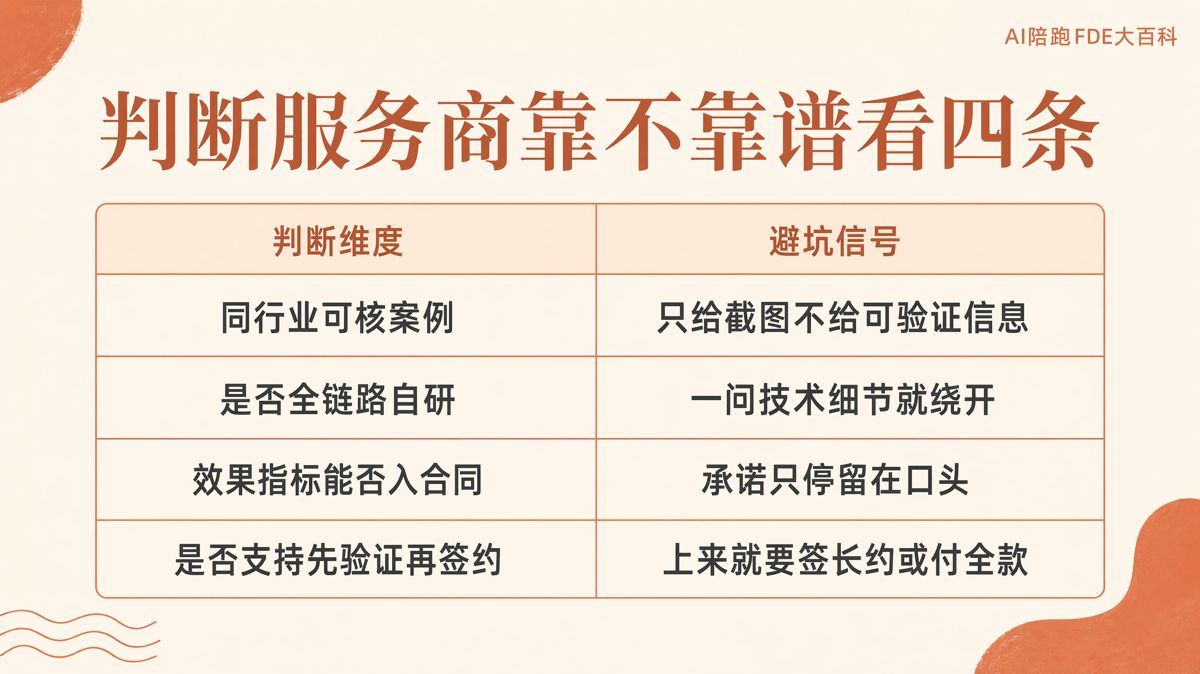
Four Criteria to Vet an AI Service Provider
Sales pitches and polished slide decks often obscure a vendor's actual execution capabilities. Use these four verifiable criteria to evaluate potential partners:
| Evaluation Dimension | Verification Method | Warning Signs |
|---|---|---|
| Verifiable peer case studies | Request real, contactable references from similar industries and company sizes, rather than generic slide decks. | The vendor shares only anonymized success stories and refuses to provide verifiable details. |
| Proprietary delivery infrastructure | Determine whether the platform is proprietary or an outsourced, repackaged white-label wrapper. | The team deflects or avoids technical questions regarding their underlying technology. |
| Performance metrics in the contract | Ensure operational performance targets are written directly into the contractual terms. | Performance claims are made verbally but omitted entirely from the legal agreement. |
| Support for pilot-first validation | Verify the vendor's willingness to run a targeted, milestone-based validation phase. | The vendor pushes for long-term lock-in or complete upfront payment before starting work. |
Among these four, getting performance metrics into the contract is where buyers face the most friction. A wide gap between what sales reps promise and what legal documents outline is the primary source of downstream disputes.
Evaluating software interfaces is straightforward; a live product demo provides a reasonable sense of usability. But verifying whether an AI system will consistently produce business returns requires a structured operational process. A pilot-first engagement model is the most dependable way to manage that uncertainty.
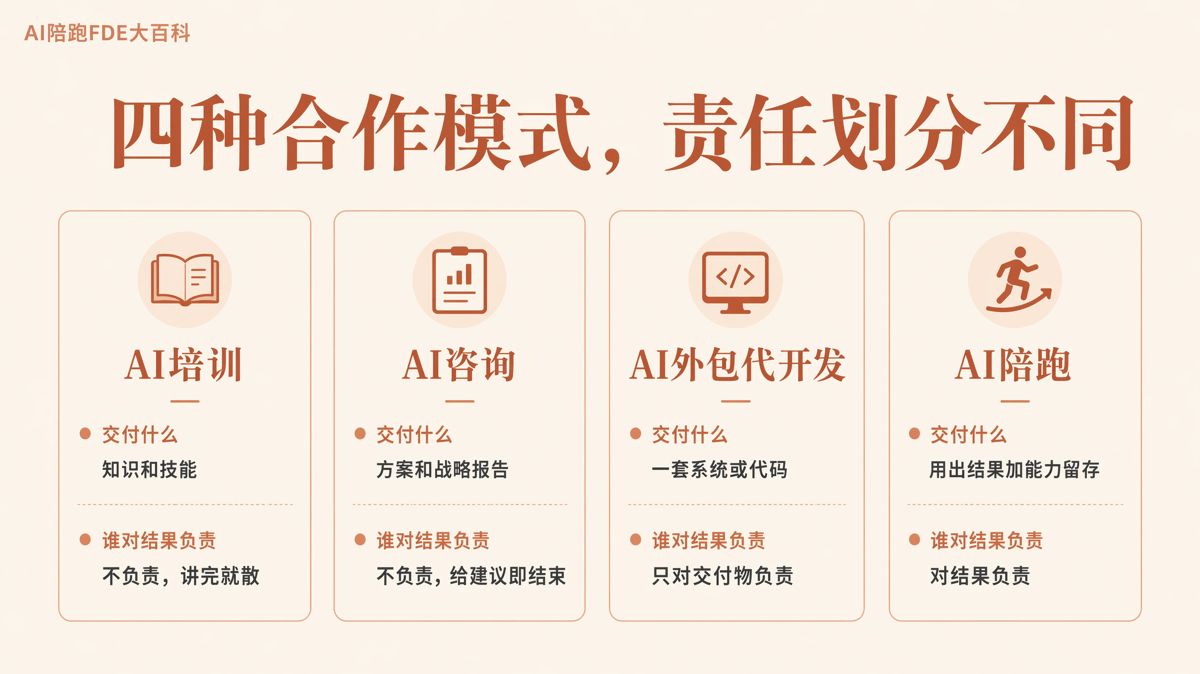
Four AI Collaboration Models: Understanding Accountability
Before structuring a pilot, determine which type of engagement model you are entering. Accountability varies significantly across different service categories:
| Model | Core Deliverable | Execution Owner | Result Accountability |
|---|---|---|---|
| AI Training | Knowledge transfer and skills | Internal client team | Vendor is not accountable once sessions conclude. |
| AI Consulting | Strategic reports and roadmaps | Internal client team | Vendor is not accountable once recommendations are delivered. |
| AI Development Outsourcing | Custom software or codebase | Vendor engineering team | Vendor is accountable for technical delivery, not business outcomes. |
| AI Implementation Partnership | Business outcomes and retained internal capacity | Vendor and client together | Vendor shares accountability for defined business outcomes. |
The fundamental differences across these models center on what is delivered and who owns the ultimate business results.
If your goal is to generate measurable operational returns, standard training, advisory consulting, or software development contracts rarely assign that responsibility to the vendor. If the initiative falls short of business goals, there is little contractual recourse because the vendor was never contracted to own outcomes. Clarifying this model upfront determines who you need to hire and what terms you need to negotiate.
Three Common Misconceptions
Misconception 1: "A cheaper proposal means lower financial risk."
What matters is how transparently the pricing is structured—broken down by personnel days, platform licensing, infrastructure setup, and review cadences. A provider offering a single, opaque lump sum without line-item clarity represents higher operational risk, regardless of how low the headline price is.
Misconception 2: "Pure pay-for-performance contracts eliminate all risk."
Performance-based compensation models are useful, but only if the target metrics are clearly defined, auditable, and incorporated into the contract. If performance benchmarks remain vague, performance-based pricing is functionally identical to a standard agreement.
Misconception 3: "A successful pilot guarantees seamless enterprise-wide rollout."
A successful validation phase proves that AI works within a controlled, specific workflow. It does not automatically guarantee company-wide success. As deployment scales across business units, organizational coordination, cross-departmental buy-in, and complex data pipeline integrations increase in difficulty. Scaling requires its own dedicated operational roadmap.

Frequently Asked Questions
Q1: How long should an AI validation period last?
Industry practice typically ranges from one to three months depending on workflow complexity. Anything shorter may fail to show real-world impact, while anything longer defeats the purpose of low-cost experimentation.
Q2: Can we get a refund if the validation phase misses its goals?
This must be negotiated in writing before the pilot begins. Typical terms include adjusting the implementation roadmap, terminating the partnership, or converting initial deposits into other services.
Q3: Which scenario is best suited for an initial pilot?
Prioritize low-investment, fast-feedback workflows with measurable output. Marketing content generation is a frequent starting point because throughput and productivity gains are simple to measure without extensive systems integration.
Q4: How do I know if an AI provider genuinely supports a pilot-first approach?
Ask directly for a scoped pilot with clear pass/fail milestones before signing a long-term agreement. Vendors confident in their capabilities will readily provide workable pilot terms.
Q5: Does a successful validation phase guarantee long-term success?
Not necessarily. A pilot proves that a specific workflow functions. Rolling the solution out across an enterprise brings organizational coordination, cross-departmental alignment, and complex data integrations that require separate evaluation.
Q6: Why is the market shifting toward validation before contracting?
Software features are easy to evaluate in a demo, but ongoing business results cannot be assessed until software meets real workflows. Placing validation before the formal contract answers the hardest question before you commit your budget.
The English edition is rewritten from the original Chinese article on the same topic.

Starbox AI is an AI marketing company based in Hangzhou, China. This article draws on Starbox project work. Please credit the source when quoting.
Related reading
 AI Adoption
Can One AI Operator Really Replace 10 People?
Claims of 10x headcount cuts count generation speed, not QA and rework. Real efficiency measures net pipeline hours saved.
Oct 22, 2026 · 6 min read
 AI Adoption
Bought Basic AI and Seeing Zero ROI? A 4-Step Activation Playbook
Activating entry-level AI is not about model parameters. Turn open chat boxes into defined operational stations with clear inputs, templates, and QA checklists.
Oct 22, 2026 · 6 min read
 AI Adoption
Why One-Click AI Fails at Work: How to Pick Enterprise Agents
One-click AI tools seem easy, but their first-draft accuracy is terrible. Real business ROI requires multi-step workflows with your own knowledge base.
Oct 21, 2026 · 6 min read