
Adopting AI on a Tighter Budget: How to Make Round Two Work
The short answer
When restarting enterprise AI on a tighter budget, avoid repeating past mistakes with new tools. Scope one workflow, track baselines, and keep internal ownership.
When enterprise teams attempt AI implementation a second time, budgets are tighter and executive approvals are much stricter. The most common mistake at this stage is simply swapping vendors or toolkits while repeating the exact same process that stalled the first time.
AI adoption does not mean purchasing software licenses or holding a one-off workshop. It means embedding AI tools that generate or analyze content into live business workflows, getting staff to use them consistently, and measuring tangible changes in efficiency, cost, or output quality.
When your budget shrinks, allocate your funds to four specific priorities: diagnose where the first rollout broke down, complete a single, narrowly scoped business scenario from start to finish, document verifiable baseline and outcome data, and transfer operational workflows to internal staff.
| What the Budget Must Cover | What You Should See at Project Close |
|---|---|
| Post-mortem and diagnosis of the first attempt | Identify the exact break point; clarify which assets are still reusable |
| A tightly scoped business scenario | Full execution from asset preparation to live use, rather than a half-finished broad rollout |
| Data tracking and formal acceptance criteria | Clear comparison of time spent, output volume, costs, or quality before and after |
| Operational handover and ongoing maintenance | Internal staff can run the workflow independently after the partner leaves |
If your budget can only fund half of a massive enterprise overhaul, do not start it. Narrow the scope further until you can deliver an end-to-end workflow completely.
Diagnose Where the First Attempt Actually Stopped
"It didn't work" is not a diagnostic finding. You need to map the entire lifecycle from procurement to abandonment to pinpoint where the project stalled.
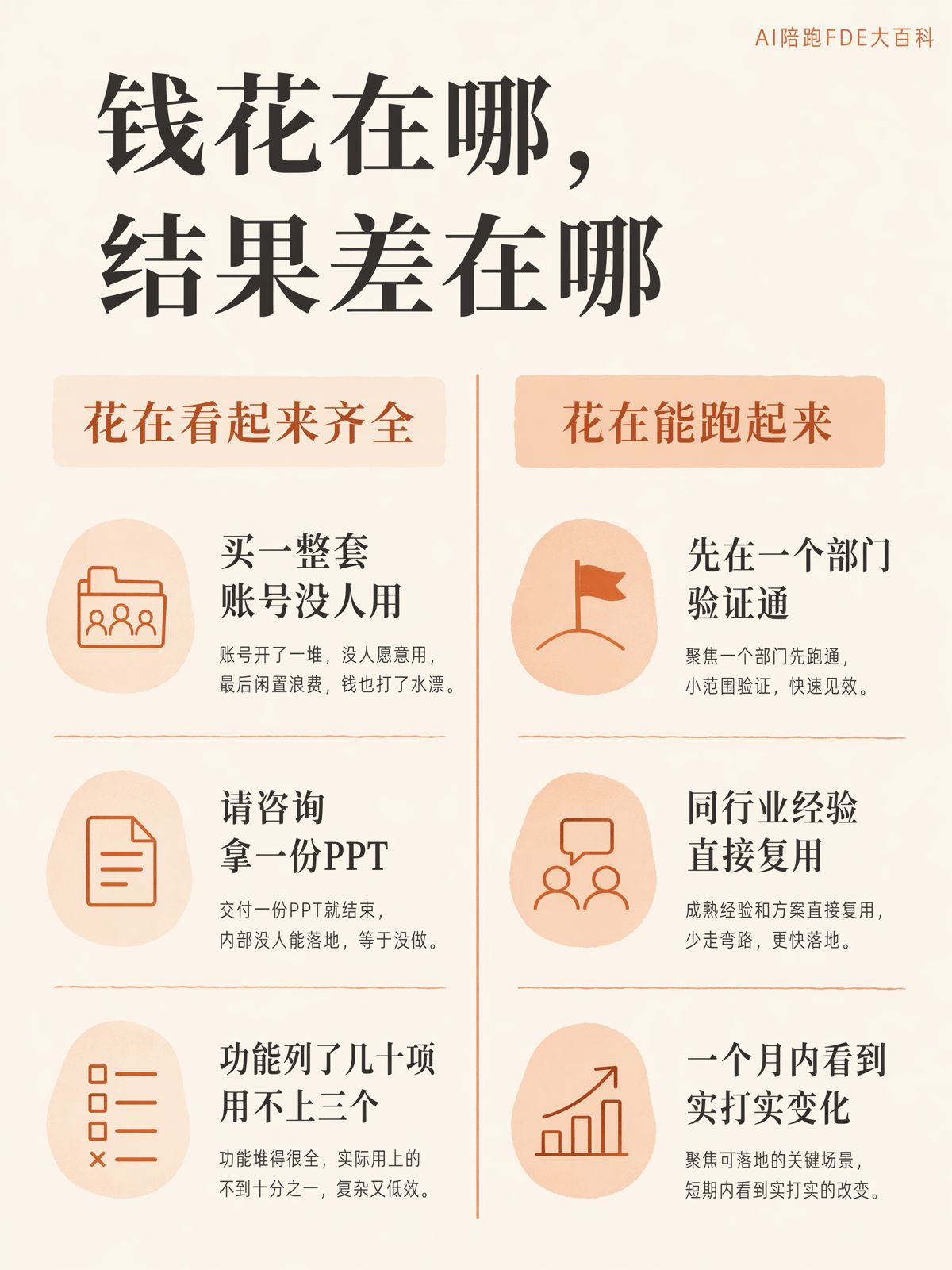
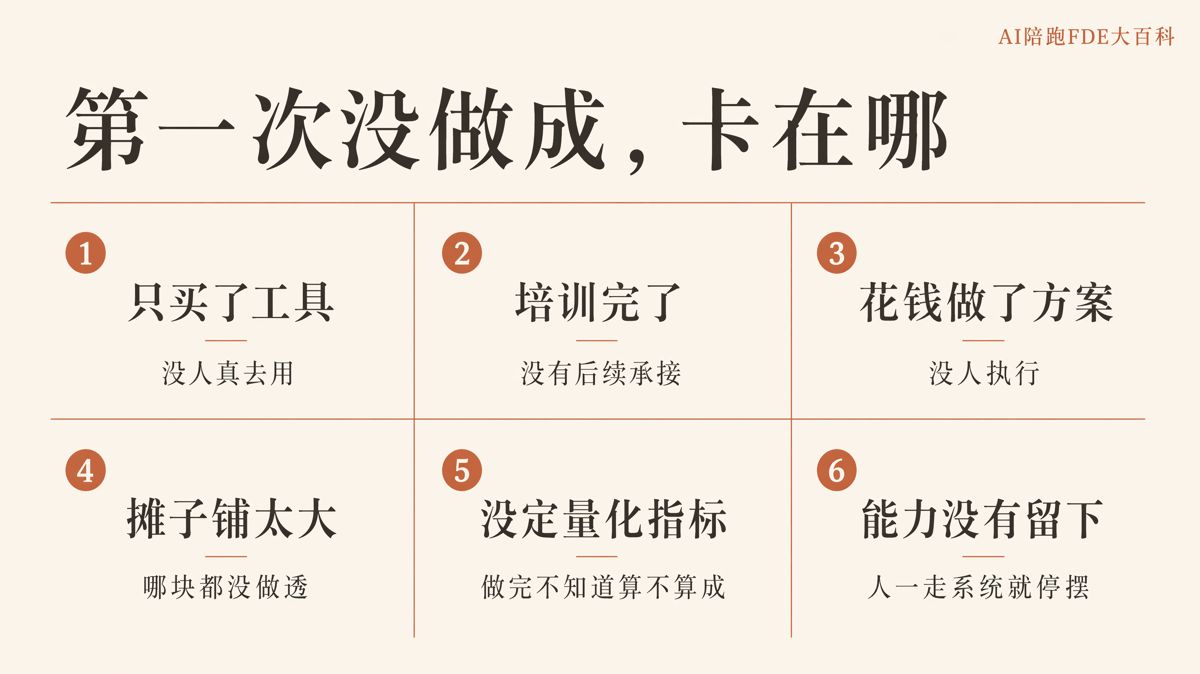
If licenses were distributed but nobody logged in, the tool likely sat outside existing workflows, or no internal owner was held accountable. If employees completed training but still could not execute daily tasks, the program taught theoretical features without guided practice and real-world correction. If an agency delivered a strategy deck that gathered dust, the root issue was usually an unassigned operational owner, missing resources, or an ambiguous delivery scope.
Other initiatives try to cover multiple departments simultaneously, leaving each team with half-built setups. Without baseline metrics recorded up front, leadership cannot verify how much time was saved or how much output increased. And if the system went dark the moment external consultants left, operational knowledge was never transferred to your team.
These friction points involve company data, operational workflows, staff ownership, execution skills, and governance rules. Governance includes who accesses specific assets, who reviews AI-generated outputs, and who takes responsibility for errors. Upgrading to a more capable model does not fix these organizational gaps.
Before committing fresh budget, audit the first attempt: What was purchased? Who actually logged in? What were the original targets? What documents, prompts, and system configurations remain? Which steps failed, and what assets can be salvaged?
This audit defines the mandate for your second attempt. Skip it, and your next partner will guess blindly, leaving you unable to tell whether their proposal solves real operational problems or just bundles another set of similar tools.

Keep the Scope Small, but Complete the Delivery
A smaller budget requires a narrower project scope. A narrow scope does not mean building half of a massive system. It means selecting one clearly bounded business problem that can be independently validated and accepted.
Before launching, establish your baseline: How long does this task currently take? How many people touch it? What is the monthly output, and how often does rework occur? These metrics establish your pre-implementation baseline. Your AI results are meaningless without this benchmark.
Next, select the scenario. Good candidates share four traits: 1. Input materials are clearly defined. 2. Operational steps are stable. 3. Outputs can be systematically reviewed. 4. An internal business owner is in place.
In marketing content production, for example, start with a single link in the chain: source material aggregation, first-draft generation, editorial review, or final publishing. Once chosen, the budget must cover everything required to make that single step functional: preparing materials, configuring tools, onboarding staff, human review workflows, metric tracking, and exception handling. Buying software licenses alone does not complete a scenario.
Pilots do not need to follow an arbitrary 30-day or 90-day calendar. The pilot should run through at least one complete business cycle: from task initiation and output generation to final retrospective. Both sides must agree in advance on acceptance dates, metrics to track, who records them, and how success is evaluated.
Validate the Working Model Before Committing Long-Term
When selecting a partner for a second attempt, prioritize their willingness to run a contained pilot over how comprehensive their pitch deck looks.
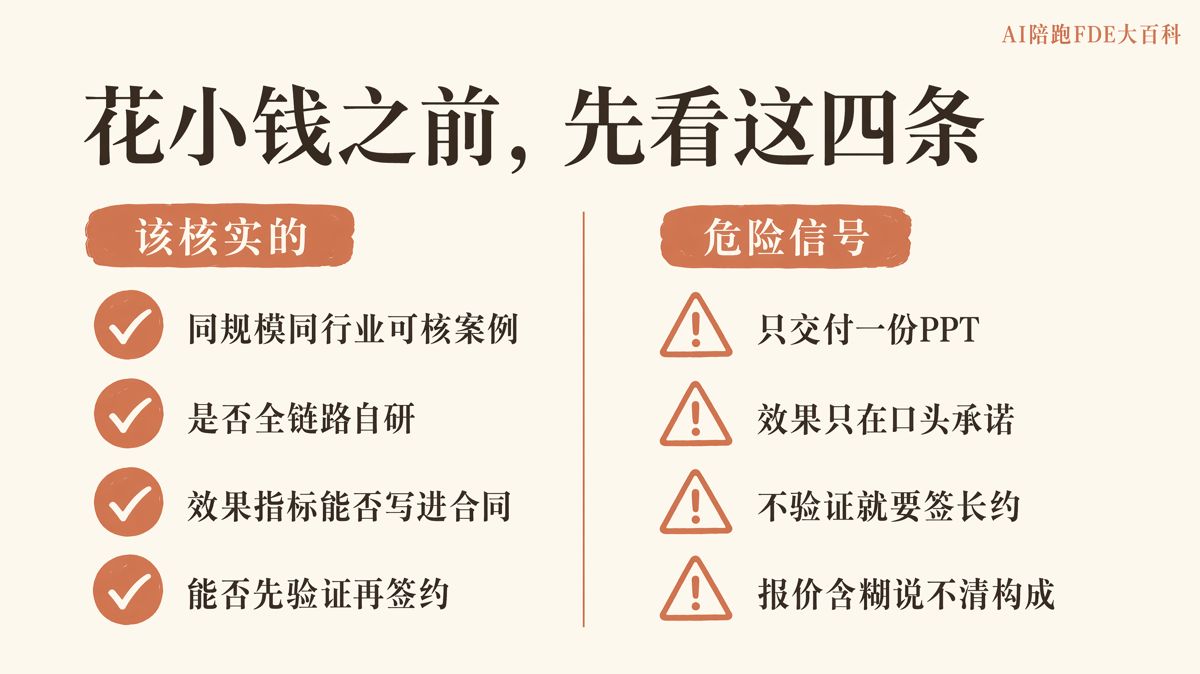
Case studies must withstand scrutiny. Ask prospective partners to specify the client, the operational problem, the implementation path, and the audit trail for claimed results. Generic claims like "improved performance significantly" do not justify procurement.
Clarify the underlying tech stack. If a partner claims to have built proprietary systems from scratch, demand proof of what was developed in-house. If they rely on third-party APIs and foundation models, establish how recurring API costs are billed, how proprietary company data is handled, and who assumes responsibility if external platform APIs change or deprecate.
Before work begins, document project goals, baseline metrics, tracking methods, acceptance criteria, and remediation plans in the contract. If targets are missed, specify whether the team iterates at no charge, dissolves the partnership, or credits previous fees toward future work.
Watch out for warning signs: - Declaring victory with a slide deck or software login. - Making verbal-only performance guarantees. - Demanding full upfront payments or long-term commitments before a pilot. - Offering vague quotes that do not tie specific fees to concrete deliverables. - Showing case studies that lack verifiable methodology.
A pilot's purpose is to answer one practical question before you commit substantial capital: Can this operational framework function inside your real-world business?
Scrutinize External Metrics Before Applying Them to Your ROI Model
Marketing claims like "results in 30 days" or "300% order growth" should never serve as industry benchmarks or internal targets unless they are backed by verifiable third-party audits.
Industry research data must also be read within its proper context:
Project NANDA's 2025 study, The GenAI Divide, reviewed over 300 public projects, interviewed representatives from 52 organizations, and surveyed 153 senior executives. While over 80% had explored or piloted generative AI tools like ChatGPT or Copilot, only about 5% of bespoke enterprise pilots transitioned into daily operations and generated measurable business value. The authors noted that this 5% figure comes primarily from qualitative interviews rather than standardized enterprise financial filings; it is an early indicator, not an immutable global success rate. The same study noted that among 52 reported projects, roughly 67% of external partnerships progressed to active deployment compared to 33% of internal DIY efforts. Here, "deployment" meant moving beyond prototypes into production environments—it is not proof that hiring an agency automatically guarantees success.
McKinsey's 2025 global survey gathered 1,993 valid responses across 105 countries. Only about 6% of respondents met the criteria for "AI high performers"—organizations extracting significant bottom-line value from AI deployments. This reflects a worldwide sample across all industries, not an isolated regional metric.
These figures highlight a universal reality: software trials are common, but embedding AI into daily workflows to capture measurable value requires data hygiene, process redesign, role accountability, and continuous maintenance.
Payback timelines also differ from pilot metrics. Deloitte's 2025 survey of 1,854 senior executives in Europe and the Middle East found that a typical enterprise AI deployment takes two to four years to deliver satisfactory ROI, with only 6% achieving payback within 12 months. Small pilots can reveal early gains in output, turnaround time, or quality, but early operational improvements do not mean the entire investment has been recouped.
When reviewing any performance claim, interrogate the methodology: What was the pre-rollout baseline? Does "growth" mean revenue, sales leads, or raw content volume? How long was performance measured? What hidden operational costs were involved? Who verified the numbers? Any metric presented without its underlying calculation has no place in your budget model.

Ensure Operations Continue After the Partner Leaves
Hands-on enablement—what Starbox AI calls FDE (Forward Deployed Engineer) consulting—involves embedding partners directly into tool configuration, employee workflows, and performance reviews, while training internal teams to run and maintain the systems independently. Unlike one-off training seminars, this model centers on live operational tasks, real-time feedback loops, and independent execution.
At project sign-off, internal teams must receive operational assets they can actually use: step-by-step Standard Operating Procedures (SOPs), system configuration documentation, access privilege inventories, operational logs, a proprietary knowledge base, and a brand style guide.
A proprietary knowledge base structures product specifications, customer profiles, operational rules, and past case studies so AI systems can retrieve and process them accurately. A brand style guide sets explicit rules for tone, phrasing, format, and human review thresholds. These two assets determine whether your team can maintain and iterate on the workflow independently.
Documentation alone does not equal a complete handover. Before final sign-off, have internal staff run the entire workflow end-to-end without vendor intervention, while the partner observes and provides feedback. If your team cannot execute the workflow once the vendor departs, you did not purchase an enablement engagement—you outsourced the task, and you will face the exact same costs on your next project.
When budgeting for your second AI rollout, maintain a disciplined sequence: diagnose why the first attempt stalled; scope a single, contained workflow that can be delivered completely; validate outcomes against baseline data; and ensure internal staff retain the documentation, operational muscle, and maintenance capabilities.
A smaller budget does not mean shopping for lower hourly rates. It means ensuring that every dollar invested yields a verifiable, measurable, and internally sustainable operational outcome.

Frequently Asked Questions
Q1: Does a failed first attempt mean our company is a bad fit for AI?
Not necessarily. A failed rollout only proves that the initial project missed its targets. You must determine whether the issue stemmed from unstructured internal data, poor workflow design, unassigned accountability, unrealistic expectations, or inadequate tooling. A single workflow failing does not mean your organization cannot adopt AI.
Q2: Can we trust a vendor offering a "three-month guaranteed outcome"?
Ask them to define "outcome" in precise, measurable terms. Establish baseline metrics, target thresholds, data tracking methods, and who signs off on acceptance. If the outcome cannot be clearly defined or tracked against hard data, a verbal guarantee has no practical value.
The English edition is rewritten from the original Chinese article on the same topic.

Starbox AI is an AI marketing company based in Hangzhou, China. This article draws on Starbox project work. Please credit the source when quoting.
Related reading
 AI Adoption
Can One AI Operator Really Replace 10 People?
Claims of 10x headcount cuts count generation speed, not QA and rework. Real efficiency measures net pipeline hours saved.
Oct 22, 2026 · 6 min read
 AI Adoption
Bought Basic AI and Seeing Zero ROI? A 4-Step Activation Playbook
Activating entry-level AI is not about model parameters. Turn open chat boxes into defined operational stations with clear inputs, templates, and QA checklists.
Oct 22, 2026 · 6 min read
 AI Adoption
Why One-Click AI Fails at Work: How to Pick Enterprise Agents
One-click AI tools seem easy, but their first-draft accuracy is terrible. Real business ROI requires multi-step workflows with your own knowledge base.
Oct 21, 2026 · 6 min read