
Team Thinks AI Doesn't Work? Find Out Why It Failed First

The short answer
Before concluding AI doesn't work for your business, trace where the last rollout fell apart. A failed pilot only means the implementation failed.
You bought AI software licenses, held training sessions, and brought in outside consultants to design a plan. Months later, operations look unchanged, employees have quietly abandoned the tools, and leadership settles on a familiar verdict: AI just doesn't work for our business.
The frustration is understandable, but that conclusion is premature.
When an AI initiative fails to deliver expected outcomes, it only proves that the last implementation did not succeed. Did the software mismatch the actual task, or did it never make it into daily workflows? Did training stop without follow-up support, or did the project launch without measurable benchmarks in the first place?
If you write off the entire technology as "useless" instead of identifying the breakdown, your next attempt—even with a new tool, a better model, or a different agency—will likely repeat the same mistakes.
Trying AI Is Not the Same as Integrating AI into Business Operations
Research consistently highlights the gap between experimentation and operational value.
The NANDA research project at MIT focuses on enterprise AI deployments. Its State of AI in Business 2025 Report analyzed over 300 publicly disclosed AI initiatives, interviewed 52 organizations, and surveyed 153 senior executives.
The findings showed that while over 80% of surveyed organizations had explored or piloted general-purpose generative AI tools like ChatGPT or Microsoft Copilot, only 5% of task-specific enterprise generative AI deployments achieved successful implementation. The report defined "successful implementation" as producing measurable, sustained efficiency gains or profit impact.
Surveys of Chinese enterprises reveal a similar divide between adoption and outcomes. The China Entrepreneurs AI Application Survey Report (2025) surveyed 128 business leaders and found that 89.84% of respondent companies had deployed AI in their operations.
Yet McKinsey's 2025 Global Survey on AI found that only about 6% of respondent organizations qualified as "AI high performers"—defined as companies attributing at least 5% of their EBIT (earnings before interest and taxes) to AI while capturing substantial value across business functions.
These studies use different methodologies, sample sizes, and criteria, making direct side-by-side comparisons impossible. But they all point to the same reality: deploying or testing AI software is not the same as driving verifiable business performance through AI.
"We already tried it" is not proof that AI lacks business value. The real questions are: What did you test? How was it implemented? How long did it run? Who was accountable? And what metrics determined success?
The MIT NANDA report also noted that across its 52 interviewees, roughly 67% of projects built with external vendors or custom partners reached formal deployment, compared to about 33% of purely internal builds. While based on self-reported data from a limited sample, this comparison underscores an important distinction: buying accounts and hosting a single workshop is fundamentally different from embedding tools into workflows, resolving ongoing operational friction, and holding the deployment accountable to business KPIs.
"AI Doesn't Work" Tells You Nothing About What to Fix
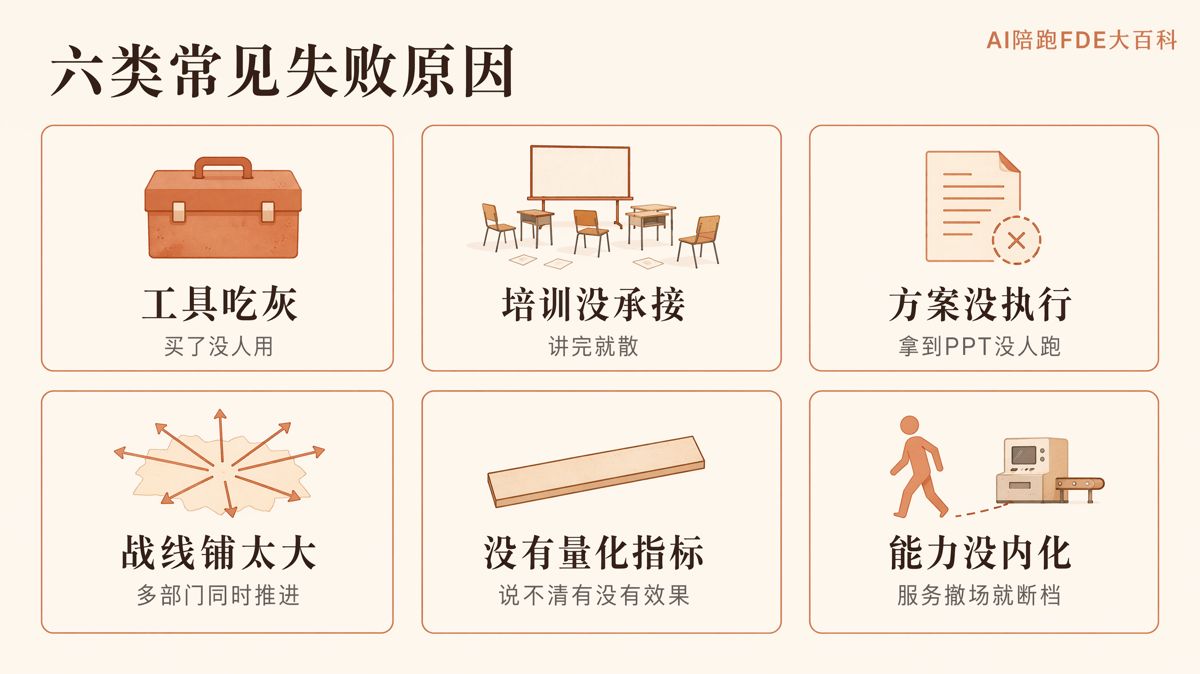
Saying "AI doesn't work" captures your team's frustration, but it offers zero diagnosis. The statement cannot be audited, and it cannot guide your next decision.
Actionable conclusions pinpoint the exact breakdown in execution:
- Licenses were provisioned, but the tool was never embedded into daily workflows.
- Training was completed, but no hands-on practice or continuous guidance followed.
- An implementation roadmap was delivered, but no one was assigned to drive execution and verify results.
- The initial rollout attempted to transform too many departments at once, stalling progress everywhere.
- No baseline operational data was recorded before launch, making it impossible to measure improvement.
- Once external advisors left, internal staff lacked the capability to operate and maintain the workflows.
When the diagnosis shifts from "AI is useless" to "we launched without baseline metrics and had no internal owner driving adoption," the problem becomes solvable.
| Evaluation Dimension | Vague Conclusion | Root-Cause Diagnosis |
|---|---|---|
| Focus | Whether AI as a whole works | Whether specific steps in the rollout worked |
| Evidence | General team sentiment | Actual tool usage, workflow shifts, business metrics |
| Auditability | Difficult to verify | Can be audited step by step |
| Actionability | None | Pinpoints exact operational gaps to fix |
| Risk of Next Attempt | High risk of repeating identical mistakes | Next attempt adjusts around known failure points |
A team that feels burned by a failed pilot will not change its mind after another executive presentation on AI trends. Minds change when teams see verifiable facts that can be documented, compared, and audited.
Six Common Reasons AI Pilots Fail
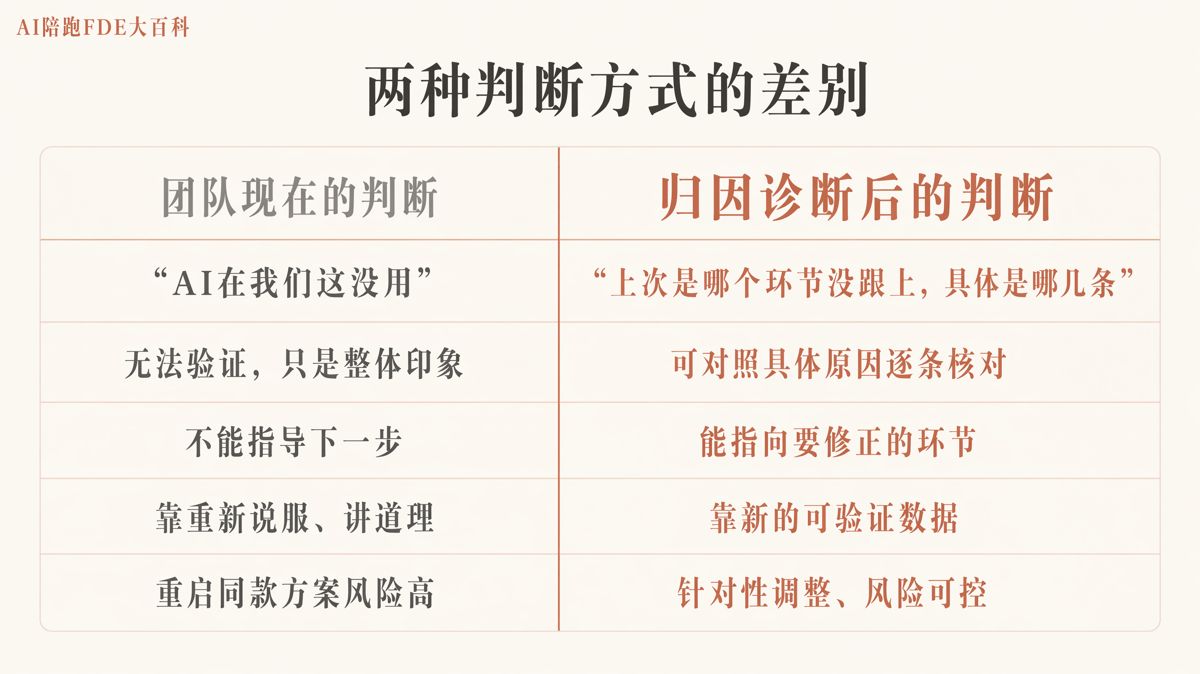
1. Accounts Were Activated, but Daily Workflows Never Changed
Leadership provisions software seats and explains product features, but leaves critical questions unanswered: Which tasks belong in this tool? Who owns them? How will output quality be evaluated? Employees return to their desks and complete tasks the way they always have.
Purchasing software only proves you acquired access; it does not mean adoption occurred.
2. Training Ended, but Practical Support Disappeared
A one-time workshop introduces employees to software features, but it cannot replace real-world task execution.
Once work begins, employees run into immediate friction: how to formulate clear instructions, how to review and edit machine-generated drafts, which tasks should be offloaded, and which still require manual execution. Without structured practice, feedback loops, and ongoing coaching, training rarely translates into operational habits.
3. A Plan Was Delivered, but No One Owned the Outcome
Companies often receive detailed implementation blueprints from consultants, but fail to assign specific owners, deadlines, or acceptance criteria.
The issue is rarely the strategy itself; the issue is that the strategy was never broken down into daily operational tasks. Without clear ownership and measurable delivery milestones, projects remain trapped in presentation decks and update meetings.
4. The Initial Scope Was Far Too Broad
Attempting to overhaul multiple departments, roles, and workflows simultaneously multiplies coordination complexity. When one bottleneck stalls, the entire program appears to stall.
An initial pilot should target a single, well-bounded workflow with easily measurable output. Prove that the workflow generates real value first, then decide whether to expand.
5. No Baseline Data Was Recorded Before Launch
If you do not track baseline volume, cycle times, or unit costs before introducing AI, you cannot answer a fundamental question later: How much did this actually improve operations?
Without a clear before-and-after benchmark, evaluation defaults to subjective impressions. A single frustrating experience can easily taint the entire team's perception of the technology.
6. When External Support Ended, Internal Capability Collapsed
During an engagement, outside consultants drive the momentum. Once the contract ends, internal teams lack the expertise to run the tools, troubleshoot exceptions, or maintain workflows. The new practices fade out.
Your business does not need a polished demo. It needs a operational capability that your own team can run independently every day.
These failure modes are not mutually exclusive; most unsuccessful pilots suffer from two or three at once. The goal is to isolate and address each failure point rather than writing off the entire initiative.
Four Questions to Ask Before Your Next AI Initiative
Before restarting an AI initiative, audit your previous attempt:
- What was the delivery mechanism? Did you buy standalone tools, run a workshop, hire consultants, or re-engineer an operational workflow?
- Who was accountable for adoption? Did frontline employees actually use the tool in their daily routines?
- Were baselines and metrics established upfront? Did you record historical performance data and set audit-ready KPIs before launching?
- Was internal handover achieved? When outside support stepped away, could internal staff operate the workflow independently?
If you cannot answer these questions clearly, do not run another pilot using the same playbook. Changing software providers will not resolve underlying implementation flaws.
How to Design an Auditable Pilot
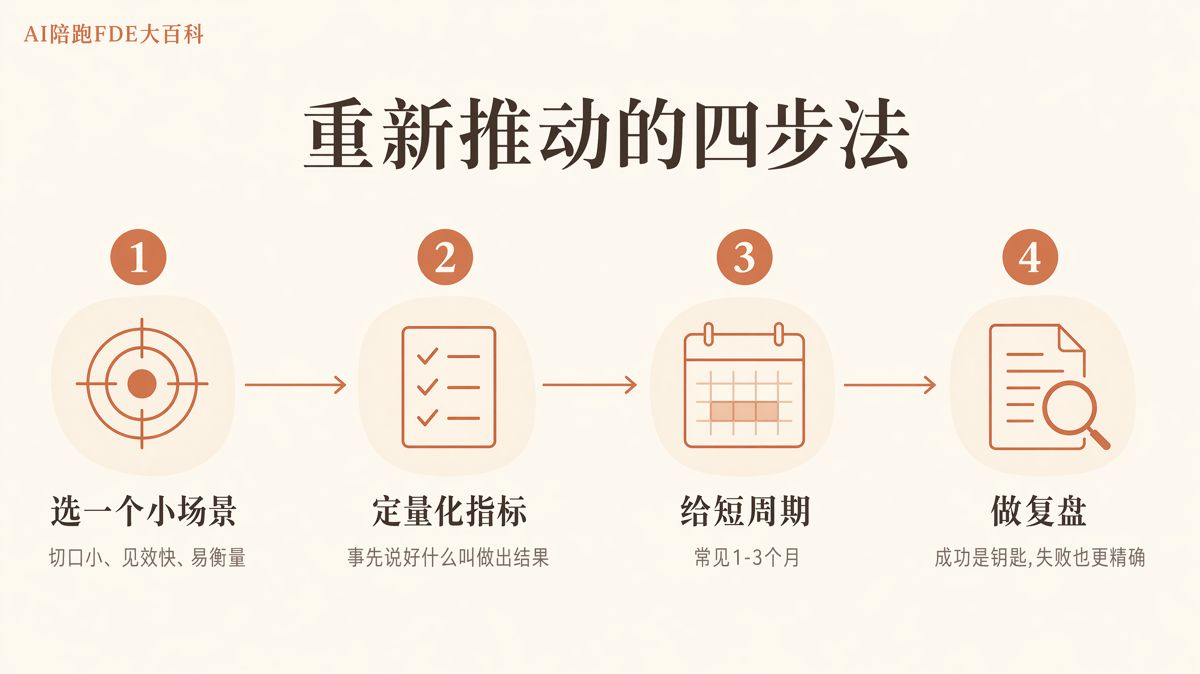
Once you identify why the previous attempt stalled, design a tightly scoped test. The objective is not to prove team members wrong about their past experience, but to produce objective data that everyone can verify.
Focus on One Specific Workflow
Do not attempt cross-departmental rollouts from day one. Instead of trying to "transform the marketing organization," validate efficiency in producing one specific content asset class.
The tighter the scope, the easier it is to identify participants, define workflows, and establish clear acceptance criteria.
Benchmark Baseline Data First
Before introducing any AI software, record current output volume, average time spent per task, and total turnaround time. Define upfront what a "successful result" looks like, and measure post-implementation progress using the exact same metrics.
Benchmarks must be locked in before launch, not selected retroactively to flatter the project.
Set an Owner, a Fixed Timeline, and Clear Acceptance Criteria
Pilot timelines generally work best between one and three months, depending on workflow complexity. A pilot shorter than one month rarely captures stable operational shifts; a pilot running longer than a quarter burns through team patience and momentum.
Regardless of timeline length, assign an operational owner, a hard end date, and measurable acceptance criteria to prevent the pilot from dragging on indefinitely.
Conduct a Post-Mortem Regardless of the Result
If the pilot succeeds, use the data to determine which specific workflows worked and decide whether to scale.
If the pilot falls short, pinpoint the exact step where execution broke down. The value of a structured second attempt lies not just in winning, but in ensuring that any failure delivers clear, operational lessons.
Teams Need Verifiable Results, Not Another Sales Pitch
When a team has already experienced a failed rollout, repeating that "AI is the future" will not rebuild confidence. Frontline employees are not resisting the concept of AI; they are resisting another open-ended time sink that fails to produce clear business value.
Restarting AI adoption does not mean trying harder to convince your team that AI matters. It means investigating why the previous deployment did not work.
Audit tool usage, training follow-through, operational scope, performance baselines, ownership, and internal capabilities. Then run an auditable test on a single workflow. Your team will stop debating abstract opinions about AI and start evaluating business facts: Did this workflow improve? By how much? And what operational practices should we keep?
One failed pilot does not mean AI is broken, nor does it guarantee the next attempt will succeed. What leadership can control is ensuring every initiative has a dedicated owner, measurable benchmarks, and an honest post-mortem. That is how successful practices become repeatable—and failed attempts stop being wasted time.
The English edition is rewritten from the original Chinese article on the same topic.

Starbox AI is an AI marketing company based in Hangzhou, China. This article draws on Starbox project work. Please credit the source when quoting.
Related reading
 AI Adoption
Can One AI Operator Really Replace 10 People?
Claims of 10x headcount cuts count generation speed, not QA and rework. Real efficiency measures net pipeline hours saved.
Oct 22, 2026 · 6 min read
 AI Adoption
Bought Basic AI and Seeing Zero ROI? A 4-Step Activation Playbook
Activating entry-level AI is not about model parameters. Turn open chat boxes into defined operational stations with clear inputs, templates, and QA checklists.
Oct 22, 2026 · 6 min read
 AI Adoption
Why One-Click AI Fails at Work: How to Pick Enterprise Agents
One-click AI tools seem easy, but their first-draft accuracy is terrible. Real business ROI requires multi-step workflows with your own knowledge base.
Oct 21, 2026 · 6 min read