
Switching AI Vendors: What Happens to Your Knowledge Base?

The short answer
Can you take your AI data and knowledge base when switching vendors? The answer depends on which layer of data you are trying to move.
When companies prepare to switch AI vendors, their first question is almost always: "Can we migrate our existing data and knowledge base to the new platform?"
The answer is rarely a simple yes or no. Some assets export easily but cannot be used directly in a new architecture. Certain technical processing results cannot be moved at all. However, as long as your raw files are intact, you will not need to collect all your information from scratch.
What you really need to verify comes down to two questions: What can you actually take back, and what will still be usable once you have it?
A successful migration depends on three factors: 1. Whether you kept independent backups of your raw source materials. 2. Whether your contract explicitly defines the scope, format, and timeline for offboarding data. 3. Whether the delivered files can be read and processed by third-party systems.
If these terms are not settled at the start of an engagement, you will likely recover only a fraction of what you thought you owned when the contract ends.
Understand Which Layer You Mean by "Knowledge Base"
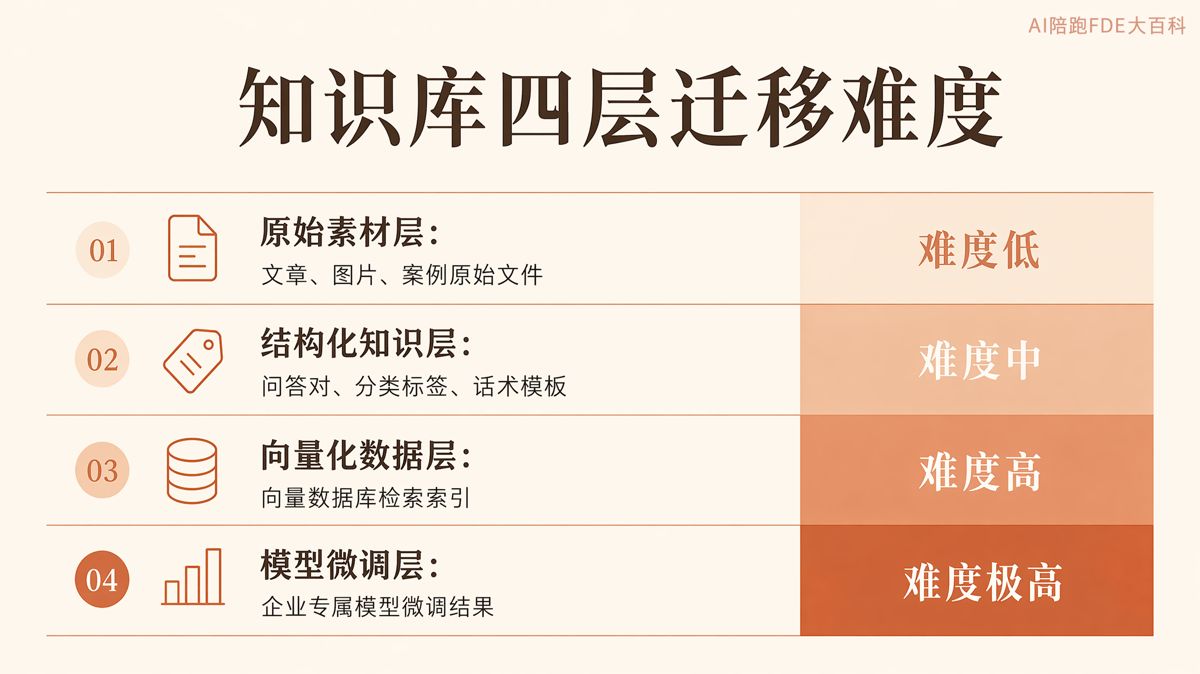
Both clients and vendors use the term "knowledge base," but they often mean entirely different things. A practical enterprise AI knowledge base consists of at least four distinct layers:
| Layer | What It Contains | Migration Difficulty | What to Watch For |
|---|---|---|---|
| Raw Assets | Product documentation, published articles, images, and customer case records | Low | If you have internal backups or the vendor exports in universal formats, you can reuse them immediately. |
| Structured Knowledge | Curated Q&As, taxonomy tags, and sales script templates | Medium | Content can be exported, but existing categories and tags may need remapping to match the new system's structure. |
| Vectorized Data | Numerical embeddings created by converting text into high-dimensional vectors for semantic search | High | Embedding models, storage schemas, and retrieval methods vary between vendors. Direct cross-system portability is rare. |
| Fine-Tuned Models | Model weights and parameters adapted specifically using your training data | Very High | These adjustments are tightly coupled to the original vendor's base model and training pipeline. They usually must be retrained on the new platform. |
These four layers are fundamentally different.
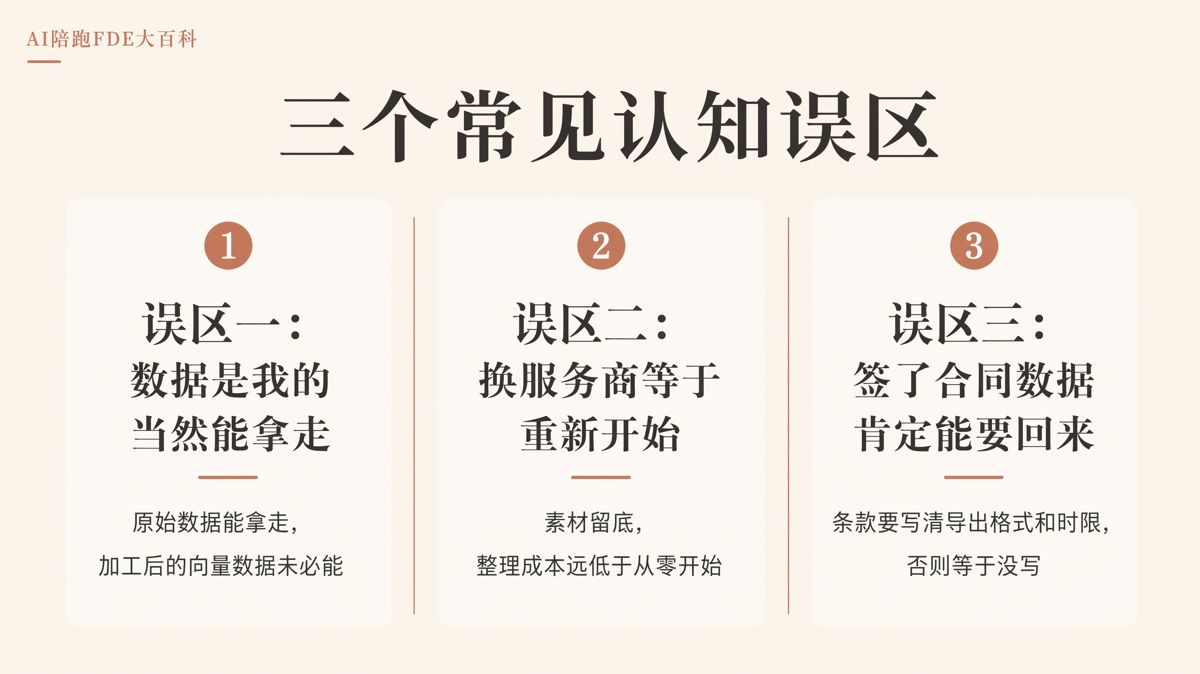
Getting your original documents back does not mean you have retained the previous system's search and retrieval capability. Receiving an export of curated Q&As does not mean your new platform can use the exact same categorization logic. Owning your business documents does not mean the vendor's technical processing outputs can be plugged into another system and run out of the box.
Asking "Can we take our entire knowledge base?" is too vague. You must evaluate each layer independently: Can this layer be exported? In what format? Can it be utilized by another system?
Why "Client Owns All Data" in the Contract Is Not Enough
Your raw product collateral and case notes are entirely different deliverables from vector indices, curated Q&As, and model fine-tuning checkpoints.
A contract clause stating "The Client owns all data" outlines a principle, not an execution plan. What dictates the outcome of a migration is concrete detail: which datasets must be handed over, the delivery deadline, the required file formats, and a clear distinction between what can be exported and what cannot.
Without these details in writing, you face two common roadblocks during offboarding: the vendor claims specific data cannot be exported, or they hand over files that your new vendor cannot read or process.
That said, switching vendors does not mean starting from zero. As long as your product manuals, published content, images, and case studies remain intact, your incoming vendor can rebuild the knowledge base from those raw assets. Categorization, tagging, and vector indexing may need to be regenerated, but you will not have to repeat the work of gathering your business information.
A 4-Step Pre-Switch Checklist
Step 1: Audit What You Already Hold Internally
Start by checking your internal drives and cloud storage. Confirm whether you have complete, unedited copies of your raw source files, including product documentation, marketing assets, images, and client records.
Separate your materials into two lists: files you back up independently, and files that exist only inside the vendor's platform. For anything stored exclusively with the vendor, request an export and verify its completeness before giving notice of termination.
Maintaining independent backups of your raw assets is the simplest way to protect yourself. Even if the old system's vector database cannot be ported over, these raw files give your next vendor everything they need to rebuild.
Step 2: Clarify What the Current System Can Actually Export
Do not simply ask, "Can we export our data?" Ask for specific deliverables:
- Which raw materials and processed datasets can be exported?
- Will taxonomies, tags, and question-answer structures be preserved?
- What file formats will be delivered?
- Which underlying technical assets cannot be migrated?
- Can the exported files be opened and verified using standard desktop software?
Common formats such as Word, Excel, PDF, plain text, and CSV are universal and easy to clean, restructure, and import into another platform.
If an exported file can only be parsed by the incumbent vendor's proprietary software, you have not received a usable delivery. An export is only valid if the files can be opened, read, and processed by standard tools.
Step 3: Require the New Vendor to Evaluate the Files Item by Item
Hand your raw materials and exported datasets to your prospective vendor for a technical audit. Require them to specify:
- Which assets can be ingested immediately.
- Which datasets need manual reformatting or restructuring.
- Which components must be rebuilt from scratch.
If a vendor claims they can "migrate everything seamlessly," ask them to define exactly what "everything" covers. Migrating raw text files is straightforward; migrating vector embeddings or fine-tuned model behaviors to a different architecture is entirely different.
Step 4: Write Offboarding Requirements into the New Contract
Use this transition to safeguard future moves. Your new contract should explicitly detail data ownership, exportable scope, file formats, and delivery timelines. Maintain your own internal archive of all source materials going forward.
When you have clear contractual offboarding terms in place, any future platform transition can follow a documented procedure rather than a contentious negotiation.
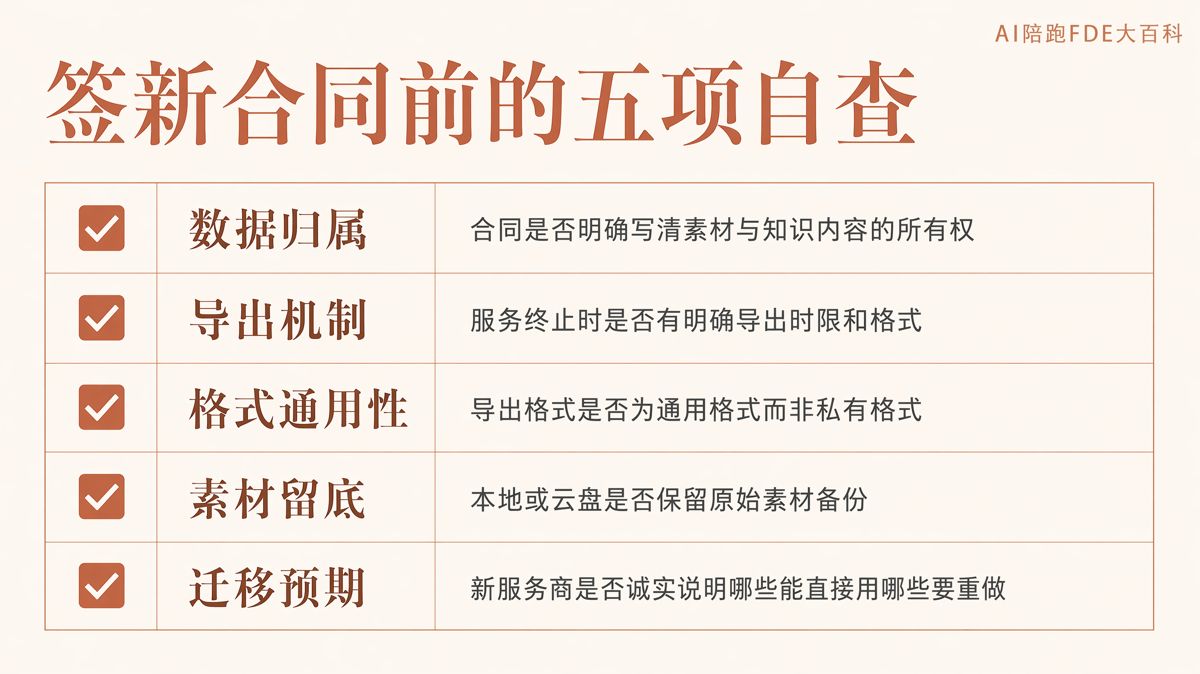
Contract and Handoff Checklist
| Checkpoint | Key Questions to Confirm |
|---|---|
| Data Ownership | Does the agreement clearly differentiate ownership between raw assets and processed items like Q&As, taxonomies, and model weights? |
| Export Scope | Which specific datasets and assets must the vendor hand over upon contract termination? |
| Delivery Timeline | How many business days does the vendor have to complete the data handover? |
| File Formats | Are deliveries required in universal formats (Word, Excel, CSV, PDF, TXT), or are they locked to proprietary schemas? |
| Asset Retention | Does your internal team keep complete, independent backups of all source materials? |
| Migration Clarity | Has the incoming vendor documented what can be reused directly versus what must be restructured or rebuilt? |
Migration Success Is Decided at Contract Signing
When evaluating AI vendors, teams naturally focus on what the software can do today. They rarely ask how an exit will work tomorrow. Yet when the time comes to switch, who holds the raw source files, what can be exported, and whether those exports work in other environments will determine your switching costs.
Changing platforms does not mean losing your investment. As long as your raw content is secure and your structured assets are exported in open formats, rebuilding a knowledge base in a new environment is manageable. The real issues arise when there are no internal backups, the contract is silent on handover deliverables, and the exported data is trapped in a proprietary format.
Before signing with an AI vendor, look past current feature lists and ask two fundamental questions: "If we terminate this agreement, what do we get back? And once we have it, can we actually use it?"
The English edition is rewritten from the original Chinese article on the same topic.

Starbox AI is an AI marketing company based in Hangzhou, China. This article draws on Starbox project work. Please credit the source when quoting.
Related reading
 AI Adoption
Can One AI Operator Really Replace 10 People?
Claims of 10x headcount cuts count generation speed, not QA and rework. Real efficiency measures net pipeline hours saved.
Oct 22, 2026 · 6 min read
 AI Adoption
Bought Basic AI and Seeing Zero ROI? A 4-Step Activation Playbook
Activating entry-level AI is not about model parameters. Turn open chat boxes into defined operational stations with clear inputs, templates, and QA checklists.
Oct 22, 2026 · 6 min read
 AI Adoption
Why One-Click AI Fails at Work: How to Pick Enterprise Agents
One-click AI tools seem easy, but their first-draft accuracy is terrible. Real business ROI requires multi-step workflows with your own knowledge base.
Oct 21, 2026 · 6 min read