
5 Things to Settle Before Switching AI Vendors

The short answer
Switching AI vendors will not fix poor execution. Before signing another long-term deal, audit past failures, run a pilot, and secure your data migration.
Enterprise AI pilots routinely fall short of expectations. According to the 2025 MIT Project NANDA study The GenAI Divide—based on 150 executive interviews, 350 employee surveys, and 300 public deployment case studies—95% of organizations saw zero measurable business return on their generative AI investments.
The same report highlights a counterintuitive finding: organizations deploying AI through external partnerships and procurement achieved a success rate of roughly 67%. In contrast, teams attempting to build purely in-house succeeded only about one-third as often. Statistically speaking, deciding to work with an external partner is sensible.
The real dividing line is not which vendor you pick or which foundation model you query. As the MIT study emphasizes, this divide is not driven by model quality or regulatory hurdles; it is driven by your path of execution.
Switching AI vendors is often the right move, but it is easy to repeat the same mistakes. Here are the steps to keep risk under control.
Figure Out Why the First Vendor Failed
When an engagement fails, most teams assume: "The last vendor was inadequate; the next one will deliver." That conclusion is usually reached too quickly.
Failed implementations rarely stem from inadequate technology. Across the industry, the common culprits look like this: - The software was purchased, but no internal teams actually used it. - Training concluded, but no internal owners stepped up to manage daily operations. - The proposal looked great on paper, but nobody executed it. - Leadership attempted a company-wide rollout on day one, overextending the operational scope. - No quantitative metrics were established, leaving everyone unable to prove business value. - Core technical and operational capabilities stayed with the vendor, leaving the client with zero internal know-how.
"Tool limitations" rarely makes the top tier of failure modes. In most operational settings, baseline model performance is already more than sufficient. Projects stall because internal datasets are messy, legacy workflows remain unchanged, and nobody is held accountable for business outcomes.
Before vetting new vendors, document the exact reasons your previous project stalled. This is not an academic exercise; it determines the criteria you must use to evaluate future partners. If your previous project failed due to a lack of clear accountability, your primary selection criteria should be whether the new partner ties their deliverables to contractual performance targets. If the issue was vendor dependency, you must evaluate their process for transferring operational workflows and custom knowledge bases to your internal staff.
Skipping this audit to focus immediately on price and feature checklists will simply replicate the original failure under a different brand name.

4 Filters to Cut Your Vendor Shortlist in Half
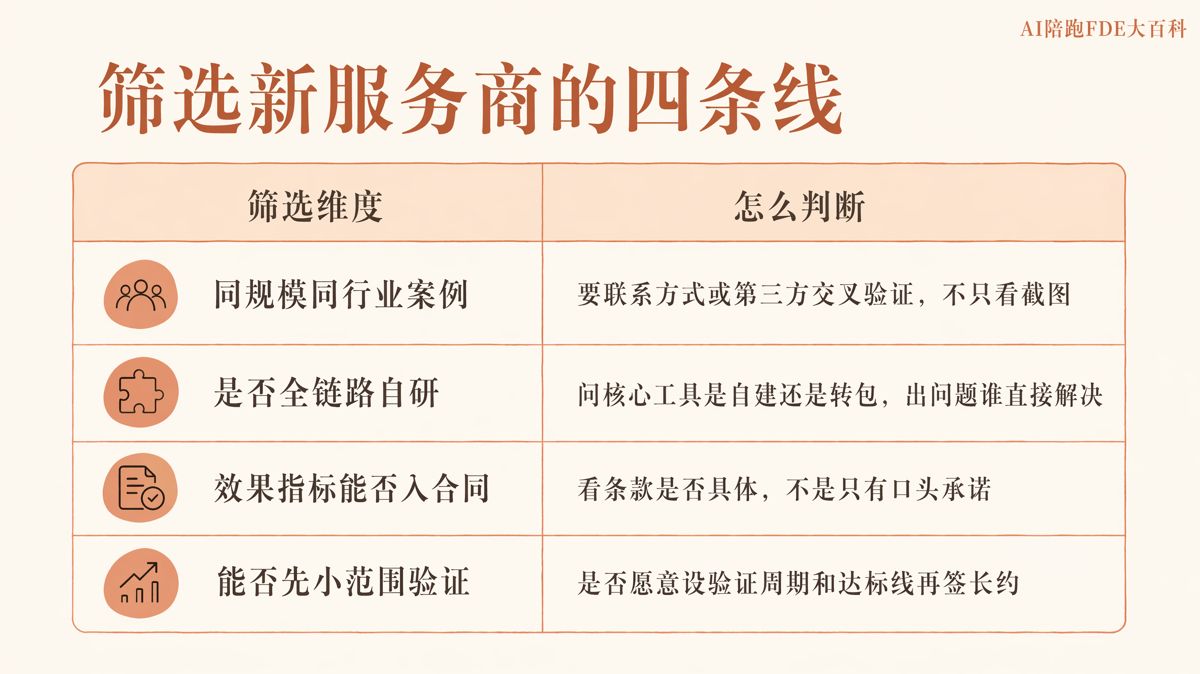
Evaluating AI implementation partners requires looking past polished sales decks. You can eliminate roughly half of prospective vendors by applying four operational filters:
- Verifiable peer case studies. Look for real deployments with organizations of comparable size, operating within similar business models. Ask for direct client references or verifiable contact channels rather than accepting sanitized dashboard screenshots.
- Proprietary development versus resold toolchains. Clarify whether the vendor develops their core technology in-house or merely re-packages third-party products. Reselling and secondary development are not inherently disqualifying, but they insert an extra layer between your team and the underlying engineering, slowing support response times and constraining deep customization.
- Contractual performance metrics. Verbal promises mean nothing before an agreement is signed. In enterprise AI, buyers face inherent information asymmetry: you cannot easily verify whether a vendor's workflow will produce measurable gains in your environment beforehand. You bridge that gap through contract mechanics: clear, quantitative performance benchmarks, explicit exit clauses, and unambiguous metric definitions.
- Willingness to validate via a phased pilot. The vendor should be willing to prove their approach on a contained use case before asking for a long-term commitment.
The first two filters evaluate a vendor's capability. The last two evaluate their governance and risk-sharing. No matter how strong a vendor's technical team appears, a contract without exit ramps leaves all downstream risk on your balance sheet.
Why Long-Term Contracts Are the Easiest Trap
Second-time enterprise buyers often tell themselves: "This time, let's commit fully so the initiative doesn't lose momentum halfway through." This impulse frequently leads to an even costlier misstep.
The most reliable way to mitigate procurement risk is to mandate a phased pilot: test the workflow on a small scope, evaluate performance against agreed thresholds, and execute a broader agreement only after the model proves viable. You should answer whether a methodology works in your specific environment before disbursing large budgets, not after.
An effective validation pilot requires four elements: - A tightly scoped business scenario designed to show measurable results quickly, avoiding company-wide rollouts at the start. - Clear, quantitative criteria defining what constitutes a passing grade. - A defined testing period, typically ranging from 1 to 3 months. - Clear contractual protocols for pilot shortfalls: whether the approach is adjusted, the contract terminated, or initial retainer fees credited toward other scopes.
When reviewing contract terms, watch for vague language like "dramatically improve marketing performance," which offers zero legal protection. Look for clear exit mechanisms, examine renewal clauses for hidden lock-in terms, and confirm explicit ownership rights for all generated data, models, and platform accounts. A vendor willing to document these items clearly is far more reliable than one asking for blind trust.

Do Not Abandon Your Accumulated Assets
During an initial AI engagement, internal teams usually accumulate valuable assets: proprietary business knowledge bases, tested workflow drafts, and team members who have built operational familiarity with the tools. Data ownership and migration rights are often overlooked during vendor transitions, leading to expensive headaches later.
To evaluate whether your organization actually retained value from a previous project, assess whether capabilities were internalized or remained an outsourced black box. Look at concrete deliverables: - Does your team hold written standard operating procedures (SOPs)? - Can proprietary knowledge bases, fine-tuned configurations, and creative assets be cleanly exported? - Did participating employees receive documented training or formal operational playbooks?
If these assets remain locked inside a vendor's proprietary system, the previous contract was merely an outsourced staffing arrangement, not an enablement initiative.
This is why failure attribution must come first. If your original project stalled because capabilities vanished the moment the vendor rolled off, handoff protocols and export rights must be treated as non-negotiable contract clauses with your next partner.
Price Tags Do Not Tell You Who Is Cheap or Expensive
AI deployment services generally use three billing structures: - Fixed-fee project pricing. - Periodic retainers or annual agreements. - Performance-linked, revenue-share, or milestone-contingent pricing.
The fundamental difference between these pricing models is not the final invoice amount; it is who shoulders the delivery risk. Fixed project fees concentrate risk on the buyer, who pays regardless of outcome. Performance-linked models theoretically distribute risk to the vendor, provided the target results are defined unambiguously in the contract.
Service quotes in the market range from a few thousand to several hundred thousand dollars. Much of this variance reflects the depth of delivery. Selling software licenses or introductory training carries low overhead; designing proprietary architectures, embedding technical specialists on-site, and driving workflow transformation requires intensive operational support.
Higher prices are not inherently exploitative, nor are low bids inherently cost-effective. The real warning sign is an opaque quote: any proposal that presents a single lump sum while refusing to itemize diagnostic assessments, platform engineering, on-site enablement, and post-launch reviews should be treated with caution.
The Bottom Line
Switching AI vendors is often the right operational decision. Industry research confirms that leveraging specialized external partners delivers significantly higher success rates than attempting to build GenAI solutions in isolation.
The difference between another failed pilot and a successful transition comes down to operational discipline: conduct an honest post-mortem on your previous attempt, screen prospective partners against verifiable criteria, mandate a phased validation pilot, codify performance metrics and asset handoffs into your agreements, and ensure your team retains full ownership of its data and workflows. Once those foundations are in place, the operational risk of changing partners becomes entirely manageable.
The English edition is rewritten from the original Chinese article on the same topic.

Starbox AI is an AI marketing company based in Hangzhou, China. This article draws on Starbox project work. Please credit the source when quoting.
Related reading
 AI Adoption
Can One AI Operator Really Replace 10 People?
Claims of 10x headcount cuts count generation speed, not QA and rework. Real efficiency measures net pipeline hours saved.
Oct 22, 2026 · 6 min read
 AI Adoption
Bought Basic AI and Seeing Zero ROI? A 4-Step Activation Playbook
Activating entry-level AI is not about model parameters. Turn open chat boxes into defined operational stations with clear inputs, templates, and QA checklists.
Oct 22, 2026 · 6 min read
 AI Adoption
Why One-Click AI Fails at Work: How to Pick Enterprise Agents
One-click AI tools seem easy, but their first-draft accuracy is terrible. Real business ROI requires multi-step workflows with your own knowledge base.
Oct 21, 2026 · 6 min read