
When an AI Project Stalls, Don't Write an Apology Letter

The short answer
An AI project review should pinpoint the exact bottleneck and swap a clear variable—not apologize for missed targets. Here is how to write one.
Here are the baseline facts:
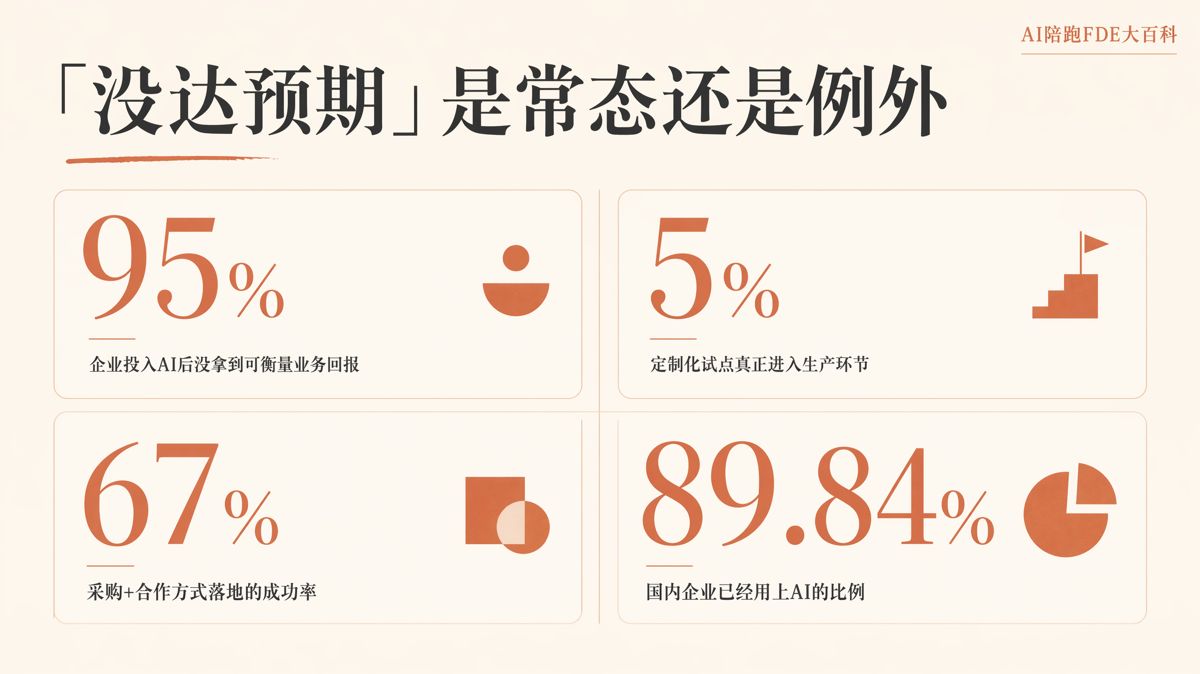
- Research from MIT's Project NANDA (2025) shows that 95% of enterprises investing in generative AI have seen no measurable business return. Only 5% of custom pilots ever make it into full production. That means an AI project missing expectations is the statistical norm in enterprise adoption, not bad luck or individual incompetence.
- That same research revealed a stark operational contrast: companies deploying AI through a combination of procurement and specialized external partnership saw a success rate of roughly 67%. Companies attempting to build and figure it out entirely in-house had roughly one-third of that success rate. How you choose to deploy is a primary variable of success or failure.
- The Chinese Entrepreneur AI Application Survey Report (2025) noted that 89.84% of surveyed domestic enterprises were already using AI. Yet McKinsey's 2025 Greater China survey revealed that only 6% of enterprises qualified as high-performance winners. Using AI is not the same as driving business performance. That gap is the reality almost every project post-mortem must address.
When you look at those three data points, the takeaway is straightforward: the first step in a project review is not an apology. It is framing your project against industry reality so leadership can see whether missing expectations was an outlier or standard enterprise friction.
The Most Common Trap: Blaming the AI Model
This is the easiest trap to fall into, and the easiest for an experienced executive to dismantle.
Across enterprise software and AI implementations, an established truth holds: project failures are almost never caused by insufficient model capabilities. The real bottlenecks are unprepared internal data, broken workflows, vague objectives, lack of cross-departmental coordination, missing operational talent, and absent governance. Those categories account for the vast majority of failed pilots.
Blaming "immature AI technology" might seem convenient in the short term, but it creates a fatal problem when leadership examines the initiative later. If you claim the technology simply isn't ready, leadership will ask why specific competitors or peers are making it work. Once you cannot answer that, the credibility of your entire review collapses.
Diagnosing the failure requires breaking down the value chain: AI Value equals Theoretical Productivity multiplied by Adoption Conversion Rate.
The adoption conversion rate is routinely ignored, yet it dictates whether an initiative lives or dies. MIT researchers call this the "learning gap"—the distance between advancing technology and the people, processes, and operating culture required to use it. If your review focuses entirely on whether model outputs looked good, you are auditing the wrong variable.
Audit Your Attribution Against a Checklist, Not a Gut Feeling
A defensible post-mortem audits the project against an objective checklist instead of offering impressions like "we feel the adoption was slow":
- Tools were purchased, but nobody actually used them. This is the most common failure point. The software is deployed, but because there is no follow-up mechanism or accountability loop, usage quietly drops to zero.
- Training finished, but there was no operational handoff. Team members attend a workshop or demo and understand the concepts. But once they return to their daily desks, there are no updated standard operating procedures (SOPs) or revised workflows to anchor those methods. They immediately revert to old habits.
- The initial scope was far too wide. The team tried to roll out AI across an entire department or company simultaneously instead of proving value in a single, tight workflow first. This multiplies complexity and operational risk.
- Success metrics were never defined. "It feels faster" is not an operational metric. If you did not define quantitative success benchmarks before spending money or time, you cannot explain how close or far you are from the target.
- Core capabilities were never internalized. The moment a third-party vendor or consultant leaves, the internal team cannot operate or iterate the system. That means the investment bought a one-off asset, not an enduring organizational capability.
Audit your initiative against these five checkpoints. You will usually find that your "underperforming project" stems from one or two clear operational breakdowns, not a mystical failure of AI technology. Clarifying this attribution is what makes a review credible.

If the Pilot Missed the Mark, Check Your Metrics
If your audit shows that the tools worked and the team showed up, the failure almost certainly sits in how the pilot was designed.
The standard methodology for enterprise AI pilots follows three rules: a narrow scenario, quantifiable metrics, and a short cycle. You pick a small operational slice that yields fast data, establish clear thresholds, and produce verifiable results within 3 to 6 months. That timeframe is deliberate. Executive leadership evaluates initiatives on numbers; if a pilot cannot generate verifiable performance within that window, it will usually be defunded.
Audit your pilot setup against these three questions:
Were the metrics too vague? Statements like "improve efficiency" or "drive digital transformation" are wishes, not metrics. Real metrics can be audited: change in weekly content throughput, cost reduction per unit of output, or turnaround time on incoming tickets.
Was the evaluation timeline unrealistic? Certain workflows show measurable impact quickly (such as marketing content generation). Others, like predictive equipment maintenance, take longer to build statistically meaningful baselines. Measuring a long-cycle use case on a short-cycle timeline yields false failures.
Were the performance targets set before kickoff, or retrofitted at the end? This is the easiest flaw for leadership to spot. If your benchmarks were defined after the project finished to match what was accomplished, the review loses all integrity.
The Decision Section: Swap a Variable, Don't Promise an Attitude
The weakest part of most post-mortems is the conclusion. Teams often wrap up by writing: "We will prioritize this further and continue optimizing." That is an empty statement.
The decision section of your report must answer one concrete question: which specific variable will we swap next, and what are we swapping it to?
Here are four common adjustments:
Swap the deployment model. If your team struggled trying to build everything in-house, look at the MIT benchmark: shifting to an external partnership and procurement path can theoretically improve adoption success from roughly 22% up toward the 67% range. That data does not guarantee project success, but as a business justification, it is far more persuasive than promising to work harder.
Swap the entry point. If the initial scope was broad and sprawling, narrow the next phase to a single, tightly defined operational scenario that can generate auditable data within 3 to 6 months. Win one clear operational beachhead before planning broad rollouts.
Swap the verification mechanism. Move to a phased proof-of-concept model: require a measurable small-scale validation before signing multi-year software commitments or expanding rollout budgets. Define up front what constitutes a pass or fail, along with what happens if the numbers fall short (such as pausing or adjusting the engagement).
Swap how capabilities are retained. If the engagement ended without leaving internal leverage, mandate verifiable deliverables for the next phase. Whether led internally or by external partners, require documented SOPs, curated knowledge bases, prompt repositories, and reusable training playbooks. These are the proof that operational capabilities stayed inside your business, rather than walking out the door.
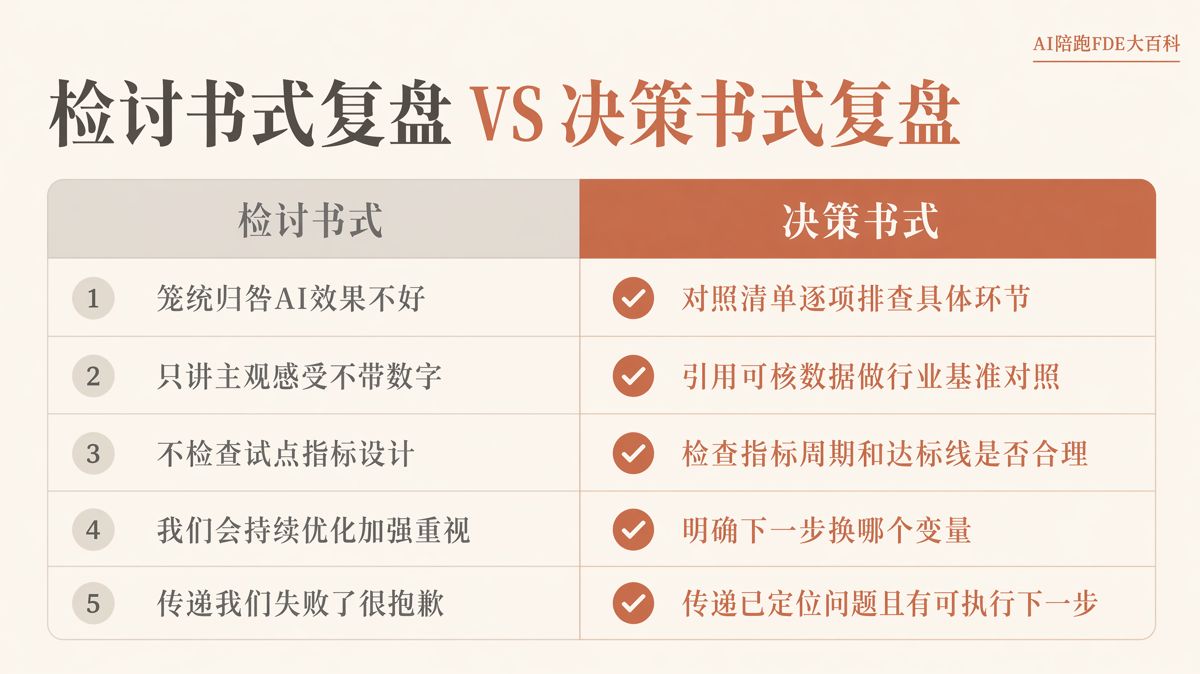
Apology Letter vs. Decision Document
| Dimension | The Apology Letter (Common Mistake) | The Decision Document (Best Practice) |
|---|---|---|
| Attribution | Broadly blames "inadequate AI tech" or "poor team execution" | Audits against a systematic checklist: tools, training, scope, metrics, internalization |
| Data Usage | Relies on subjective feelings and personal impressions | Uses verifiable industry benchmarks (e.g., MIT NANDA) with clear citations |
| Metrics Audit | Ignores how the pilot's baseline indicators were designed | Checks whether metrics were vague, cycles were misaligned, or targets were retrofitted |
| Conclusion | Vaguely promises to "optimize, learn, and try harder" | Specifies exactly which variable to swap: path, entry point, verification, or capability retention |
| Signal Sent to Leadership | "We failed, and we are sorry." | "We diagnosed the operational bottleneck, and here is our next business decision." |
Frequently Asked Questions
Do you have to cite industry data in an AI project review?
It is not mandatory, but it is strongly recommended. Without third-party data, leadership cannot tell whether missing targets is an industry-wide baseline or unique to your team. Citing verifiable research like MIT's Project NANDA puts your results in context. If you lack third-party benchmarks for a specific claim, label it clearly as an internal empirical observation rather than industry consensus.
Should you admit to choosing the wrong vendor or tool?
If the breakdown actually happened there, yes. But explain the exact breakdown rather than making a vague statement. Did the vendor lack verifiable peer case studies? Was their pricing opaque? Did they refuse a phased validation period before a long-term contract? Naming the exact failure point turns a mistake into procurement criteria for the next cycle.
How long should an enterprise AI pilot run?
There is no universal timeline; it depends on scenario complexity. Most enterprise pilots need a 3-to-6-month window to produce reliable operational data. Simple content production workflows might show results faster, while complex use cases like predictive maintenance take longer. The critical rule is setting this window before kickoff, rather than extending it after results fall flat.
Does missing expectations mean you should scrap the AI initiative entirely?
Not necessarily. When 95% of enterprise generative AI projects fail to produce measurable returns, an initial miss does not prove that AI cannot work in your organization. You need to diagnose whether the failure stems from the tool, the deployment model, or internal operational readiness. Each requires a completely different fix; walking away entirely often discards valuable operational groundwork.
Should you write different versions of the review for leadership and the team?
The core conclusions must remain consistent, but emphasis can shift. The version for leadership should focus heavily on clear decisions and measurable, verifiable metrics with minimal technical jargon. The internal team version can expand on the step-by-step diagnostic breakdown and operational notes to prevent the same friction during execution.
How can you tell if your root-cause attribution is accurate?
Explain your conclusion to someone who was not involved in the project. If they ask follow-up questions about the specific bottleneck and you can answer with verifiable operational details, your attribution holds up. If you find yourself falling back on generic statements like "the AI output was inconsistent" or "the team lacked execution," you need to drill down one level deeper.
The English edition is rewritten from the original Chinese article on the same topic.

Starbox AI is an AI marketing company based in Hangzhou, China. This article draws on Starbox project work. Please credit the source when quoting.
Related reading
 AI Adoption
Can One AI Operator Really Replace 10 People?
Claims of 10x headcount cuts count generation speed, not QA and rework. Real efficiency measures net pipeline hours saved.
Oct 22, 2026 · 6 min read
 AI Adoption
Bought Basic AI and Seeing Zero ROI? A 4-Step Activation Playbook
Activating entry-level AI is not about model parameters. Turn open chat boxes into defined operational stations with clear inputs, templates, and QA checklists.
Oct 22, 2026 · 6 min read
 AI Adoption
Why One-Click AI Fails at Work: How to Pick Enterprise Agents
One-click AI tools seem easy, but their first-draft accuracy is terrible. Real business ROI requires multi-step workflows with your own knowledge base.
Oct 21, 2026 · 6 min read