
Calculating AI ROI: 4 Numbers You Cannot Count as Revenue

The short answer
Producing more content or saving hours feels productive, but true AI ROI requires verified cost reductions or traceable new revenue.
Your team published dozens of extra articles, day-to-day work feels lighter, overall company revenue climbed, and the first month's dashboard looks impressive.
These changes often follow an AI rollout. However, you cannot directly log them as AI-generated financial returns. What happens after AI goes live and what AI actually earns for the business are two distinct things.
Return on Investment (ROI) evaluates the financial gain relative to a specific expenditure:
ROI = (Return - Investment) / Investment
The formula is straightforward. The common pitfall lies in how teams define "Return." To enter an ROI calculation, a metric must link directly to an actual reduction in cash costs or an auditable increase in revenue, supported by traceable data.
According to a 2025 study from MIT Project NANDA, 95% of enterprises have not extracted measurable business returns from their generative AI investments. Similarly, McKinsey's 2025 Greater China AI adoption survey found that only about 6% of enterprises qualified as "high-performing winners"—the cohort achieving substantial, measurable gains.
Deploying tools and increasing output volume does not mean your organization has generated an auditable return. The following four metrics are where AI ROI calculations most frequently go wrong.
1. Higher Output Only Proves You Did More Work
When an organization introduces AI, workload metrics are usually the first to change:
- Total articles generated in a month
- Weekly publishing frequency
- API call volumes across AI tools
- Total internal AI workflows deployed
- Additional tasks completed in the same timeframe
These figures demonstrate that teams are adopting the tools and increasing operational throughput. But they answer the question "How much work was done?", not "How much revenue did it produce?"
If your team uses AI to produce 80 additional articles this month, calculating financial return requires tracking downstream performance: How many people actually read those articles? How many readers submitted an inquiry? How many inquiries converted into paying clients, and how much gross margin did they generate?
If you cannot connect those 80 pieces of content to downstream commercial results, the number remains a measure of production volume—not financial return.
Output volume only enters an ROI calculation when it maps directly to verified cost savings or commercial outcomes. For instance, if producing those deliverables allowed you to reduce external agency or freelance spend by a specific dollar amount, or if the unit cost to complete a task demonstrably dropped, you can count the verified cost difference. You cannot count the 80 articles themselves.
Production volume, tool usage, and update frequencies are operational and efficiency metrics. They show that AI is being used, but they cannot stand alone as financial return.

2. A Relieved Team Does Not Equal Lower Payroll Costs
"Work feels so much easier now" and "A task that took a full day now takes half a day" are common qualitative feedback points after deploying AI.
This feedback indicates that work habits are evolving. However, subjective sentiment cannot be entered into an ROI formula. Even if a workflow takes fewer hours, company operating expenses remain unchanged unless payroll, contractor fees, or external service costs actually decrease.
Consider a copywriting task that previously took 2 hours and now takes 20 minutes with AI assistance. The only verified fact is that the task required 1 hour and 40 minutes less time.
You must look at what happened to that freed-up time:
- Did the saved hours eliminate planned overtime, cancel an outsourced agency retainer, or prevent a scheduled hire? If so, you can calculate the actual cash expenses avoided.
- Did the team use those hours to deliver a new service line that generated verifiable revenue? If so, you can assess the gross contribution of those new sales.
- If the saved hours had no designated commercial allocation, and headcount and operating expenses remained flat, you have an efficiency improvement—not a cost reduction.
Before team convenience can become an ROI metric, you must complete two verification steps: document the exact hours saved, and verify whether those hours reduced actual cash expenditures or generated auditable new revenue. Until then, treat it as an internal efficiency gain under evaluation.
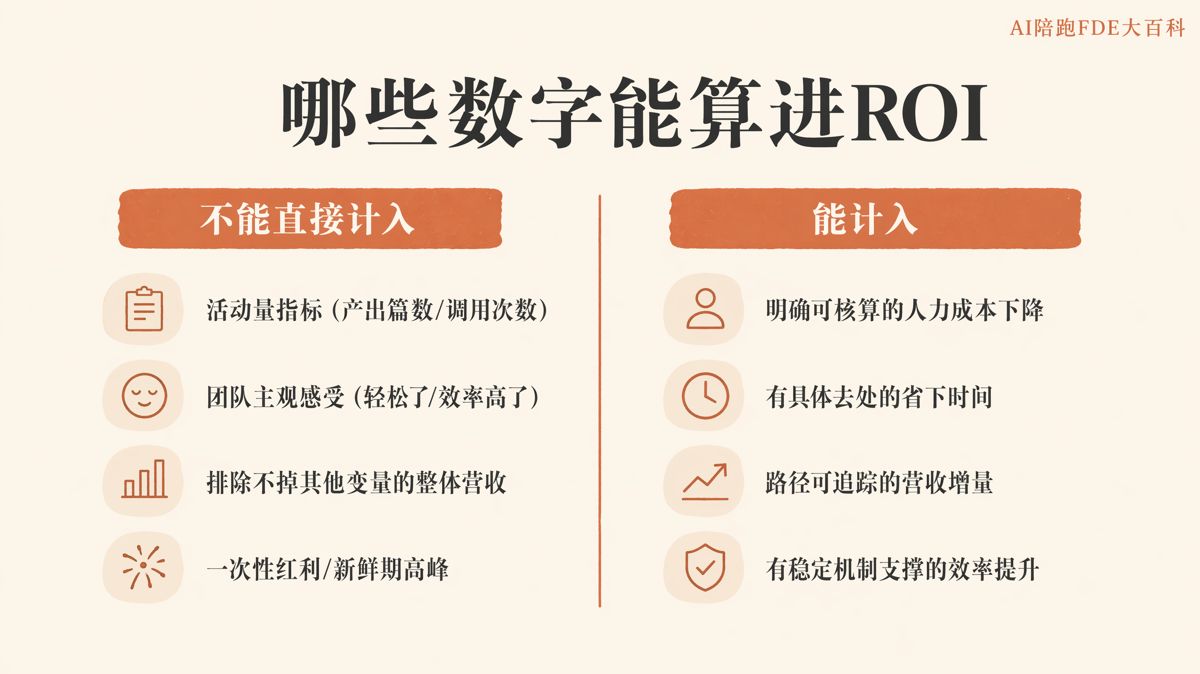
3. Overall Revenue Growth Cannot Be Fully Credited to AI
When top-line revenue rises after an AI launch, attributing the entire quarterly increase to AI will rarely survive executive or finance scrutiny.
Top-line revenue fluctuates based on seasonal demand, product launches, account renewals, competitive shifts, pricing adjustments, and broader macroeconomic conditions. Unless you isolate these external drivers, you cannot claim broad revenue growth as an AI deliverable.
Instead, track only the commercial outcomes that AI directly influenced along an auditable path.
For example, when using AI in content marketing and distribution, follow the trail starting from the AI-assisted assets: track views, click-through rates, inbound inquiries, qualified leads, and final contract values. The incremental revenue you can justify in your ROI model is the portion tied directly to that tracked pipeline—not the company's total quarterly growth.
Similarly, team output per hour, individual asset production costs, and task unit economics must be measured within the specific scope of the project, rather than merged into company-wide financial figures. The narrower and clearer the calculation boundary, the easier it is to answer where the money came from.
Efficiency gains must translate into auditable cost reductions or traceable pipeline revenue before they enter an ROI model. Unattributed growth belongs on the general business P&L, not the AI project scorecard.

4. First-Month Spikes Are Not Baseline Long-Term Returns
AI initiatives frequently show an initial surge in performance during month one.
This early lift often stems from concentrated team focus, novelty factor, or an early piece of content catching a temporary trend. While real, these initial spikes rarely reflect sustainable monthly baselines.
Treating month-one highs as a permanent recurring return distorts your financial models. When numbers normalize in months two and three, leadership may wrongly assume the project is failing, when in reality performance has simply settled to its true baseline.
To assess whether a return is sustainable, examine whether it comes from a repeatable, structured process. A consistent editorial workflow, a repeatable topic discovery system, and steady distribution channels produce outcomes worth measuring over time.
Spikes driven by viral trends or temporary launch efforts should be logged separately as one-off gains rather than recurring performance.
Across the industry, observing initiatives over a continuous 3- to 6-month window is common practice to separate short-term anomalies from durable baseline impact. This window serves as an observational benchmark rather than a strict payback deadline; actual tracking periods should reflect your sales cycle and operational cadence.
Build a Credible Report: Categorize Metrics into Three Tiers
Excluding these figures from your ROI calculation does not mean hiding them. A clear evaluation report organizes data into three distinct tiers:
| Metric Category | What It Includes | How to Handle It |
|---|---|---|
| Verified Financial Returns | Confirmed reductions in payroll, outsourcing, or tool spend; traceable revenue generated from AI-assisted pipelines; verified lower average cost per delivered task. | Included in the ROI numerator. Must clearly document data sources and attribution logic. |
| Operational & Efficiency Metrics | Assets published, API call volume, task completion time, publishing frequency, task output per work hour. | Used to measure workflow adoption and productivity changes. Do not count as financial return until tied to cost or revenue impact. |
| Pending or One-Off Results | Subjective staff feedback, unallocated hours saved, macro revenue growth with untangled variables, initial launch spikes. | Note context and constraints; observe over time; keep separate from verified returns. |
5 Questions to Ask Before Adding Any Number to ROI
Before adding any metric to your AI ROI model, run it through this checklist:
- Which specific cash expense line or revenue stream does this correspond to?
- Is there a traceable source record that finance can inspect?
- Can we show the step-by-step path of how AI produced or influenced this result?
- Have we isolated other concurrent business factors, such as seasonality or product updates?
- Can this result be consistently replicated using the same operating workflow?
If you can answer all five questions with data, the number qualifies for your ROI formula. If any answer is missing, classify the metric as an operational indicator or a pending result, and continue monitoring.
For organizations with focused budgets, start small. Track a single content or operational workflow to verify whether it reduces real costs or generates traceable sales opportunities. Validate unit economics on one workflow before expanding budget allocations.
The strength of an AI ROI report does not depend on reporting an inflated headline number. It depends on showing a defensible lineage for every dollar claimed. When you can clearly explain where the returns came from, how they were calculated, and which external factors were excluded, the model will hold up under CFO review.
Note: The 95% figure references the 2025 MIT Project NANDA study; the ~6% figure references McKinsey's 2025 Greater China AI adoption survey. The 3- to 6-month observation window represents an industry-standard monitoring benchmark; organizations should adjust timelines based on their specific sales cycles and operational rhythms.
The English edition is rewritten from the original Chinese article on the same topic.

Starbox AI is an AI marketing company based in Hangzhou, China. This article draws on Starbox project work. Please credit the source when quoting.
Related reading
 AI Adoption
Can One AI Operator Really Replace 10 People?
Claims of 10x headcount cuts count generation speed, not QA and rework. Real efficiency measures net pipeline hours saved.
Oct 22, 2026 · 6 min read
 AI Adoption
Bought Basic AI and Seeing Zero ROI? A 4-Step Activation Playbook
Activating entry-level AI is not about model parameters. Turn open chat boxes into defined operational stations with clear inputs, templates, and QA checklists.
Oct 22, 2026 · 6 min read
 AI Adoption
Why One-Click AI Fails at Work: How to Pick Enterprise Agents
One-click AI tools seem easy, but their first-draft accuracy is terrible. Real business ROI requires multi-step workflows with your own knowledge base.
Oct 21, 2026 · 6 min read