
Why Losing Money in Year One of AI Is Normal (and How to Explain It)

The short answer
Most enterprises see negative ROI in their first year of GenAI. Here is why it happens, where the money actually goes, and how to report it to leadership.
Here are four numbers that explain why most corporate AI initiatives struggle financially in their first year:
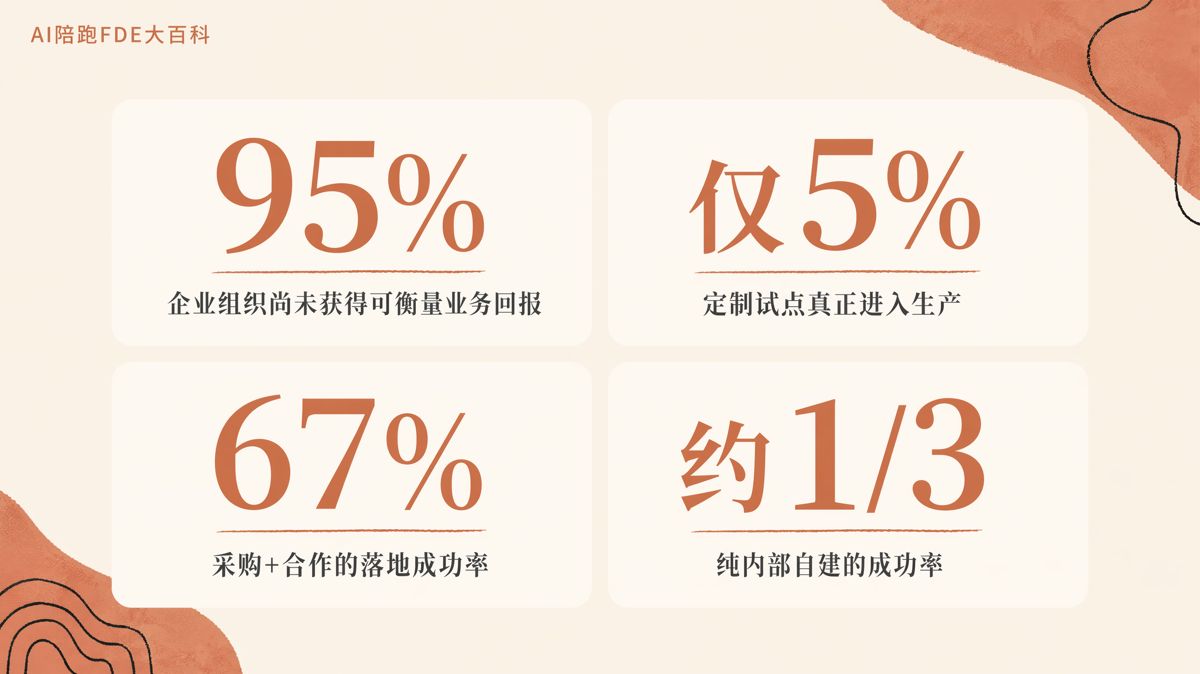
- Over 80% of enterprises have tested tools like ChatGPT or Microsoft Copilot, but only 5% of custom pilots ever make it into production and generate measurable business value (MIT Project NANDA, 2025).
- Partnering with external, specialized providers yields an implementation success rate of around 67%. Building entirely in-house succeeds only about one-third as often (MIT Project NANDA, 2025).
- Across industry benchmarks, typical AI payback periods range between two and four years. A small fraction of use cases see positive ROI within 12 months, and rare high-frequency workflows (such as predictive maintenance in manufacturing) can compress that to about three months.
- In China, 89.84% of surveyed enterprises already use AI in some form, but only 16.41% have established a dedicated AI team (2025 Chinese Entrepreneur AI Application Survey Report).
Put these figures together, and the pattern is unmistakable: running at a loss in year one is not an execution failure. It is an industry-wide structural reality.
Why the "Instant ROI" Expectation Is Broken
When many leadership teams greenlight an AI project, their mental model looks like buying factory equipment: install the machine today, watch production capacity double next month.
AI does not work that way.
The industry refers to this disconnect as "high adoption, low conversion." Trying a tool is frictionless—nearly 90% of enterprises have already done it. Turning that tool into business performance is an entirely different challenge, because an unbudgeted intermediate layer sits between the model and your bottom line.
That layer is the organizational bridge: internal knowledge bases, operational workflows, role redesigns, and standard operating procedures (SOPs) that connect general-purpose AI capabilities to your specific business operations.
After conducting 150 executive interviews, surveying 350 employees, and reviewing 300 public deployments, MIT researchers found that AI initiatives almost never fail because underlying models lack intelligence. They fail because corporate data is unprepared, workflows remain unintegrated, and teams do not adapt.
MIT labeled this gap the "GenAI Divide." Their report emphasizes that this divide is not determined by model quality or regulatory hurdles. It is determined by your implementation path.
When an AI initiative operates at a loss in its first year, you are not burning money. You are paying for the translation process between raw software capability and actual business value.
Where the Money Actually Goes in Year One
Breaking down year-one costs into three distinct buckets makes the financial picture transparent—and much easier to justify to executive leadership.
1. Learning Costs
Between discovering a tool and embedding it into daily operations, there is an unavoidable ramp-up period. During this window, productivity often drops instead of rising. Employees are learning a new operating rhythm alongside their existing workloads. Short-term efficiency dips before long-term gains materialize.
2. Trial-and-Error Costs
Industry track records consistently prove that focused, single-point entry is the most effective approach. Rather than attempting a company-wide rollout on day one, you select one measurable workflow—such as marketing content production—refine it, generate hard data, and only then replicate the system across other teams.
Even with a single-point rollout, the first version of an SOP is rarely perfect. It takes multiple operational cycles to iron out friction. That iteration is a genuine cost, and you cannot buy a pre-packaged shortcut through it.
3. Organizational Adaptation Costs
A new way of working requires shifting responsibilities. Existing job scopes must adjust: who reviews AI-generated output, who approves the final draft, and who is held accountable for the end result? Establishing this chain of responsibility is not a technical problem; it is an operational management problem. It requires management attention and billable hours, all of which count against year-one investment.
These three buckets constitute the apparent "loss" on paper. They are not waste. They represent the necessary tuition every enterprise pays to transform generic AI capability into defensible operational capacity.

How to Tell a Healthy Ramp-Up from Real Failure
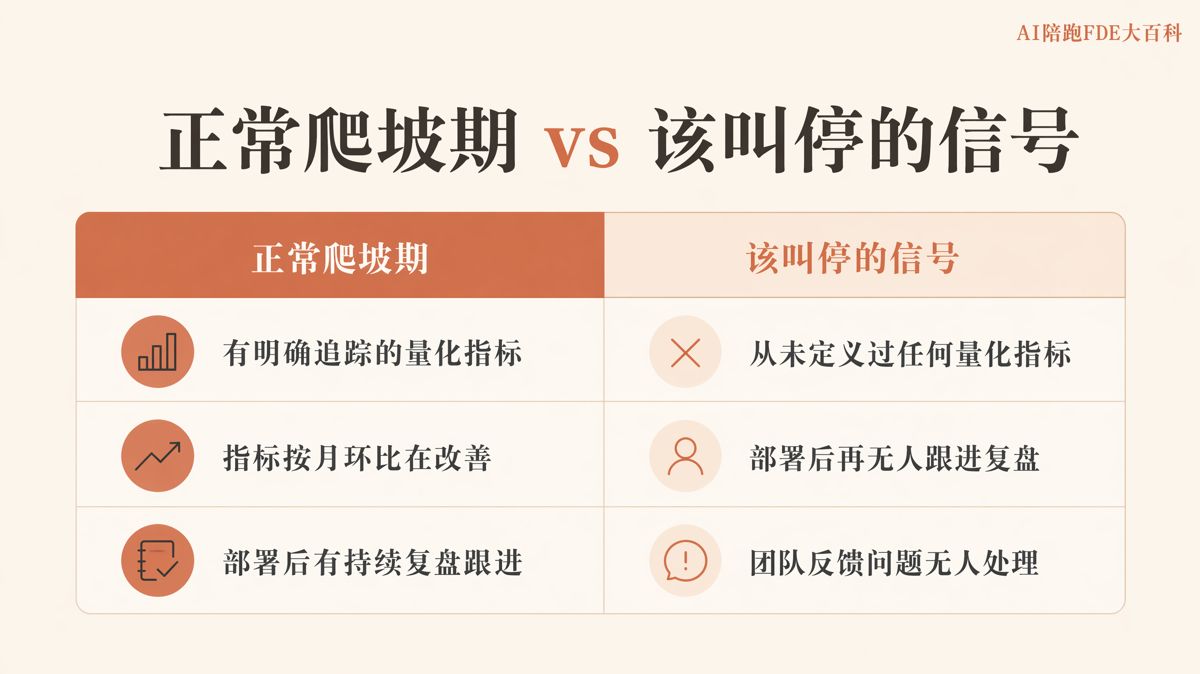
Operating at a deficit in year one is normal. The danger lies in failing to distinguish a healthy learning ramp-up from a project that is genuinely dead in the water.
You can evaluate your progress using three criteria:
Are Metrics Quantifiable and Tracked?
During a pilot, stop relying on subjective impressions like "the team feels AI is helpful." Focus on concrete numbers: - Total content or task output volume - Time spent per unit of production - Human efficiency ratios (how many resources a role can now cover) - Net workflow cost changes
Establish baseline numbers and target thresholds before launching the pilot. Never invent success criteria retroactively.
Is the Time Window Realistic?
A focused pilot should produce auditable operational signals within three to six months. If you see zero measurable change after six months, you should be concerned.
Conversely, expecting positive revenue impact within 30 days is unrealistic. If output volume and turnaround times are improving steadily after three to six months, you are on schedule—even if broader revenue or client acquisition metrics have not shifted yet. A standard content marketing strategy, for instance, typically requires a full three-month operational cycle before market-facing compounding effects become visible.
Are You Iterating Based on Continuous Reviews?
A healthy year-one loss features weekly or monthly data reviews where teams diagnose operational bottlenecks and adjust course. An unhealthy failure looks like stagnant silence: software deployed, no one managing adoption, and zero process changes six months later. Stagnation is a signal to pull the plug; active iteration is just the ramp-up cost.
Why Second Attempts Are Often More Successful
There is a counterintuitive trend across enterprise AI adoptions: companies that fail on their first attempt and conduct an honest post-mortem succeed at a much higher rate on their second attempt.
Most initial failures do not stem from software limitations. They fail because the initial scope was too broad, ongoing implementation support was missing, or nobody had clear accountability for the outcome. Once an enterprise identifies these pitfalls, it can avoid them entirely.
If your first deployment fell short, run through this diagnostic checklist: - Did you merely purchase software licenses without operational integration? - Did you run one-off employee training without ongoing tool support, allowing everyone to revert to old habits within 90 days? - Did you spread resources across ten surface-level experiments without establishing deep traction in one? - Did you fail to set quantifiable baseline metrics at kickoff, leaving everyone unsure whether the pilot worked?
If your failure matches these patterns, the problem is your deployment strategy, not the technology.
This also impacts how you choose your implementation model. MIT's Project NANDA research noted that partnering with specialized external providers yields a 67% implementation success rate, compared to roughly 22% for teams that attempt to build and figure everything out internally from scratch. Working with external partners who bring battle-tested paths significantly de-risks a second attempt.
What to Present When Reporting to Leadership
When presenting your AI budget and progress to your CEO or board, focus on four clear messages:
- Clarify the nature of the cost. Frame year-one expenses as standard organizational ramp-up and learning costs. Use industry data—such as the 95% pilot failure rate noted by MIT—to demonstrate that this is a structural characteristic of the technology transition, not internal underperformance.
- Present quantifiable leading indicators. Do not say "the team is working hard." Show that production time dropped by 40%, output volume doubled, or per-unit costs fell. Even if top-line revenue has not moved yet, these operational metrics prove the workflow is advancing.
- Define the next evaluation window and kill criteria. Set a firm review date—such as the end of month three or month six. State clearly what performance thresholds justify continued investment and what numbers will prompt an immediate strategic pivot. A defined decision threshold is far more reassuring to leadership than asking for indefinite patience.
- Deliver honest attribution if a pilot fails. If an experiment does not work, explain precisely why: the entry point was too complex, the tooling lacked workflow support, or internal incentives were misaligned. Owning the operational diagnosis builds credibility and turns an initial loss into usable enterprise IP for the next iteration.
Operating at a loss in year one means this transformation is hard, not that you should abandon it. The enterprises that cross the GenAI Divide do not get lucky. They simply budget for the learning curve up front, track the right numbers, and manage the transition with their eyes wide open.
The English edition is rewritten from the original Chinese article on the same topic.

Starbox AI is an AI marketing company based in Hangzhou, China. This article draws on Starbox project work. Please credit the source when quoting.
Related reading
 AI Adoption
Can One AI Operator Really Replace 10 People?
Claims of 10x headcount cuts count generation speed, not QA and rework. Real efficiency measures net pipeline hours saved.
Oct 22, 2026 · 6 min read
 AI Adoption
Bought Basic AI and Seeing Zero ROI? A 4-Step Activation Playbook
Activating entry-level AI is not about model parameters. Turn open chat boxes into defined operational stations with clear inputs, templates, and QA checklists.
Oct 22, 2026 · 6 min read
 AI Adoption
Why One-Click AI Fails at Work: How to Pick Enterprise Agents
One-click AI tools seem easy, but their first-draft accuracy is terrible. Real business ROI requires multi-step workflows with your own knowledge base.
Oct 21, 2026 · 6 min read