
How to Prove Your AI Project Actually Works Before Year-End

The short answer
Lock down your baseline, 1-2 core metrics, and review cadence in writing before launch. Without them, you will never prove your AI project's ROI.
The biggest risk in enterprise AI is not overspending. It is spending the budget and having no one able to explain whether the investment was worth it.
When leadership asks for results, marketing points to higher output, finance asks if that output generated cash, and the conversation stalls.
Here is why enterprise AI initiatives turn into financial black holes, where the breakdown happens, and how to lock down accountability before launching.
Key Facts: - Research from MIT Project NANDA (2025) shows that while over 80% of enterprises have tested generative AI tools, only 5% of customized pilots ever reach production and generate measurable business value. - The same MIT study found that implementations combining procurement with external partnerships achieved an approximate 67% success rate, whereas purely internal initiatives succeeded at roughly one-third of that rate. - McKinsey's 2025 AI adoption survey in Greater China revealed that only 6% of enterprises qualify as "high-performing winners." - The China Entrepreneur AI Application Survey Report (2025) noted that 89.84% of surveyed companies actively use AI, yet only 16.41% have established dedicated AI teams. - The widely cited industry claim that "70% to 85% of AI projects fail" comes from secondary reporting and should not be conflated with MIT NANDA's specific finding that 95% fail to show measurable ROI.
Why Most AI Projects Cannot Prove Their Value
MIT Project NANDA's 2025 report makes a clear diagnosis: when enterprise AI initiatives fail, the root cause is almost never model capability. Failures stem from gaps in data, workflows, goals, organizational structure, talent, and governance.
Among these, undefined goals are the primary culprit. If a project kickoff fails to define the exact problem, the primary metric, and what constitutes success, proving impact later becomes impossible.
This is not an isolated problem. MIT terms the drop-off between the 80% of companies testing GenAI and the 5% deploying production pilots with measurable returns the "GenAI Divide." The issue is not tool availability; it is the missing bridge between usage and business outcomes.
Unaccountable projects do not happen by accident at year-end. They stem from three structural mistakes made during planning:
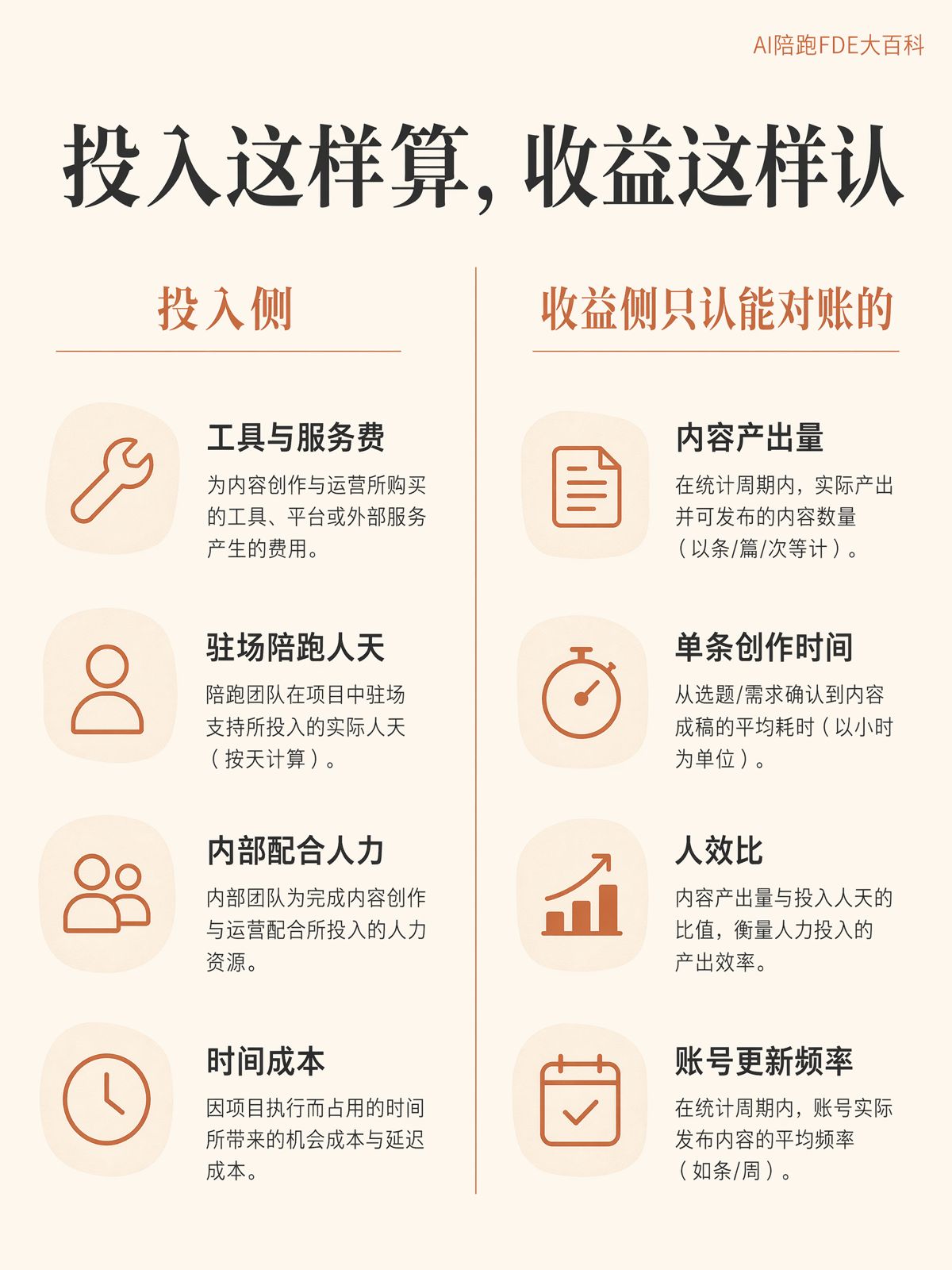
1. No baseline. If you do not record current performance before launch, you cannot prove improvement later. For example, if nobody tracks how many marketing assets a team produces monthly before adopting AI, doubling that output later cannot be verified. It remains a subjective impression.
2. Vague metric definitions. Statements like "better performance," "improved efficiency," and "higher output" are sentiments, not metrics. A business metric must be a verifiable number that two different auditors calculate to the same figure—such as "reducing production time per asset from 4 hours down to 1.5 hours." Finance cannot reconcile feelings.
3. Conflating different operational stages. Content production volume, lead conversion rates, and revenue growth are distinct stages. Revenue involves market volatility, pricing, and sales performance—variables AI cannot control. Attributing revenue growth directly to an AI tool sets up a flawed ledger by mixing operational variables with commercial results.

The Misconceptions That Derail AI Programs
The most frequent error is treating tool procurement or pilot tests as completed adoption. MIT NANDA's data proves that experimenting with software does not equal business impact; 75% of companies remain stuck between testing tools and measuring value.
Another trap is assuming that broad corporate training creates organizational capability. Training delivers one-way knowledge transfer. Without immediate operational deployment and usage tracking, learned behaviors vanish. That is why so many teams return to their old routines within three months of finishing an AI workshop. Training creates no operational data; tracking actual daily execution does.
Finally, relying on performance-based compensation or risk-sharing agreements without defining measurable deliverables provides a false sense of security. Performance contracts work only when outcomes are quantifiable, reconcilable, and documented in the agreement. Writing "assist in improving marketing performance" into a contract locks down nothing and makes enforcement impossible.
Three Requirements to Lock Down at Kickoff
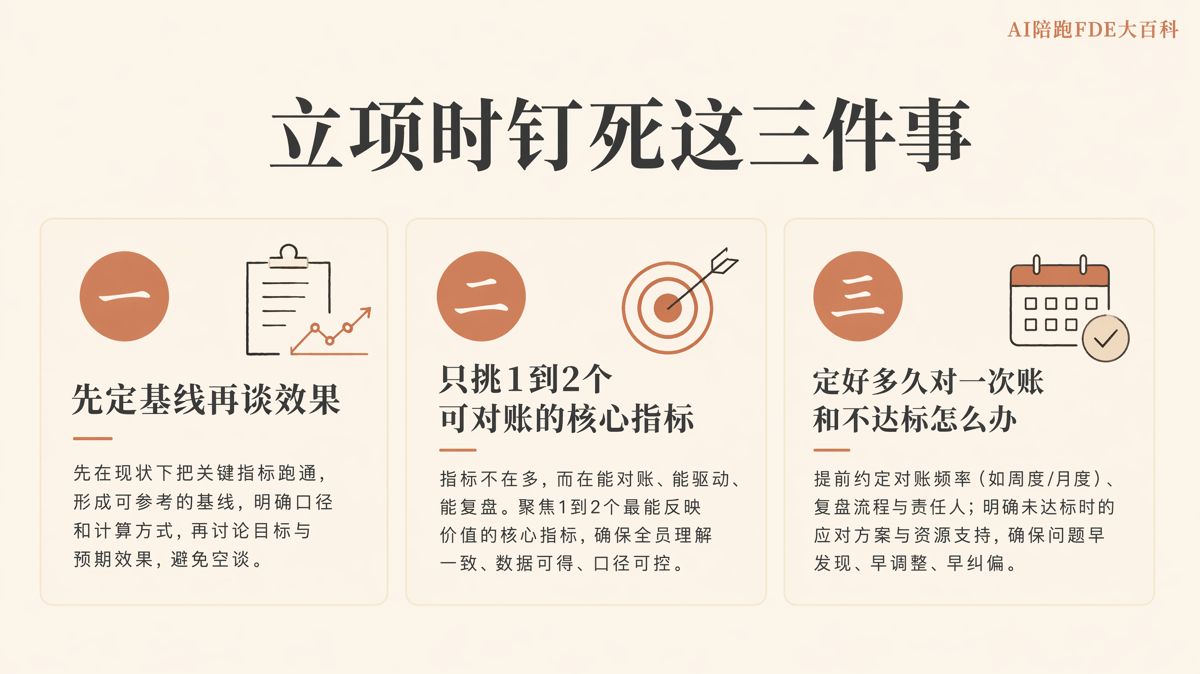
1. Document your baseline first. Run your existing manual or software workflows to record performance before bringing in new tools. Whether measuring output volume, production turnaround, or customer response speed, capture where your team stands today. Without this baseline, any subsequent claim of improvement is unsubstantiated.
2. Select 1-2 reconcilable metrics. The most reliable implementation strategy focuses on achieving a single, deep operational win with visible data before scaling across the organization. Avoid attempting to overhaul the entire workflow at once. Concentrated metrics reveal true performance shifts in short cycles, whereas broad metric sets dilute focus and obscure what is working. Reliable metrics include: average production time per asset, monthly output volume, response turnaround times, or conversion rates at specific pipeline stages. Pick one or two directly tied to the deployment and ignore the rest initially.
3. Define review cycles and exit criteria. A standard validation cycle runs between one and three months. Short cycles reveal viability quickly and prevent six months of wasted investment on a flawed approach. The initial agreement must specify clear remediation terms: if performance misses the target at the review date, do you adjust scope, pause deployment, or terminate? Setting these rules up front prevents endless debate later.

A Quick Self-Assessment: Project Readiness
| Assessment Item | Present | Absent |
|---|---|---|
| Baseline recorded prior to launch | Specific numerical baseline documented | General impressions only |
| 1-2 primary target metrics defined | Exact metric names and formulas established | Vague goals like "better efficiency" |
| Defined validation timeframe | Explicit calendar target (days/months) | Open-ended schedule |
| Dedicated owner for data tracking | Named owner tracking data on a regular schedule | Tracking relies on memory or impressions |
| Performance metrics written into documentation | Formal inclusion in contracts or project charter | Oral commitments only |
| Explicit remediation plan for underperformance | Defined path (pivot, pause, or terminate) | No contingency plan |
Evaluation: If your project marks "Absent" on three or more items, it will almost certainly face accountability issues within months. The failure will not stem from technical limits, but from a failure to design for accountability from day one.

Evaluating External Partners on Accountability
When evaluating AI implementation partners, do not focus on qualitative promises. Ask them directly how they track and verify results. Use these criteria:
- Demand verifiable case studies within your sector. Broad claims like "we boosted efficiency for multiple clients" offer zero value. Look for specific, verifiable figures and auditable integration workflows.
- Inspect pricing transparency. A proposal that lists only a lump sum without breaking down man-days, deployment costs, tooling, and post-launch reviews signals ambiguous delivery. Ambiguous pricing usually leads to ambiguous outcomes.
- Require a phased validation path. Providers willing to run a one- to two-month focused validation phase before locking in a multi-year commitment demonstrate confidence in their ability to deliver verifiable numbers.
- Require performance targets in the written agreement. Service providers who make oral promises about performance but refuse to put explicit metrics into the contract likely lack confidence in the eventual outcome.
A partner committed to defining accountability helps de-risk your deployment. A vendor that focuses on abstract value statements will likely leave you with an untrackable bill, regardless of whose underlying technology powers the system.
Frequently Asked Questions
How long does it take to see tangible results from an AI project?
Industry benchmarks show that operational process metrics, such as content volume and per-asset production time, usually shift within the first month. Full commercial impact typically requires a complete business cycle, roughly three months. Timelines vary across operational scenarios; these benchmarks represent general operational milestones rather than guarantees.
Can an AI project be saved if its ROI is already unclear?
Yes. Run a post-mortem to pinpoint the cause: did you skip baseline measurements, fail to track ongoing usage, or set vague metrics from the start? In most struggling initiatives, the failure lies in accounting design rather than tool capability. Establish a baseline now, set up a tracking routine, and measure progress forward from this point.
Why should companies avoid attributing top-line revenue growth directly to AI?
Top-line revenue depends on broader market conditions, sales conversion, average order value, and seasonality—variables completely outside AI's control. Claiming that revenue growth was driven entirely by an AI pilot creates flawed reporting. Focus on direct intermediate metrics first, such as output volume or turnaround time, before analyzing any correlation with financial outcomes.
Should we track as many metrics as possible to get a complete picture?
No. Too many metrics dilute management attention and obscure clear cause-and-effect relationships within short testing cycles. Focus on one or two primary metrics directly tied to the specific AI deployment, prove the impact there, and expand tracking into other areas later.
Is an in-house build or an external partnership more likely to yield measurable results?
Data from MIT Project NANDA (2025) indicates that enterprise implementations using procurement combined with external partnerships achieve a 67% success rate, compared to roughly one-third of that for purely internal builds. External partners often bring tested measurement frameworks, but success ultimately hinges on assigning clear ownership for tracking the numbers.
What is an appropriate validation timeframe for an AI pilot?
Standard validation cycles range between one and three months. A shorter window yields insufficient data to spot trends, while a longer window delays necessary pivots or resource allocation. The exact timeframe should match the underlying business process: production volume shifts within weeks, while conversion cycles require full sales intervals.
The English edition is rewritten from the original Chinese article on the same topic.

Starbox AI is an AI marketing company based in Hangzhou, China. This article draws on Starbox project work. Please credit the source when quoting.
Related reading
 AI Adoption
Can One AI Operator Really Replace 10 People?
Claims of 10x headcount cuts count generation speed, not QA and rework. Real efficiency measures net pipeline hours saved.
Oct 22, 2026 · 6 min read
 AI Adoption
Bought Basic AI and Seeing Zero ROI? A 4-Step Activation Playbook
Activating entry-level AI is not about model parameters. Turn open chat boxes into defined operational stations with clear inputs, templates, and QA checklists.
Oct 22, 2026 · 6 min read
 AI Adoption
Why One-Click AI Fails at Work: How to Pick Enterprise Agents
One-click AI tools seem easy, but their first-draft accuracy is terrible. Real business ROI requires multi-step workflows with your own knowledge base.
Oct 21, 2026 · 6 min read